(a) Find the interval \((a, b)\) in which \(\mathrm{f}(x)\) does not take any values.
Fully justify your answer. [5 marks]
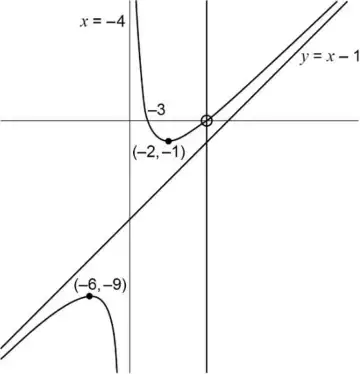
(b) Find the coordinates of the two stationary points of the graph of \(y = \mathrm{f}(x)\) [2 marks]
(c) Show that the graph of \(y = \mathrm{f}(x)\) has an oblique asymptote and find its equation. [2 marks]
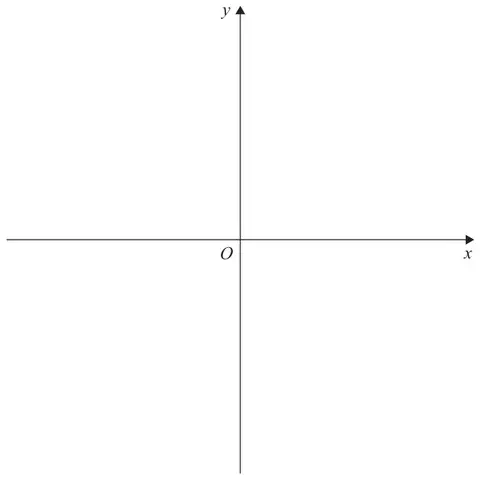
(d) Sketch the graph of \(y = \mathrm{f}(x)\) on the axes below. [4 marks]
Mark scheme (a)
Scheme
Marks
AO
Forms an equation \(\dfrac{x(x + 3)}{x + 4} = {}\)‘\(k\)’ or Differentiates using quotient rule.
M1
3.1a
Rearranges their equation into a quadratic in \(x\). or Obtains the correct \(\mathrm{f}^{\prime}(x) = \dfrac{(x + 4) \times (2x + 3) - (x^2 + 3x) \times 1}{(x + 4)^2}\).
M1
1.1a
Explains that the discriminant of this quadratic \(\lt 0\) or Explains that because there is a vertical asymptote the minimum is higher up the graph than the maximum and the two turning points lie on different branches of the graph.
E1
2.4
Forms a quadratic equation or inequality in ‘\(k\)’ from their discriminant. or Equates their \(\mathrm{f}^{\prime}(x)\) or its numerator to 0 and solves
M1
1.1a
Completes a rigorous argument to show that \(\mathrm{f}(x)\) does not take any values in the interval \((-9, -1)\). Condone \(-9 \lt k \lt -1\)
So \(\mathrm{f}(x)\) does not take any values in the interval \((-9, -1)\)
Mark scheme (b)
Scheme
Marks
AO
Substitutes their \(-9\) or \(-1\) into \(y = f(x)\) and forms a quadratic in \(x\) or Differentiates using the quotient rule and equates their \(\mathrm{f}^{\prime}(x)\) or its numerator to 0
M1
1.1a
Finds the coordinates of both stationary points
A1F
1.1b
Typical solution
Stationary points \((-6, -9)\) and \((-2, -1)\)
Mark scheme (c)
Scheme
Marks
AO
Divides the numerator by \(x + 4\) and obtains \(\mathrm{f}(x) = x + \cdots\)
M1
3.1a
Obtains the correct equation of the asymptote \(y = x - 1\)