
A2 June 2022 Paper 1 Q9
9 Roberto is solving this mathematics problem:
The curve \(C_1\) has polar equation \[r^2 = 9\sin 2\theta\]for all possible values of \(\theta\) Find the area enclosed by \(C_1\) |
Roberto’s solution is as follows:
| \[\begin{aligned} A &= \frac{1}{2}\int_{-\pi}^{\pi} 9\sin 2\theta\,\mathrm{d}\theta \\ &= \left[-\frac{9}{4}\cos 2\theta\right]_{-\pi}^{\pi} \\ &= 0 \end{aligned}\] |

\(P\) is above the initial line.
Find the polar coordinates of \(P\) and \(Q\) [2 marks]
T maps \(C_1\) onto a curve \(C_2\)
Find the polar coordinates of \(P^{\prime}\) [4 marks]
Fully justify your answer. [2 marks]
| Scheme | Marks | AO |
|---|---|---|
| Draws at least one loop in the correct place | B1 | 1.1b |
| Draws both loops correctly (approx equal size) and no others | B1 | 1.1b |
| (2) |
Typical solution
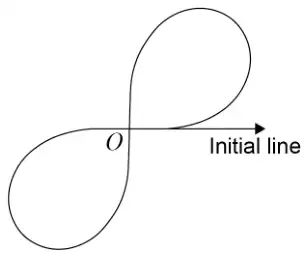
| Scheme | Marks | AO |
|---|---|---|
| Criticises limits of integration used by Roberto PI | M1 | 2.3 |
| Explains what is wrong with Roberto’s range of values, including reference to \(r^2 \geqslant 0\) | R1 | 2.4 |
| (2) |
Typical solution
Roberto has used incorrect limits of integration.
He should only have included values of \(\theta\) which make \(\sin 2\theta\) positive, because \(r^2\) must be positive
| Scheme | Marks | AO |
|---|---|---|
| Forms an expression for an area using valid limits PI by 9/4, 9/2 or 9 | M1 | 2.2a |
| Obtains correct answer | A1 | 1.1b |
| (2) |
Typical solution
\[A = \frac{1}{2}\int_{-\pi}^{-\frac{\pi}{2}} 9\sin 2\theta\,\mathrm{d}\theta + \frac{1}{2}\int_{0}^{\frac{\pi}{2}} 9\sin 2\theta\,\mathrm{d}\theta\]\[= \int_{0}^{\frac{\pi}{2}} 9\sin 2\theta\,\mathrm{d}\theta\]by symmetry
\[\begin{aligned} A &= \left[-\frac{9}{2}\cos 2\theta\right]_0^{\frac{\pi}{2}} \\ &= -\frac{9}{2}(\cos\pi - \cos 0) \\ &= 9 \end{aligned}\]| Scheme | Marks | AO |
|---|---|---|
| Deduces at least one correct value of \(\theta\) | M1 | 2.2a |
| Obtains both correct solutions (not \(r = -3\)) Condone \(r\) and \(\theta\) transposed. accept \(\dfrac{5\pi}{4}\) etc OE decimals to 3sig fig or better | A1 | 1.1b |
| (2) |
Typical solution
Max. value of \(r = 3\)
For \(r\) maximum, \(\sin 2\theta = 1\)
\[2\theta = \frac{\pi}{2},\ -\frac{3\pi}{2}\]\[\theta = \frac{\pi}{4},\ -\frac{3\pi}{4}\]\(P\left(3, \dfrac{\pi}{4}\right)\) and \(Q\left(3, -\dfrac{3\pi}{4}\right)\)
| Scheme | Marks | AO |
|---|---|---|
| (i) Finds cartesian coordinates or position vector of their \(P\), ACF | B1F | 1.1b |
| Multiplies their cartesian position vector by matrix \(\mathbf{M}\), must be \(\mathbf{M}\mathbf{v}\), to obtain an image | M1 | 3.1a |
| Obtains their correct value for \(r\) or \(\theta\), ACF, for their image | M1 | 1.1a |
| Obtains their correct answer, either exact or to at least 2 sig fig AWRT (6.7, 0.32) Must have M1M1 | A1F | 1.1b |
| (4) | ||
| (ii) Explains correctly why the area is unchanged | E1 | 2.4 |
| Obtains their correct area from their part (c) and their det | B1F | 2.2a |
| (2) | ||
| (14 marks) |
Typical solution
(i)
Cartesian coordinates of \(P\) are \(\left(\dfrac{3\sqrt{2}}{2}, \dfrac{3\sqrt{2}}{2}\right)\)
\[\begin{bmatrix} 1 & 2 \\ 0 & 1 \end{bmatrix}\begin{bmatrix} \dfrac{3\sqrt{2}}{2} \\ \dfrac{3\sqrt{2}}{2} \end{bmatrix} = \begin{bmatrix} \dfrac{9\sqrt{2}}{2} \\ \dfrac{3\sqrt{2}}{2} \end{bmatrix}\]For \(P^{\prime}\), \(r^2 = \dfrac{81}{2} + \dfrac{9}{2} = 45 \Rightarrow r = 3\sqrt{5}\)
\[\tan\theta = \frac{1}{3} \Rightarrow \theta = \tan^{-1}\left(\frac{1}{3}\right)\]\(P^{\prime}\left(3\sqrt{5}, \tan^{-1}\left(\dfrac{1}{3}\right)\right)\)
(ii)
Det M = 1
Area enclosed by \(C_2\) = (Area enclosed by \(C_1\)) × det M
= 9 × 1 = 9