
A2 June 2022 Paper 2 Q2
2 Two polar curves, \(C_1\) and \(C_2\), are defined by \(C_1 : r = 2\theta\) and \(C_2 : r = \theta + 1\) where \(0 \leqslant \theta \leqslant 2\pi\).
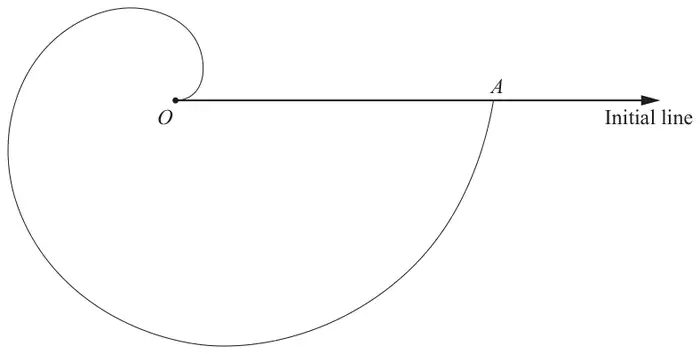
\(C_1\) intersects the initial line at two points, the pole and the point \(A\).
(a) Write down the polar coordinates of \(A\). [2]
(b) Determine the polar coordinates of the point of intersection of \(C_1\) and \(C_2\). [2]
The diagram below shows a sketch of \(C_1\).
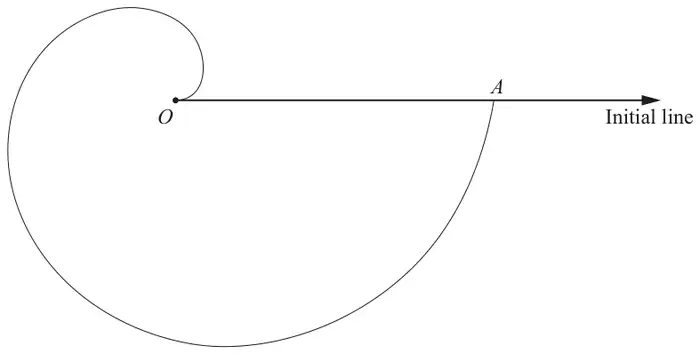
(c) On the copy of this sketch below, sketch \(C_2\). [1]
| Scheme | Marks | AO |
|---|---|---|
| At \(A\) \(\theta = 2\pi\) so \(A[\ldots, 2\pi]\) | B1 | 2.2a |
| \(r = 2\theta = 2 \times 2\pi = 4\pi\) so \(A[4\pi, \ldots]\) | B1 | 1.1 |
| [2] |
Notes
B1: or just \(\theta = 2\pi\). ISW
B1: or just \(r = 4\pi\). ISW
| Scheme | Marks | AO |
|---|---|---|
| At PoI \(2\theta = \theta + 1\) | M1 | 1.1 |
| \(\Rightarrow \theta = 1\) so \([2, 1]\) | A1 | 1.1 |
| [2] |
Notes
M1: Correct condition for PoI
A1: or \(r = 2\) and \(\theta = 1\). ISW
| Scheme | Marks | AO |
|---|---|---|
![Sketch of C1 and C2 on axes: C2 starts at the point [1, 0], spirals out outside C1, crosses C1 at a single point in the first quadrant, then lies inside C1 and stops on the initial line](https://www.westiesworkshop.com/wp-content/uploads/question-bank/fm-ocr/ocr-y541-jun22-q2-ms-fig1.webp) | B1 | 1.1 |
| [1] |
Notes
B1: \(C_2\) drawn as a smooth curve spiralling out from \([1, 0]\) outside \(C_1\) until a single point in the 1st quadrant and then inside \(C_1\). Must stop on initial line.
Start at \([1, 0]\).
Intersection in 1st quadrant (by eye).
\(r\) increasing (by eye).
Reaches initial line and stops.
Ignore labels.