
A2 October 2021 Paper 1 Q7
7 The diagram below shows the curve with polar equation \(r = \sin 3\theta\) for \(0 \leqslant \theta \leqslant \frac{1}{3}\pi\).
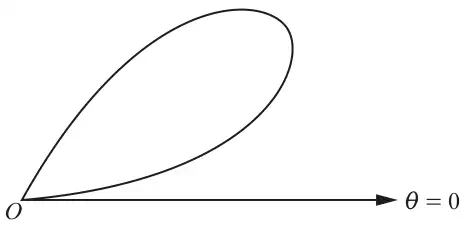
(a) Find the values of \(\theta\) at the pole. [1]
(b) Find the polar coordinates of the point on the curve where \(r\) takes its maximum value. [2]
(c) In this question you must show detailed reasoning.
Find the exact area enclosed by the curve. [4]
Find the exact area enclosed by the curve. [4]
(d) Given that \(\sin 3\theta = 3\sin\theta - 4\sin^3\theta\), find a cartesian equation for the curve. [2]
| Scheme | Marks | AO |
|---|---|---|
| \(\left(\begin{array}{l} r = 0 \Rightarrow \sin 3\theta = 0 \\ \Rightarrow 3\theta = 0, \pi \end{array}\right) \Rightarrow \theta = 0, \dfrac{\pi}{3}\) | B1 | 1.1 |
| [1] |
Notes
B1: Both required
Don’t give if any extras within range.
Ignore values outside range
| Scheme | Marks | AO |
|---|---|---|
| \(\left[\sin\dfrac{3\pi}{6}, \dfrac{\pi}{6}\right]\) i.e. \(\left[1, \dfrac{\pi}{6}\right]\) | B1 B1 | 1.1 1.1 |
| [2] |
Notes
B1: For \(r\)
B1: For \(\theta\)
| Scheme | Marks | AO |
|---|---|---|
| DR \(\displaystyle \text{Area} = \frac{1}{2}\int_0^{\pi/3} r^2\,\mathrm{d}\theta = \frac{1}{2}\int_0^{\pi/3} \sin^2 3\theta\,\mathrm{d}\theta\) | M1 | 1.1 |
| \(\displaystyle = \frac{1}{4}\int_0^{\pi/3} (1 - \cos 6\theta)\,\mathrm{d}\theta\) | M1* | 3.1a |
| \(= \dfrac{1}{4}\left[\theta - \dfrac{1}{6}\sin 6\theta\right]_0^{\pi/3}\) | DepM1 | 1.1 |
| \(= \dfrac{1}{4}\left(\dfrac{\pi}{3} - 0\right) = \frac{1}{12}\pi\) | A1 | 1.1 |
| [4] |
Notes
M1: Correct use of formula – ignore limits
M1*: Attempt to use double angle formula (Could be wrong way round, 2 missing or sign wrong)
DepM1: Integrate their integrand
A1: Use correct limits, must be seen
| Scheme | Marks | AO |
|---|---|---|
| \(\sin 3\theta = 3\sin\theta - 4\sin^3\theta\) \(\Rightarrow r = \dfrac{3y}{r} - 4\left(\dfrac{y}{r}\right)^3\) | M1 | 1.1 |
| \(\Rightarrow r^4 = 3r^2y - 4y^3\) \(\left(x^2 + y^2\right)^2 = 3y\left(x^2 + y^2\right) - 4y^3\) oe e.g. \(\left(x^2 + y^2\right)^2 = 3x^2y - y^3\) | A1 | 1.1 |
| [2] |
Notes
M1: Using triple angle formula and \(y = r\sin\theta\)
A1: isw