
A2 June 2024 Paper 1 Q12
12 For any positive parameter \(k\), the curve \(C_k\) is defined by the polar equation
\(r = k(\cos\theta + 1) + \dfrac{10}{k}, 0 \leqslant \theta \leqslant 2\pi\).
For each value of \(k\) the curve is a single, closed loop with no self-intersections. The diagram shows \(C_{10.5}\) for the purpose of illustration.
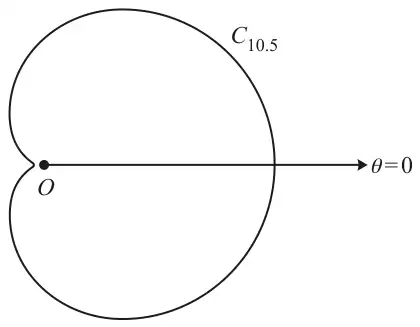
Each curve, \(C_k\), encloses a certain area, \(A_k\).
You are given that there is a single minimum value of \(A_k\).
Determine, in an exact form, the value of \(k\) for which \(C_k\) encloses this minimum area. [7]
| Scheme | Marks | AO |
|---|---|---|
| \(\displaystyle\frac{1}{2}\int_0^{2\pi}\left(k\left(\cos\theta + 1\right) + \frac{10}{k}\right)^2\mathrm{d}\theta\) or \(\displaystyle\int_0^{\pi}\left(k\left(\cos\theta + 1\right) + \frac{10}{k}\right)^2\mathrm{d}\theta\) | M1* | 3.1a |
| \(\displaystyle = \frac{1}{2}\int_0^{2\pi} k^2\left(\cos^2\theta + 2\cos\theta + 1\right) + 2k\left(\frac{10}{k}\right)(\cos\theta + 1) + \frac{100}{k^2}\,\mathrm{d}\theta\) \(\displaystyle = \frac{1}{2}\int_0^{2\pi} \frac{k^2}{2}\left(\cos 2\theta + 1\right) + 2k\left(k + \frac{10}{k}\right)\cos\theta + \left(k + \frac{10}{k}\right)^2\mathrm{d}\theta\) | M1 | 1.1 |
| \(\displaystyle = \frac{1}{2}\left[\frac{k^2}{2}\left(\frac{1}{2}\sin 2\theta\right) + 2k\left(k + \frac{10}{k}\right)\sin\theta + \left(\frac{k^2}{2} + \left(k + \frac{10}{k}\right)^2\right)\theta\right]_0^{2\pi}\) | M1dep* | 1.1 |
| \(\displaystyle = \frac{k^2}{8}\sin 4\pi + k\left(k + \frac{10}{k}\right)\sin 2\pi + \pi\left(\frac{k^2}{2} + \left(k + \frac{10}{k}\right)^2\right)\) | M1 | 1.1 |
| \(= \pi\left(\dfrac{3k^2}{2} + 20 + \dfrac{100}{k^2}\right)\) | A1 | 1.1 |
| \(\dfrac{\mathrm{d}}{\mathrm{d}k}\left(\pi\left(\dfrac{3k^2}{2} + 20 + \dfrac{100}{k^2}\right)\right) = \pi\left(3k - \dfrac{200}{k^3}\right) (= 0)\) | M1 | 2.1a |
| \(k = \left(\dfrac{200}{3}\right)^{\frac{1}{4}}\) | A1 | 1.1 |
| [7] |
Notes
M1*: Using \(\frac{1}{2}\int r^2\,\mathrm{d}\theta\) with correct expression for \(r\) - condone lack of (or incorrect) limits. Condone missing \(\frac{1}{2}\) only.
M1: Expanding and using correct \(\cos^2\theta = \dfrac{1}{2}(1 + \cos 2\theta)\) - need not be in an integral.
M1dep*: Integrating their \(\int k_1\cos 2\theta + k_2\cos\theta + k_3\,\mathrm{d}\theta\) correctly to \(\frac{1}{2}k_1\sin 2\theta + k_2\sin\theta + k_3\theta\) with \(k_1, k_2, k_3 \neq 0\)
M1: Substitute correct limits 0 and \(2\pi\) - dependent on previous M mark. Need not see zeros from 0 limit or other terms that would be zero when evaluated. (Corrected from the printed mark scheme: the last term of this line is printed as \(2\pi\left(\frac{k^2}{2} + \left(k + \frac{10}{k}\right)^2\right)\); after the factor \(\frac{1}{2}\) it is \(\pi\left(\ldots\right)\), as the next line shows.)
A1: cao from correct integral and correct integration. Condone \(\pi\left(3k^2 + 40 + 200k^{-2}\right)\) from missing \(\frac{1}{2}\).
M1: Differentiating their \(A_k\) correctly which must be of the form \(ak^2 + b + ck^{-2}\) with \(a, b, c \neq 0\). Dependent on all previous M marks.
A1: Dependent on all previous marks and no errors. A0 if correct \(k\) obtained but \(\frac{1}{2}\) missing from area formula (unless justified). Accept any exact equivalent. Condone omission of \(\pi\) (or other constant factor) for final two marks.