
A2 June 2025 Paper 2 Q6
6 One of the regions bounded by two polar curves, \(C_1\) and \(C_2\), is used to model the face of a flat earring.
The polar equations of \(C_1\) and \(C_2\) are
\(C_1: r = 2\theta\)
\(C_2: r = \theta^2\)
where \(0 \leqslant \theta \leqslant \pi\).
The curves \(C_1\) and \(C_2\) are shown in the diagram below with the region used to model the earring shaded.
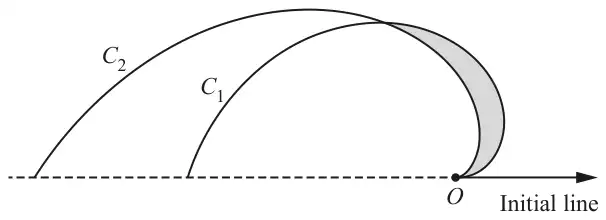
You are given that \(C_1\) and \(C_2\) intersect at the pole \(O\).
Determine the area of the face of the earring. [4]
| Scheme | Marks | AO |
|---|---|---|
| \(2\theta = \theta^2 \Rightarrow (\theta = 0\text{ or}) \ \theta = 2\) | M1 | 3.1a |
| \([4, 2]\) | A1 | 2.5 |
| [2] |
Notes
M1: Can be implied by correct value in final answer
0 does not have to be explicitly rejected.
A1: Notation must be correct, accept \((4, 2)\) but not \([2, 4]\)
| Scheme | Marks | AO |
|---|---|---|
| DR Use of \(A = \frac{1}{2}\int_0^2 r^2\,\mathrm{d}\theta\) at least once | B1 | 3.4 |
| Required area \(= \dfrac{1}{2}\displaystyle\int_0^2 (2\theta)^2\,\mathrm{d}\theta - \dfrac{1}{2}\int_0^2 (\theta^2)^2\,\mathrm{d}\theta\) | M1 | 3.1a |
| \(= \dfrac{1}{2}\displaystyle\int_0^2 4\theta^2 - \theta^4\,\mathrm{d}\theta = \frac{1}{2}\left[\frac{4}{3}\theta^3 - \frac{1}{5}\theta^5\right]_0^2\) | A1FT | 3.4 |
| \(\dfrac{1}{2}\left(\dfrac{4}{3} \times 2^3 - \dfrac{1}{5} \times 2^5 - 0\right) = \dfrac{32}{15}\) or awrt 2.13 | A1 | 1.1 |
| [4] |
Notes
B1: Constant and limits must be correct (BOD for missing \(\mathrm{d}\theta\))
M1: Condone integrals switched or missing \(\frac{1}{2}\) (ignore limits)
Must have \((2\theta)^2\) and \((\theta^2)^2\) and a subtraction for this mark.
A1FT: Integrating their expression correctly (ignore limits)
FT their integrals.
A1: Answer must be positive but condone recovery by removing negative sign at end