
A2 June 2024 Paper 1 Q16
16 The curve \(C\) has polar equation \(r = 2 + \tan\theta\)
The curve \(C\) meets the line \(\theta = \dfrac{\pi}{4}\) at the point \(A\)
The point \(B\) has polar coordinates \((4, 0)\)
The diagram shows part of the curve \(C\), and the points \(A\) and \(B\)
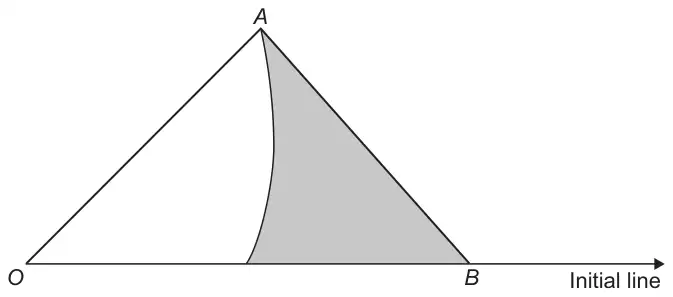
(a) Show that the area of triangle \(OAB\) is \(3\sqrt{2}\) units. [2 marks]
(b) Find the area of the shaded region.
Give your answer in an exact form. [7 marks]
| Scheme | Marks | AO |
|---|---|---|
| Obtains \(2 + \tan\dfrac{\pi}{4}\) | M1 | 2.2a |
| Completes a reasoned argument to obtain Area \(= 3\sqrt{2}\) AG | R1 | 2.1 |
| (2) |
Typical solution
At \(A\), \(r = 2 + \tan\dfrac{\pi}{4} = 3\)
Area of triangle \(OAB\)
\[= \frac{1}{2} \times 4 \times 3 \times \sin\frac{\pi}{4}\]\[= 3\sqrt{2}\]| Scheme | Marks | AO |
|---|---|---|
| Writes down \(\dfrac{1}{2}\displaystyle\int (2 + \tan\theta)^2\,\mathrm{d}\theta\) | M1 | 1.1a |
| Obtains a correct integral for polar area. \(\dfrac{1}{2}\displaystyle\int (4 + 4\tan\theta + \tan^2\theta)\,\mathrm{d}\theta\) | A1 | 1.1b |
| Replaces \(\tan^2\theta\) in the integrand with \(\sec^2\theta - 1\) Condone \(\pm\sec^2\theta \pm 1\) | M1 | 3.1a |
| Obtains \(3\theta + 4\ln(\sec\theta) + \tan\theta\) | A1 | 1.1b |
| Obtains \(k\left(\dfrac{3\pi}{4} + 2\ln 2 + 1\right)\) OE | A1 | 1.1b |
| Obtains a numerical value for the area of the shaded region using \(3\sqrt{2} -\) their area of unshaded region | M1 | 2.4 |
| Completes a reasoned argument to obtain \(= 3\sqrt{2} - \dfrac{3\pi}{8} - \ln 2 - \dfrac{1}{2}\) | R1 | 2.1 |
| (7) | ||
| (9 marks) |
Typical solution
Area enclosed by curve
\[\begin{aligned}&= \frac{1}{2}\int_0^{\frac{\pi}{4}} (2 + \tan\theta)^2\,\mathrm{d}\theta \\ &= \frac{1}{2}\int_0^{\frac{\pi}{4}} (4 + 4\tan\theta + \tan^2\theta)\,\mathrm{d}\theta \\ &= \frac{1}{2}\int_0^{\frac{\pi}{4}} (3 + 4\tan\theta + \sec^2\theta)\,\mathrm{d}\theta \\ &= \frac{1}{2}\Big[3\theta + 4\ln(\sec\theta) + \tan\theta\Big]_0^{\frac{\pi}{4}} \\ &= \frac{1}{2}\left(\frac{3\pi}{4} + 4\ln\left(\sqrt{2}\right) + 1 - 0\right) \\ &= \frac{3\pi}{8} + \ln 2 + \frac{1}{2}\end{aligned}\]Shaded area
\[= 3\sqrt{2} - \frac{3\pi}{8} - \ln 2 - \frac{1}{2}\]