
A2 June 2023 Paper 2 Q1
1.
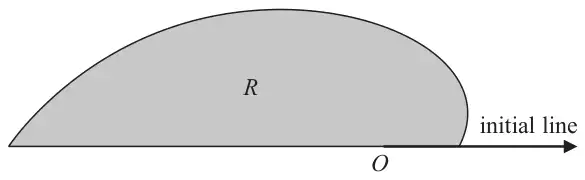
Figure 1 shows a sketch of the curve with polar equation
\[r = 2\sqrt{\sinh\theta + \cosh\theta} \qquad 0 \leqslant \theta \leqslant \pi\]The region \(R\), shown shaded in Figure 1, is bounded by the initial line, the curve and the line with equation \(\theta = \pi\)
Use algebraic integration to determine the exact area of \(R\) giving your answer in the form \(p\mathrm{e}^q - r\) where \(p\), \(q\) and \(r\) are real numbers to be found.
(4)
| Scheme | Marks | AO |
|---|---|---|
| Area \(= \dfrac{1}{2}\displaystyle\int_0^{\pi} r^2\,\mathrm{d}\theta = \frac{1}{2}\int_0^{\pi} \left[2\sqrt{\sinh\theta + \cosh\theta}\right]^2 \{\mathrm{d}\theta\}\) or \(\dfrac{1}{2}\displaystyle\int_0^{\pi} 4(\sinh\theta + \cosh\theta)\,\{\mathrm{d}\theta\}\) | B1 | 1.1b |
| \(= 2\left[\cosh\theta + \sinh\theta\right]_0^{\pi}\) or \(2\displaystyle\int_0^{\pi} \left(\frac{\mathrm{e}^{\theta} - \mathrm{e}^{-\theta}}{2} + \frac{\mathrm{e}^{\theta} + \mathrm{e}^{-\theta}}{2}\right)\mathrm{d}\theta = 2\int_0^{\pi} \mathrm{e}^{\theta}\,\mathrm{d}\theta = 2\left[\mathrm{e}^{\theta}\right]_0^{\pi}\) | M1 | 1.1b |
| \(= 2\left((\cosh\pi + \sinh\pi) - (\cosh 0 + \sinh 0)\right)\) \(= 2\left(\left(\dfrac{\mathrm{e}^{\pi} + \mathrm{e}^{-\pi}}{2} + \dfrac{\mathrm{e}^{\pi} - \mathrm{e}^{-\pi}}{2}\right) - (1 + 0)\right)\) or \(= 2\left(\mathrm{e}^{\pi} - \mathrm{e}^{0}\right)\) | M1 | 3.1a |
| \(= 2\mathrm{e}^{\pi} - 2\) or \(2\left(\mathrm{e}^{\pi} - 1\right)\) | A1 | 2.1 |
| (4) | ||
| (4 marks) |
Notes
B1: Correct area formula applied, including the \(\dfrac{1}{2}\) and correct limits, may be seen later, \(\mathrm{d}\theta\) may be implied.
M1: Attempts the integration \(\sinh\theta \rightarrow \pm\cosh\theta\) and \(\cosh\theta \rightarrow \pm\sinh\theta\) or in terms of exponentials \(\displaystyle\int \mathrm{e}^{\lambda\theta}\,\mathrm{d}\theta = \frac{1}{\lambda}\mathrm{e}^{\lambda\theta}\)
M1: Applies their limits to the integral, subtracts (there must be an attempt to integrate) and uses exponential definitions to achieve answer in suitable form. Condone the inclusion of i or a missing ½ from the definitions. This can be implied.
A1: Correct exact answer, no i