
A2 June 2022 Paper 2 Q7
7.
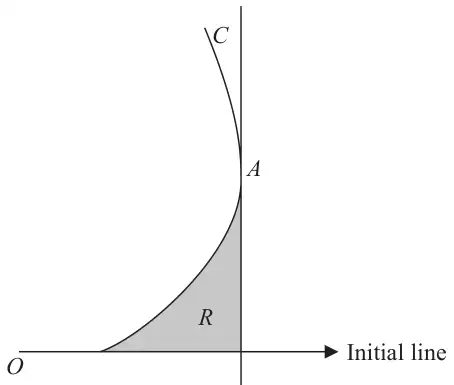
Figure 1 shows a sketch of the curve \(C\) with equation
\[r = 1 + \tan\theta \qquad\qquad 0 \leqslant \theta \lt \frac{\pi}{3}\]Figure 1 also shows the tangent to \(C\) at the point \(A\).
This tangent is perpendicular to the initial line.
The finite region \(R\), shown shaded in Figure 1, is bounded by \(C\), the tangent at \(A\) and the initial line.
| Scheme | Marks | AO |
|---|---|---|
| \(x = r\cos\theta = (1 + \tan\theta)\cos\theta = \cos\theta + \sin\theta\) \(= \cos\theta + \tan\theta\cos\theta\) \(\frac{\mathrm{d}x}{\mathrm{d}\theta} = \alpha(1 + \tan\theta)\sin\theta + \beta\sec^2\theta\cos\theta\) or \(\frac{\mathrm{d}x}{\mathrm{d}\theta} = \alpha\sin\theta + \beta\cos\theta\) \(\frac{\mathrm{d}x}{\mathrm{d}\theta} = \alpha\sin\theta + \beta\sec^2\theta\cos\theta + \delta\tan\theta\sin\theta\) | M1 | 3.1a |
| \(\frac{\mathrm{d}x}{\mathrm{d}\theta} = -(1 + \tan\theta)\sin\theta + \sec^2\theta\cos\theta\) or \(\frac{\mathrm{d}x}{\mathrm{d}\theta} = -\sin\theta + \cos\theta\) \(\frac{\mathrm{d}x}{\mathrm{d}\theta} = -\sin\theta + \sec^2\theta\cos\theta - \tan\theta\sin\theta\) or \(\frac{\mathrm{d}x}{\mathrm{d}\theta} = -\sin\theta + \sec\theta - \tan\theta\sin\theta\) | A1 | 1.1b |
| For example \(\left\{\frac{\mathrm{d}x}{\mathrm{d}\theta} =\right\} -\sin\theta + \cos\theta = 0 \Rightarrow \tan\theta = 1 \Rightarrow \theta = \ldots\) \(\left\{\frac{\mathrm{d}x}{\mathrm{d}\theta} =\right\} -\sin\theta + \cos\theta = 0 \Rightarrow \sin\theta = \cos\theta \Rightarrow \theta = \ldots\) \(\left\{\frac{\mathrm{d}x}{\mathrm{d}\theta} =\right\} -\sin\theta + \cos\theta = \sqrt{2}\cos\left(\theta + \dfrac{\pi}{4}\right) = \theta = \ldots\) or \(\left\{\frac{\mathrm{d}x}{\mathrm{d}\theta} =\right\} -(1 + \tan\theta)\sin\theta + \sec^2\theta\cos\theta = 0\) \(\Rightarrow -\sin\theta - \dfrac{\sin^2\theta}{\cos\theta} + \dfrac{1}{\cos\theta} = 0 \Rightarrow -\sin\theta + \dfrac{1 - \sin^2\theta}{\cos\theta} = 0\) \(\Rightarrow -\sin\theta + \cos\theta = 0 \Rightarrow \tan\theta = 1 \Rightarrow \theta = \ldots\) or \(\left\{\frac{\mathrm{d}x}{\mathrm{d}\theta} =\right\} -\sin\theta - \tan\theta\sin\theta + \sec\theta = 0\) \(\Rightarrow -\dfrac{1}{2}\sin 2\theta - \sin^2\theta + 1 = 0 \Rightarrow \sin 2\theta + 2\sin^2\theta - 1 = 1\) \(\Rightarrow \sin 2\theta - \cos 2\theta = 1 \Rightarrow \sqrt{2}\sin\left(2\theta - \dfrac{\pi}{4}\right) = 1 \Rightarrow \theta = \ldots\) or \(\left\{\frac{\mathrm{d}x}{\mathrm{d}\theta} =\right\} -\sin\left(\dfrac{\pi}{4}\right) + \cos\left(\dfrac{\pi}{4}\right) = 0\) \(\left\{\frac{\mathrm{d}x}{\mathrm{d}\theta} =\right\} -\left(1 + \tan\left(\dfrac{\pi}{4}\right)\right)\sin\left(\dfrac{\pi}{4}\right) + \sec^2\left(\dfrac{\pi}{4}\right)\cos\left(\dfrac{\pi}{4}\right) = 0\) \(\left\{\frac{\mathrm{d}x}{\mathrm{d}\theta} =\right\} -\sin\left(\dfrac{\pi}{4}\right) + \sec^2\left(\dfrac{\pi}{4}\right)\cos\left(\dfrac{\pi}{4}\right) - \tan\left(\dfrac{\pi}{4}\right)\sin\left(\dfrac{\pi}{4}\right) = 0\) | dM1 | 3.1a |
| \(r = 1 + \tan\left(\dfrac{\pi}{4}\right) = 2\) therefore \(A\left(2, \dfrac{\pi}{4}\right)\) * | A1* | 2.1 |
| (4) |
Notes
M1: Substitutes the equation of \(C\) into \(x = r\cos\theta\) and differentiates to the required form
A1: Fully correct differentiation
dM1: Dependent on previous method mark. Sets their \(\frac{\mathrm{d}x}{\mathrm{d}\theta} = 0\) and uses correct trig identities to find a value for \(\theta\). Alternatively substitutes \(\theta = \dfrac{\pi}{4}\) into their \(\frac{\mathrm{d}x}{\mathrm{d}\theta}\) and shows equals 0.
A1*: Shows that \(r = 2\) and hence the polar coordinates \(\left(2, \dfrac{\pi}{4}\right)\) from correct working
| Scheme | Marks | AO |
|---|---|---|
| Area bounded by the curve \(= \dfrac{1}{2}\displaystyle\int(1 + \tan\theta)^2\ \{\mathrm{d}\theta\}\) \(= \dfrac{1}{2}\displaystyle\int\left(1 + 2\tan\theta + \tan^2\theta\right)\ \{\mathrm{d}\theta\}\) \(= \dfrac{1}{2}\displaystyle\int\left(1 + 2\tan\theta + \left[\sec^2\theta - 1\right]\right)\ \{\mathrm{d}\theta\} = \ldots\) | M1 | 3.1a |
| \(= \dfrac{1}{2}\left[2\ln|\sec\theta| + \tan\theta\right]\) or \(\ln|\sec\theta| + \dfrac{1}{2}\tan\theta\) or \(-\ln\cos\theta + \dfrac{1}{2}\tan\theta\) or \(= \dfrac{1}{2}\left[-2\ln|\cos\theta| + \tan\theta\right]\) | A1 | 1.1b |
| \(= \dfrac{1}{2}\left[2\ln\left|\sec\left(\dfrac{\pi}{4}\right)\right| + \tan\left(\dfrac{\pi}{4}\right)\right] - \dfrac{1}{2}\left[2\ln|\sec(0)| + \tan(0)\right]\) \(= \left(\ln\left|\sec\left(\dfrac{\pi}{4}\right)\right| + \dfrac{1}{2}\tan\left(\dfrac{\pi}{4}\right)\right) - \left(\ln|\sec 0| + \dfrac{1}{2}\tan 0\right)\) \(\left\{= \ln\sqrt{2} + \dfrac{1}{2}\right\}\) | dM1 | 1.1b |
| Area of triangle \(= \dfrac{1}{2}xy = \dfrac{1}{2}\left(2\cos\dfrac{\pi}{4}\right)\left(2\sin\dfrac{\pi}{4}\right) = \ldots\left\{\dfrac{1}{2} \times \sqrt{2} \times \sqrt{2} = 1\right\}\) The equation of the tangent is \(r = \sqrt{2}\sec\theta\) then applies Area bounded of triangle \(= \dfrac{1}{2}\displaystyle\int_0^{\frac{\pi}{4}}\left(\sqrt{2}\sec\theta\right)^2\ \{\mathrm{d}\theta\}\) | M1 | 1.1b |
| Finds the required area = area of triangle – area bounded by the curve \(= 1 - \left[\ln\sqrt{2} + \dfrac{1}{2}\right]\) May be seen within an integral \(= \dfrac{1}{2}\displaystyle\int\left(\sqrt{2}\sec\theta\right)^2\ \{\mathrm{d}\theta\} - \dfrac{1}{2}\int(1 + \tan\theta)^2\ \{\mathrm{d}\theta\}\) | M1 | 3.1a |
| \(= \dfrac{1}{2}(1 - \ln 2)\) * cso | A1* | 2.1 |
| (6) | ||
| (10 marks) |
Notes
M1: Applies area \(= \dfrac{1}{2}\int r^2\ \mathrm{d}\theta\), multiplies out, uses the identity \(\pm 1 \pm \tan^2\theta = \sec^2\theta\) to get into an integrable form and integrates. Condone missing \(\mathrm{d}\theta\), limits are not required for this mark
A1: Correct integration. Note may include \(\theta - \theta\) if the one’s were not cancelled earlier.
dM1: Dependent on the first method mark. Applies the limits of \(\theta = 0\) and \(\theta = \dfrac{\pi}{4}\) and subtracts the correct way round. Since substitution of the limit \(\theta = 0\) is 0 so may be implied
M1: Correct method to find the area of triangle seen. This may be minimal but area = 1 only is M0, they need to show some method.
M1: Finds the required area = area of triangle – area bounded by the curve
A1*: Correct answer, with no errors or omissions. cso
Alternative
| Scheme | Marks | AO |
|---|---|---|
| Area bounded by the curve \(= \dfrac{1}{2}\displaystyle\int(1 + \tan\theta)^2\ \{\mathrm{d}\theta\}\) \(= \dfrac{1}{2}\displaystyle\int\left(1 + 2\tan\theta + \tan^2\theta\right)\ \{\mathrm{d}\theta\}\) let \(u = \tan\theta \Rightarrow \dfrac{\mathrm{d}u}{\mathrm{d}\theta} = \sec^2\theta\) Leading to \(= \dfrac{1}{2}\displaystyle\int\frac{\left(1 + 2u + u^2\right)}{1 + u^2}\ \{\mathrm{d}u\} = \frac{1}{2}\int 1 + \frac{2u}{1 + u^2}\ \{\mathrm{d}u\} = \ldots\) | M1 | 3.1a |
| \(\dfrac{1}{2}\left[u + \ln\left(1 + u^2\right)\right]\) | A1 | 1.1b |
| \(\dfrac{1}{2}\left[\left(1 + \ln\left(1 + (1)^2\right)\right) - (0 + \ln 1)\right]\) or \(\dfrac{1}{2}\left[\left(\tan\left(\dfrac{\pi}{4}\right) + \ln\left(1 + \tan^2\left(\dfrac{\pi}{4}\right)\right)\right) - \left(\tan(0) + \ln\left(1 + \tan^2(0)\right)\right)\right]\) \(\left\{= \dfrac{1}{2}\ln 2 + \dfrac{1}{2}\right\}\) | dM1 | 1.1b |
| Area of triangle \(= \dfrac{1}{2}xy = \dfrac{1}{2}\left(2\cos\dfrac{\pi}{4}\right)\left(2\sin\dfrac{\pi}{4}\right) = \ldots\left\{\dfrac{1}{2} \times \sqrt{2} \times \sqrt{2} = 1\right\}\) | M1 | 1.1b |
| Finds the required area = area of triangle – area bounded by the curve \(= 1 - \left[\ln\sqrt{2} + \dfrac{1}{2}\right]\) | M1 | 3.1a |
| \(= \dfrac{1}{2}(1 - \ln 2)\) * | A1* | 2.1 |
| (6) |
M1: Applies area \(= \dfrac{1}{2}\int r^2\ \mathrm{d}\theta\), multiplies out, uses the substitution \(u = \tan\theta\) to get into an integrable form and integrates. Limits are not required for this mark
A1: Correct integration
dM1: Dependent on the first method mark. Applies the limits of \(u = 0\) and \(u = 1\) or substitutes back using \(u = \tan\theta\) and uses the limits \(\theta = 0\) and \(\theta = \dfrac{\pi}{4}\) and subtracts the correct way round. Since substitution of the limit \(\theta = 0\) is 0 so may be implied
M1: Correct method to find the area of triangle
M1: Finds the required area = area of triangle – area bounded by the curve
A1*: Correct answer, with no errors or omissions. cso
(Corrected from the printed mark scheme: both M1 notes print the area formula as \(\dfrac{1}{2}\int r^2\theta\ \mathrm{d}\theta\).)