
A2 June 2023 Paper 2 Q4
4.
The tangent to \(C\) at the point \(A\), where \(0 \lt \theta \lt \dfrac{\pi}{2}\), is parallel to the initial line.
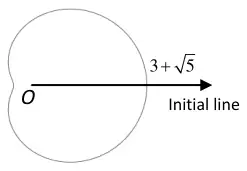
| Scheme | Marks | AO |
|---|---|---|
| Recalls correct shape for the type of curve, including ‘dimple’ | B1 | 1.2 |
| Correct position with labelling of pole, initial line and point. | B1 | 1.1b |
| (2) |
Notes
B1: Recalls the correct cardioid shape for this type of polar curve.
B1: Correctly placed with the pole, initial line and point where curve crosses the initial line all indicated in some way.
| Scheme | Marks | AO |
|---|---|---|
\(\dfrac{\mathrm{d}}{\mathrm{d}\theta}(r\sin\theta) = \dfrac{\mathrm{d}}{\mathrm{d}\theta}\left(3\sin\theta + \sqrt{5}\sin\theta\cos\theta\right) = A\cos\theta + B\cos 2\theta\) \(\dfrac{\mathrm{d}}{\mathrm{d}\theta}(r\sin\theta) = \dfrac{\mathrm{d}}{\mathrm{d}\theta}\left(\left(3 + \sqrt{5}\cos\theta\right)\sin\theta\right) = A\sin^2\theta + B\cos\theta + C\cos^2\theta\) | M1 | 1.1b |
\(\dfrac{\mathrm{d}}{\mathrm{d}\theta}(r\sin\theta) = \dfrac{\mathrm{d}}{\mathrm{d}\theta}\left(3\sin\theta + \sqrt{5}\sin\theta\cos\theta\right) = 3\cos\theta + \sqrt{5}\cos 2\theta\) \(\dfrac{\mathrm{d}}{\mathrm{d}\theta}(r\sin\theta) = \dfrac{\mathrm{d}}{\mathrm{d}\theta}\left(\left(3 + \sqrt{5}\cos\theta\right)\sin\theta\right) = -\sqrt{5}\sin^2\theta + 3\cos\theta + \sqrt{5}\cos^2\theta\) | A1 | 1.1b |
| \(\dfrac{\mathrm{d}y}{\mathrm{d}x} = 0 \Rightarrow 3\cos\theta + \sqrt{5}\left(2\cos^2\theta - 1\right) = 0\) or \(-\sqrt{5}\left(1 - \cos^2\theta\right) + 3\cos\theta + \sqrt{5}\cos^2\theta = 0\) Leading to a quadratic in \(\cos\theta\) \(\left\{2\sqrt{5}\cos^2\theta + 3\cos\theta - \sqrt{5} = 0\right\}\) | M1 | 3.1a |
| \(\cos\theta = \dfrac{1}{\sqrt{5}}\) following a correct quadratic, any extra solutions are rejected \(\left\{\cos\theta = \dfrac{-3 \pm 7}{4\sqrt{5}}\right.\), quadrant 1 needs \(\left.\cos\theta \gt 0\right\}\) | A1 | 2.3 |
| (4) |
Notes
M1: Uses \(y = r\sin\theta\) with the curve and attempts to differentiate. Accept any correct form but may have slips in coefficients, so e.g. as shown or \(A\cos\theta + B\cos^2\theta + C\sin^2\theta\) can score M1.
A1: Correct differentiation. Accept equivalents, e.g. \(3\cos\theta + \sqrt{5}\cos^2\theta - \sqrt{5}\sin^2\theta\)
M1: Sets their derivative equal to zero (may be implied), using trig identities to form a quadratics for \(\cos\theta\)
Allow this mark form the use of \(r\cos\theta\) leads to \(-3\sin\theta - 2\sqrt{5}\sin\theta\cos\theta = 0\), score M1 for factorising out \(\sin\theta\) and finds a value for \(\cos\theta\)
A1: Solves their quadratic and selects the correct value for \(\cos\theta\). If the other value is given it is A0 unless clearly rejected.
| Scheme | Marks | AO |
|---|---|---|
| \(r = 4\) | B1 | 1.1b |
| (1) | ||
| (7 marks) |
Notes
B1: Correct value for \(r\)