
A2 June 2021 Paper 2 Q9
9
Show that \(L\) is perpendicular to the initial line. [2 marks]
Find the polar coordinates of the points of intersection of \(L\) and \(C\)
Fully justify your answer. [5 marks]
and
\[r \lt 3 + \cos\theta\]Find the exact area of \(R\) [7 marks]
| Scheme | Marks | AO |
|---|---|---|
| Obtains \(x = \frac{7}{4}\) oe | B1 | 1.1b |
| Explains that \(L\) is perpendicular to the initial line or \(x\)-axis | E1 | 2.1 |
| (2) |
Typical solution
\[r = \frac{7}{4}\sec\theta\]\[r\cos\theta = \frac{7}{4}\]And \(x = r\cos\theta\)
So in Cartesian coordinates: \(x = \frac{7}{4}\) which is perpendicular to the \(x\)-axis
\(\therefore L\) is perpendicular to the initial line
| Scheme | Marks | AO |
|---|---|---|
| Obtains equation in \(\theta\) or \(r\) | M1 | 1.1a |
| Rearranges and solves for \(\cos\theta\) or \(\sec\theta\) or \(r\) | M1 | 3.1a |
| Rejects, with a reason, the impossible value of \(\cos\theta\) or \(r\) | E1 | 2.2a |
| Obtains correct value of \(\cos\theta\) or \(r\) | A1 | 1.1b |
| Obtains correct polar coordinates | A1 | 1.1b |
| (5) |
Typical solution
At points of intersection
\[\frac{7}{4}\sec\theta = 3 + \cos\theta\]\[\cos^2\theta + 3\cos\theta - \frac{7}{4} = 0\]\[4\cos^2\theta + 12\cos\theta - 7 = 0\]\(\cos\theta = -\frac{7}{2}\) (reject as \(-1 \leqslant \cos\theta \leqslant 1\))
or \(\cos\theta = \frac{1}{2}\)
Points are \(\left(\frac{7}{2}, \frac{\pi}{3}\right)\) and \(\left(\frac{7}{2}, -\frac{\pi}{3}\right)\)
| Scheme | Marks | AO |
|---|---|---|
| Identifies the required region. | M1 | 3.1a |
| Obtains correct area of triangle | B1 | 1.1b |
| Obtains \(k\int(3 + \cos\theta)^2\,\mathrm{d}\theta\) with or without limits | M1 | 3.1a |
| Uses \(\cos^2\theta = \frac{1}{2}\cos 2\theta + \frac{1}{2}\) | M1 | 3.1a |
| Integrates their (at least three-part) expression correctly | A1F | 1.1b |
| Obtains correct area of sector or half of sector | A1 | 1.1b |
| Obtains exact correct answer | A1 | 1.1b |
| (7) | ||
| (14 marks) |
Typical solution
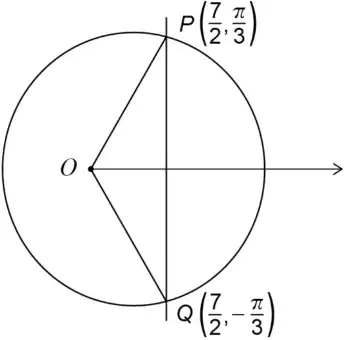
Area of triangle \(OPQ\)
\[= \frac{1}{2} \times \frac{7\sqrt{3}}{2} \times \frac{7}{4} = \frac{49\sqrt{3}}{16}\]Area of sector \(OPQ = 2\left(\int_0^{\frac{\pi}{3}} \frac{1}{2}r^2\,\mathrm{d}\theta\right)\) (by symmetry)
\[\begin{aligned} &= \int_0^{\frac{\pi}{3}} (3 + \cos\theta)^2\,\mathrm{d}\theta \\ &= \int_0^{\frac{\pi}{3}} (9 + 6\cos\theta + \cos^2\theta)\,\mathrm{d}\theta \\ &= \int_0^{\frac{\pi}{3}} \left(9 + 6\cos\theta + \frac{1}{2}\cos 2\theta + \frac{1}{2}\right)\mathrm{d}\theta \\ &= \left[\frac{19\theta}{2} + 6\sin\theta + \frac{1}{4}\sin 2\theta\right]_0^{\frac{\pi}{3}} \\ &= \left(\frac{19\pi}{6} + 3\sqrt{3} + \frac{\sqrt{3}}{8}\right) - 0 \\ &= \frac{19\pi}{6} + \frac{25\sqrt{3}}{8} \end{aligned}\]\[\begin{aligned} \text{Required area} &= \frac{19\pi}{6} + \frac{25\sqrt{3}}{8} - \frac{49\sqrt{3}}{16} \\ &= \frac{19\pi}{6} + \frac{\sqrt{3}}{16} \end{aligned}\]