
A2 October 2020 Paper 2 Q9
9 Two thin poles, \(OA\) and \(BC\), are fixed vertically on horizontal ground. A chain is fixed at \(A\) and \(C\) such that it touches the ground at point \(D\) as shown in the diagram.
On a coordinate system the coordinates of \(A\), \(B\) and \(D\) are \((0, 3)\), \((5, 0)\) and \((2, 0)\).
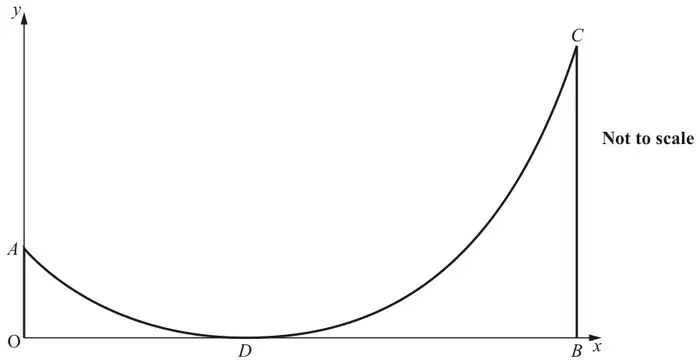
It is required to find the height of pole \(BC\) by modelling the shape of the curve that the chain forms.
Jofra models the curve using the equation \(y = k\cosh(ax - b) - 1\) where \(k\), \(a\) and \(b\) are positive constants.
Holly models the curve using the equation \(y = \frac{3}{4}x^2 - 3x + 3\).
| Scheme | Marks | AO |
|---|---|---|
| Min value of cosh is 1 (and point on ground is at the minimum) | M1 | 2.2a |
| (so \(0 = k \times 1 - 1 \Rightarrow\)) \(k = 1\) | A1 | 2.2a |
| [2] |
Notes
M1: Using minimum point of curve and knowledge of cosh graph. Could be derived by differentiation
A1: If zero scored then sc1 for k=1 www
| Scheme | Marks | AO |
|---|---|---|
| Passes through \((0, 3) \Rightarrow 3 = \cosh(-b) - 1\) \(\Rightarrow b = -\cosh^{-1}(3 + 1)\) | *M1 | 3.3 |
| \(b = (\pm)\ln\left(4 + \sqrt{(4^2 - 1)}\right)\) | dep*M1 | 3.1a |
| \(\Rightarrow b = \ln(4 + \sqrt{15})\) | A1 | 1.1 |
| Passes through \((2, 0) \Rightarrow 0 = \cosh(2a - b) - 1\) \(\Rightarrow b = 2a\) | M1 | 3.3 |
| \(\Rightarrow a = \frac{1}{2}\ln(4 + \sqrt{15})\) | A1 | 1.1 |
| [5] |
Notes
*M1: Use of \((0, 3)\) to derive an expression for \(b\). accept \(\cosh(-b) = \frac{4}{k}\)
dep*M1: Correct numerical use of formula. Or rearranges.
M1: Use of \((2, 0)\) to derive \(b = 2a\). Could be from (a). Allow ft
| Scheme | Marks | AO |
|---|---|---|
| (By symmetry of both;) \((4, 3)\) | B1 | 2.2a |
| [1] |
| Scheme | Marks | AO |
|---|---|---|
| Holly’s model; \(d_{\mathrm{H}} = 6.75\) | B1 | 3.4 |
| Jofra’s model: \(d_{\mathrm{J}} = \cosh(5a - b) - 1\) | M1 | 3.4 |
| AG \(d_{\mathrm{J}} - d_{\mathrm{H}} = 10.067\ldots - 6.75 = 3.32\) (3 sf) | A1 | 1.1 |
| [3] |
Notes
B1: Condone 27/4
M1: Use of \(x = 5\) with their values of \(a\) and \(b\) to predict \(d\). Must have \(-1\)
\(a = 1.0317\ldots,\ b = 2.0634\ldots,\ d_{\mathrm{J}} = 10.067\ldots\) Condone 10.07 only if clear evidence of production
A1: From correct values