
A2 June 2024 Paper 1 Q12
12 The diagram shows the curve with parametric equations
\(x = 2\cosh t + \sinh t,\ y = \cosh t - 2\sinh t\).
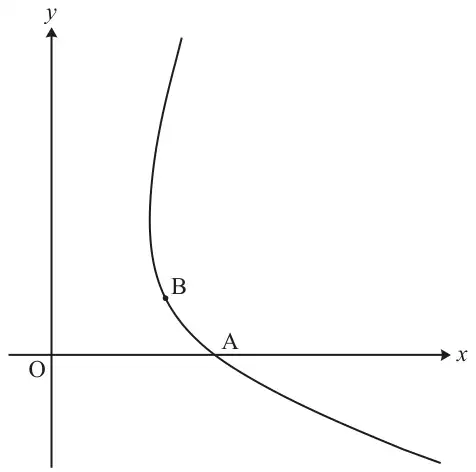
Determine the equation of the tangent to the curve at B. [6]
| Scheme | Marks | AO |
|---|---|---|
| (i) At A, \(\cosh t - 2\sinh t = 0 \Rightarrow \tanh t = \frac{1}{2}\) | M1* A1 | 3.1a 1.1 |
| \(\Rightarrow t = \dfrac{1}{2}\ln\dfrac{1 + \frac{1}{2}}{1 - \frac{1}{2}}\) | M1dep | 1.1 |
| \(= \frac{1}{2}\ln 3\) | A1 | 1.1 |
| [4] | ||
| (ii) \(x = 2\cosh\left(\frac{1}{2}\ln 3\right) + \sinh\left(\frac{1}{2}\ln 3\right)\) | M1 | 1.1 |
| \(= 2.89\) (3 s.f.) | A1 | 1.1 |
| [2] |
Notes
(a)(i)
M1*: Use of \(\tanh t = \sinh t / \cosh t\) in \(y = 0\) equation
A1: Correct value of \(\tanh t\)
M1dep: Use of artanh formula with their \(\frac{1}{2}\)
A1: Must be exact, www
Alternative method 1
| Scheme | Marks |
|---|---|
| \(\cosh t - 2\sinh t = 0 \Rightarrow \frac{\mathrm{e}^t + \mathrm{e}^{-t}}{2} - 2\left(\frac{\mathrm{e}^t - \mathrm{e}^{-t}}{2}\right) = 0\) | M1* |
| \(3\mathrm{e}^{-t} - \mathrm{e}^t = 0\) \(3 - \mathrm{e}^{2t} = 0\) | A1 |
| \(2t = \ln 3\) | M1dep |
| \(t = \frac{1}{2}\ln 3\) | A1 |
M1*: Exponential definitions used
A1: Collecting \(e^t\) terms and \(e^{-t}\) terms correctly
M1dep: Logs taken to isolate a term in \(t\) correctly
A1: Must be exact www
Alternative method 2
| Scheme | Marks |
|---|---|
| \(\cosh^2 t = 4\sinh^2 t\) \(1 + \sinh^2 t = 4\sinh^2 t\) or \(\cosh^2 t = 4(\cosh^2 t - 1)\) | M1* |
| \(\sinh t = \dfrac{1}{\sqrt{3}}\) or \(\cosh t = \dfrac{2}{\sqrt{3}}\) | A1 |
| \(t = \ln\left(\dfrac{1}{\sqrt{3}} + \sqrt{\dfrac{1}{3} + 1}\right)\) or \(t = \ln\left(\dfrac{2}{\sqrt{3}} + \sqrt{\dfrac{4}{3} - 1}\right)\) | M1dep |
| \(= \frac{1}{2}\ln 3\) | A1 |
| [4] |
M1*: Squaring both sides and using \(\cosh^2 t - \sinh^2 t = 1\)
A1: Correct value of \(\sinh t\) or \(\cosh t\). Condone \(\sinh t = \pm\frac{1}{\sqrt{3}}\) but not \(\cosh t = \pm\frac{2}{\sqrt{3}}\)
M1dep: Use of arsinh or arcosh formula with their \(\frac{1}{\sqrt{3}}\) or \(\frac{2}{\sqrt{3}}\)
A1: Must be exact, www. Any \(\sinh t \lt 0\) must be explicitly rejected.
(a)(ii)
M1: Substituting their \(\frac{1}{2}\ln 3\) \((= 0.5493)\) into correct expression for \(x\). FT a decimal for their exact value.
A1: Must be 3sf
| Scheme | Marks | AO |
|---|---|---|
| \(\dfrac{\mathrm{d}y}{\mathrm{d}x} = \dfrac{\mathrm{d}y}{\mathrm{d}t}\Big/\dfrac{\mathrm{d}x}{\mathrm{d}t}\) | M1 | 3.1a |
| \(= \dfrac{\sinh t - 2\cosh t}{2\sinh t + \cosh t}\) | A1 | 2.1 |
| When \(t = 0, \sinh t = 0, \cosh t = 1 \Rightarrow \dfrac{\mathrm{d}y}{\mathrm{d}x} = -2\) | A1 | 2.1 |
| B is (2, 1) | B1 | 2.1 |
| so equation of tangent is \(y - 1 = -2(x - 2)\) | M1 | 2.1 |
| \(\Rightarrow y = -2x + 5\) | A1 | 2.2a |
| [6] |
Notes
M1: Parametric differentiation leading to an expression for \(\frac{\mathrm{d}y}{\mathrm{d}x}\) with correct numerator or denominator. Implied by correct expression for \(\frac{\mathrm{d}y}{\mathrm{d}x}\).
A1: Could be in exponential form, e.g. \(\frac{\mathrm{e}^t + 3\mathrm{e}^{-t}}{\mathrm{e}^{-t} - 3\mathrm{e}^t}\)
B1: soi by correct use in equation for tangent
M1: Use of \(y = mx + c\) or \(y - y_1 = m(x - x_1)\) with their B\((2, 1)\) and their value for \(\frac{\mathrm{d}y}{\mathrm{d}x}\)
A1: or \(2x + y = 5\) or \(2x + y - 5 = 0\). Must be simplified.