
October 2020 Paper 2 Q2
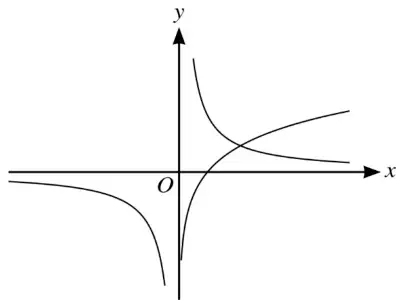
2 Two curves have equations \(y = \ln x\) and \(y = \dfrac{k}{x}\), where \(k\) is a positive constant.
(a) Sketch the curves on a single diagram. [3]
(b) Explain how your diagram shows that the equation \(x\ln x - k = 0\) has exactly one real root. [2]
| Scheme | Marks | AO |
|---|---|---|
 | B2 | 1.1 1.1 |
| B1 | 1.1 | |
| [3] |
Notes
B2: Excellent curve for \(y = kx^{-1}\) in both quadrants:
- Correct shape, rotational symmetry about \(O\), not touching axes
- Asymptote clearly the axes
- Not finite (i.e. extending to the ends of the axes)
- Allow slight movement away from asymptote at one end but not more
N.B. Ignore ‘feathering’ now that answers are scanned.
B1 only – correct shape in 1st and 3rd quadrants only. Graph must not touch axes more than once. Finite ‘plotting’ condoned.
B1: Correct curve for \(y = \ln x\) in 1st and 4th quadrants – asymptote clearly the \(y\)-axis
For full marks curves should only intersect once in the 1st quadrant
| Scheme | Marks | AO |
|---|---|---|
| \(x\ln x - k = 0\) is a rearrangement of the equation \(\ln x = \dfrac{k}{x}\) | B1 | 2.4 |
| The curves intersect at a single point (and so therefore the equation \(x\ln x - k = 0\) has only one real root) | B1 FT | 2.4 |
| [2] |
Notes
B1: Either explained or shown algebraically
B1 FT: Follow through from incorrect curves provided they only intersect once. Intersection in the 1st quadrant