
June 2023 Paper 1 Q9
9 The graph shows the function \(y = \mathrm{e}^{2x}\).
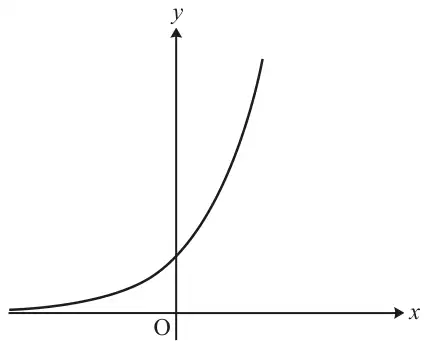
A second function is defined by \(y = k + \mathrm{e}^x\).
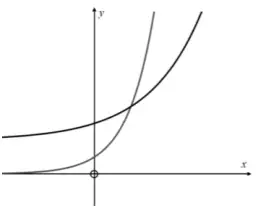
Add a sketch of the graph of \(y = k + \mathrm{e}^x\) in a case where \(k\) is a positive constant. [2]
| Scheme | Marks | AO |
|---|---|---|
| Stretch in the \(x\)-direction | B1 | 1.2 |
| Stretch scale factor \(\frac{1}{2}\) | B1 | 1.1b |
| [2] |
| Scheme | Marks | AO |
|---|---|---|
 | B1 B1 | 1.1b 1.1b |
| [2] |
Notes
B1: General shape of exponential graph less steep than the given graph for positive \(x\) (note red graph is printed)
B1: Horizontal asymptote above the \(x\)-axis and intersection with \(y\)-axis must be above that for the given graph
(In this greyscale copy, the printed graph of \(y = \mathrm{e}^{2x}\) is the paler, steeper curve.)
| Scheme | Marks | AO |
|---|---|---|
| The graphs intersect when \(\mathrm{e}^{2x} = k + \mathrm{e}^x\) So when \(\mathrm{e}^{2x} - \mathrm{e}^x - k = 0\) | M1 | 2.1 |
| discriminant \((-1)^2 - 4(-k)\) | M1 | 2.1 |
| is negative for \(k \lt -\dfrac{1}{4}\) so no real roots and no points of intersection | E1 | 2.1 |
| [3] |
Notes
M1: Attempts to solve simultaneously. Allow \(k = -\frac{1}{4}\) substituted
M1: Uses discriminant of the equation
E1: must state no real roots or no points of intersection
| Scheme | Marks | AO |
|---|---|---|
| When \(k = 2\), \(\mathrm{e}^{2x} - \mathrm{e}^x - 2 = 0\) gives \(\mathrm{e}^x = -1,\ 2\) | M1 | 2.1 |
| So \(x = \ln 2\) as \(\mathrm{e}^x = -1\) is not possible | A1 | 2.1 |
| [2] |
Notes
M1: Evaluates \(\mathrm{e}^x\) from their quadratic and attempts to use natural logs
A1: must state that \(\ln 2\) is a root and that there are no others.
Allow SC1 for substituting \(x = \ln 2\) in both equations and concluding it must be a root