
June 2016 Paper 2 Q19
19 The continuous curve \(\ y = \mathrm{g}(x)\ \) has exactly two stationary points.
The stationary points are
- a point of inflection at \(P(1, 2)\)
- a minimum point at \(Q(a, b)\) where \(a \gt 1\) and \(b \lt 0\)
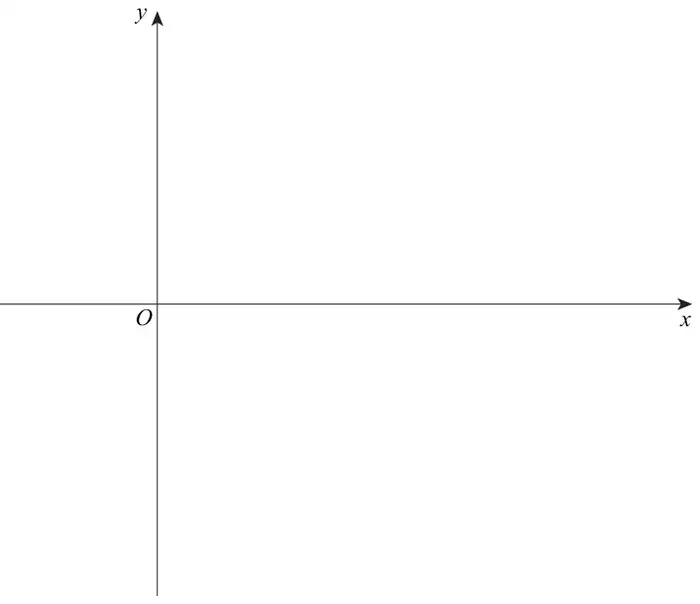
On the axes below, sketch the curve.
Label points \(P\) and \(Q\) on your sketch. [3 marks]
| Answer | Mark | Comments |
|---|---|---|
| Continuous curve with point of inflection, labelled \(P\) or (1, 2), in first quadrant and minimum point, labelled \(Q\) or \((a, b)\), in fourth quadrant, with \(x\)-coordinate of Q > \(x\)-coordinate of \(P\) eg 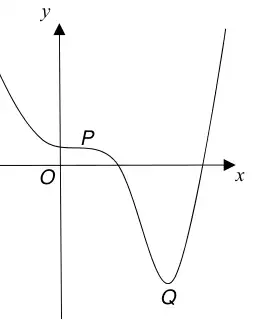 | B3 | For B3, allow the labelling of one coordinate as sufficient for each point B2 As B3 but not sufficiently labelled B1 Curve with point of inflection, labelled \(P\) or (1, 2), in first quadrant or curve with minimum point, labelled \(Q\) or \((a, b)\), in fourth quadrant For B1, allow labelling using one coordinate as sufficient SC2 As B3 but \(x\)-coordinate of Q < \(x\)-coordinate of \(P\) eg 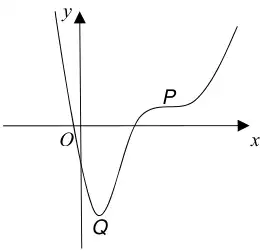 |
Additional guidance
For B3, curve does not have to cross the \(x\)-axis after \(Q\) and does not have to cross the \(y\)-axis before \(P\)
For a stationary point, curve must not stop at the point
At \(P\), the curve must change from concave upward to concave downward for B3 or B2 or vice-versa for B1 or SC2
Note that other non-stationary points of inflection may also be seen (up to B3 possible)
Curve may have horizontal asymptotes as \(x \to \pm\infty\) (up to B3 possible)
Mark intention for stationary points, positioning of labels and smoothness of curve
More than 1 stationary point of inflection and/or more than 1 minimum point and/or maximum point(s) can score a maximum of B1
Labelling using a coordinate or coordinates may be seen by labelling on an axis or on axes (axes may also show other numbers)