
June 2016 Paper 1 Q17
17 The diagram shows a sketch of the cubic curve \(\qquad y = \frac{1}{3}x^3 - x^2 - 3x + k\)
where \(k\) is a constant.
The \(x\)-axis is a tangent to the curve at its minimum point.
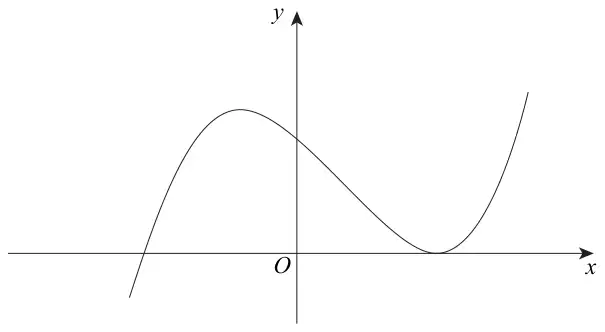
Not drawn accurately
Work out the value of \(k\). [5 marks]
| Answer | Mark | Comments |
|---|---|---|
| \(\dfrac{\mathrm{d}y}{\mathrm{d}x} = x^2 - 2x - 3\) | M1 | |
| \(x^2 - 2x - 3 = 0\) | M1 | ft their \(x^2 - 2x - 3\) ... they must equate to 0 |
| \((x - 3)(x + 1)\) or \(x = 3\) | A1 | |
| \(0 = \frac{1}{3} \times 3^3 - 3^2 - 9 + k\) | M1dep | oe ft their 3, which must be a positive value ... it must be the greater of their two values |
| (\(k\) =) 9 | A1 |
Additional guidance
They must start this question by differentiating ... any other attempted solutions will score zero marks.
The 2nd M mark can be implied by them equating their factors to zero or by seeing an answer of \(x = 3\)
Substituting \(x = 3\) in \(y = \frac{1}{3}x^3 - x^2 - 3x + k\) implies the 1st A1 (M1 M1 already earned)
The 3rd M mark is dependent on both of the first two M marks
Look out for \(k = 9\) coming from using \(x = -3\) when \(y = 0\) ... they cannot use a negative value for \(x\) at this stage