
June 2023 Paper 2 Q9
9 The dimensions of the cuboid are given in centimetres.
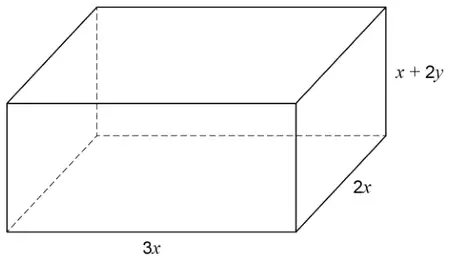
The total length of all 12 edges is 300 cm
(a) Show that \(\quad y = \dfrac{75 - 6x}{2}\) [2 marks]
(b) The volume of the cuboid is \(V\text{ cm}^3\)
Show that \(\quad V = 450x^2 - 30x^3\) [2 marks]
(c) Use calculus to work out the maximum value of \(V\) as \(x\) varies. [3 marks]
| Answer | Mark | Comments |
|---|---|---|
| Expression for length of all edges = 300 or expression for length of the 3 given edges \(= \dfrac{300}{4}\) | M1 | must have terms in \(x\) and \(y\) on one side and 300 or \(\dfrac{300}{4}\) on the other side eg \(4(3x + 2x + x + 2y) = 300\) or \(12x + 8x + 4x + 8y = 300\) or \(24x + 8y = 300\) or \(6x + 2y = \dfrac{300}{4}\) do not award M1 if only seen from working back from \(y = \dfrac{75 - 6x}{2}\) only \(6x + 2y = 75\) is M0 |
| M1 seen and shows correct simplification to \(y = \dfrac{75 - 6x}{2}\) | A1 | must see at least one intermediate equation after M1 with terms in \(x\) and \(y\) fully simplified and no incorrect equations seen |
Additional guidance
| Condone eg \(\dfrac{8y = 300 - 24x}{8}\) as not being an incorrect equation | |
| Missing brackets must be recovered | |
| Ignore units and working involving areas or volumes | |
| \(12x + 8x + 4x + 8y = 300\) \(8y = 300 - 24x\) \(y = \dfrac{75 - 6x}{2}\) | M1 A1 |
| \(24x + 8y = 300\) \(y = \dfrac{75 - 6x}{2}\) | M1 A0 |
| \(24x + 8y = 300\) \(8y = 300 + 24x\) (incorrect equation seen) \(y = \dfrac{75 - 6x}{2}\) | M1 A0 |
| NOTE \(\;y = \dfrac{75 - 6x}{2}\) may be seen with no correct working eg \(6x + 2y = 300 \qquad y = \dfrac{75 - 6x}{2}\) | M0A0 |
| \(12x + 8x + 4x + 8y = 300\) \(8y = 300 - 24x\) \(y = 37.5 - 3x\) and \(\dfrac{75 - 6x}{2} = 37.5 - 3x\) | M1 A1 |
| Answer | Mark | Comments |
|---|---|---|
| \(3x \times 2x \times (x + 75 - 6x)\) or \(6x^2(75 - 5x)\) | M1 | oe expression only in terms of \(x\) eg \(3x \times 2x \times (75 - 5x)\) or \(6x^3 + 12x^2 \times \dfrac{75 - 6x}{2}\) |
| M1 seen and \(450x^2 - 30x^3\) with no incorrect expressions seen | A1 |
Additional guidance
| For M1 the expression cannot be \(450x^2 - 30x^3\) | |
| \(V =\) is not required | |
| M1 may be seen in stages | |
| Missing brackets must be recovered before the final answer eg1 \(3x \times 2x \times x + 2y\) \(6x^3 + 12x^2 \times \dfrac{75 - 6x}{2} = 450x^2 - 30x^3\) eg2 \(6x^2 \times 75 - 5x = 450x^2 - 30x^3\) | M1A1 M0 |
| Using the given answer and working back | M0 |
| \(6x^2(x + 2y)\) with no further correct work | M0 |
| \(6x^2(75 - 6x)\) | M0 |
| NOTE \(\;450x^2 - 30x^3\) may be seen with no correct working eg \(6x(75 - 5x) = 450x^2 - 30x^3\) | M0A0 |
| Answer | Mark | Comments |
|---|---|---|
| \(900x\) or \(-90x^2\) | M1 | oe eg \(2 \times 450x^{2 - 1}\) or \(3 \times -30x^{3 - 1}\) |
| their \((900x - 90x^2) = 0\) | M1dep | oe must have exactly two terms |
| 15 000 with \(900x - 90x^2\) seen | A1 | ignore units SC1 15 000 |
Additional guidance
| Up to M2 may be awarded for correct work with no answer or incorrect answer, even if this is seen amongst multiple attempts | |
| Condone incorrect notation eg \(V = 900x - 90x^2\) | 1st M1 |
| Answer \(x = 10\) with \(900x - 90x^2\) and 15 000 in working lines | M2A0 |
| Answer \(x = 10\) with 15 000 in working lines | M0 |
| Condone (10, 15 000) for 15 000 | |
| Ignore higher derivatives | |
| Ignore any work investigating the nature of the ‘turning point’ |