
June 2025 Paper 1 Q12
12.
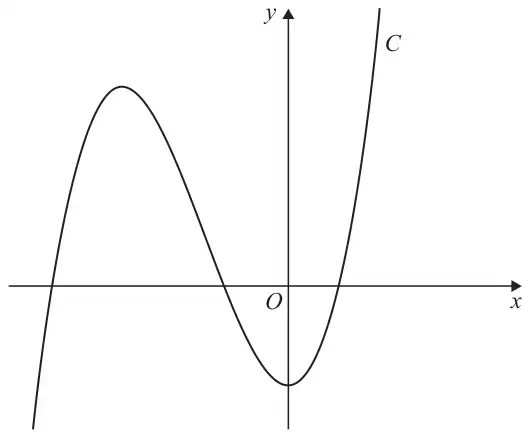
Figure 5 shows a sketch of the curve \(C\).
The curve has a minimum turning point on the \(y\)-axis and a maximum turning point in quadrant 2.
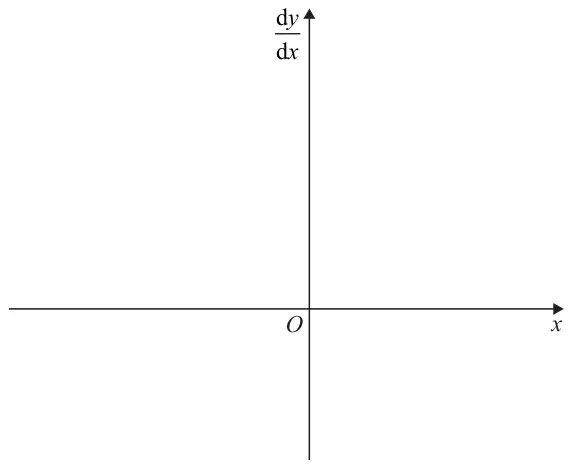
The gradient function for \(C\) has one of the following equations
\[\dfrac{\mathrm{d}y}{\mathrm{d}x} = (x+1)^2 - 2 \qquad \dfrac{\mathrm{d}y}{\mathrm{d}x} = 3x^2 + 9x \qquad \dfrac{\mathrm{d}y}{\mathrm{d}x} = -x(x+7) \qquad \dfrac{\mathrm{d}y}{\mathrm{d}x} = x^2 - 5x\]
| Scheme | Marks | AO |
|---|---|---|
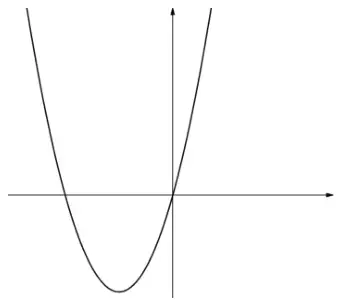
| \(\cup\) shaped not \(\cap\) shaped. | B1 | 1.1b |
| Crosses the negative \(x\)-axis. | B1 | 1.1b |
| Crosses the \(x\)-axis at the origin. | B1 | 1.1b |
| (3) |
Notes
Look out for the sketch drawn on Figure 5 but Diagram 1 takes precedence.
Ignore any values given at intersection/turning points.
B1: \(\cup\) shaped curve not \(\cap\) shaped. Ignore any roots or lack of roots.
B1: At least one intersection with the negative \(x\)-axis. (May be a straight line)
Allow their curve/line to touch for this mark.
B1: A curve intersecting the origin. (May be a straight line)
Allow their curve/line to touch for this mark.
| Scheme | Marks | AO |
|---|---|---|
| Correctly identifies \(\left(\dfrac{\mathrm{d}y}{\mathrm{d}x} =\right) 3x^2 + 9x\) with one correct justification (see below) | B1 | 2.2a |
| It is a positive quadratic with a negative root and a root at the origin. | dB1 | 2.4 |
Notes
Look out for the sketch drawn on Figure 5 but Diagram 1 takes precedence.
B1: Deduces that the gradient function is \(\left(\dfrac{\mathrm{d}y}{\mathrm{d}x} =\right) 3x^2 + 9x\) with one valid justification (see below)
Allow correct calculations for either roots \(x = -3\) or \(x = 0\) or for the turning point at \(x = -\dfrac{3}{2}\) as a valid justification.
dB1: Explanation that includes
- one root being negative or e.g. has a root at \(x = -3\) with no implication of there being more than one negative root
- one root being at the origin (or \(O\)) e.g. has a root at \(x = 0\) (condone the \(y\) intercept is 0 but not “it doesn’t have a \(y\) intercept”)
- that it is U shaped (or a positive parabola/quadratic or it is the derivative of a positive cubic but not “positive graph/curve”)
Alternatively, allow a complete explanation eliminating each of the other equations.
e.g. can’t be:
- \((x+1)^2 - 2\) as this doesn’t go through the origin
- \(-x(x+7)\) as this is not a U shape
- \(x^2 - 5x\) as this doesn’t have a negative root
Or e.g.
- the curve has a turning point in quadrant 3 or is at \(\left(-\dfrac{3}{2},\ -\dfrac{27}{4}\right)\)
- one root is at the origin
If extra incorrect statements are included they can be ignored.
Note B0dB1 is not possible.