
C2 June 2014 Q10
10.
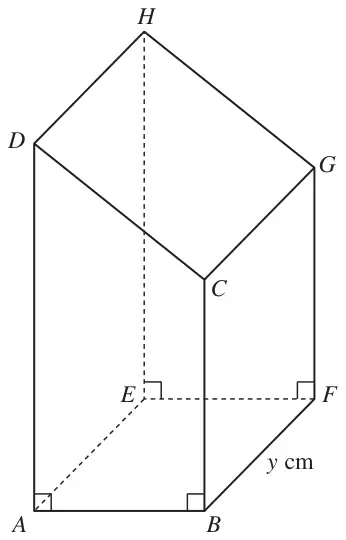
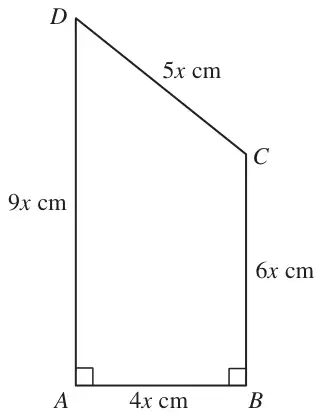
Figure 4 shows a closed letter box \(ABFEHGCD\), which is made to be attached to a wall of a house.
The letter box is a right prism of length \(y\) cm as shown in Figure 4. The base \(ABFE\) of the prism is a rectangle. The total surface area of the six faces of the prism is \(S\) cm2.
The cross section \(ABCD\) of the letter box is a trapezium with edges of lengths \(DA = 9x\) cm, \(AB = 4x\) cm, \(BC = 6x\) cm and \(CD = 5x\) cm as shown in Figure 5.
The angle \(DAB = 90^\circ\) and the angle \(ABC = 90^\circ\).
The volume of the letter box is 9600 cm3.
| Scheme | Marks |
|---|---|
| \(\dfrac{1}{2}(9x + 6x)4x\) or \(\quad 2x \times 15x\) or \(\quad \left(\dfrac{1}{2}4x \times (9x - 6x) + 6x \times 4x\right)\) or \(\quad 6x^2 + 24x^2\) or \(\quad \left(9x \times 4x - \dfrac{1}{2}4x \times (9x - 6x)\right)\) or \(\quad 36x^2 - 6x^2\) | M1A1cso |
| \(\Rightarrow 30x^2y = 9600 \Rightarrow y = \dfrac{9600}{30x^2} \Rightarrow y = \dfrac{320}{x^2}\) * | |
| (2) |
Notes
M1: Correct attempt at the area of a trapezium.
Note that \(30x^2\) on its own or \(30x^2\) from incorrect work e.g. \(5x \times 6x\) is M0.
If there is a clear intention to find the area of the trapezium correctly allow the M1 but the A1 can be withheld if there are any slips.
A1: Correct proof with at least one intermediate step and no errors seen.
“\(y =\)” is required.
| Scheme | Marks |
|---|---|
| \((S =)\ \dfrac{1}{2}(9x + 6x)4x + \dfrac{1}{2}(9x + 6x)4x + 6xy + 9xy + 5xy + 4xy\) | M1A1 |
| \(y = \dfrac{320}{x^2} \Rightarrow (S =)\ 30x^2 + 30x^2 + 24x\left(\dfrac{320}{x^2}\right)\) | M1 |
| So, \((S =)\ 60x^2 + \dfrac{7680}{x}\) * | A1* cso |
| (4) |
Notes
M1: An attempt to find the area of six faces of the prism. The 2 trapezia may be combined as \((9x + 6x)4x\) or \(60x^2\) and the 4 other faces may be combined as \(24xy\) but all six faces must be included. There must be attempt at the areas of two trapezia that are dimensionally correct.
A1: Correct expression in any form.
Allow just \((S =)\ 60x^2 + 24xy\) for M1A1
M1: Substitutes \(y = \dfrac{320}{x^2}\) into their expression for \(S\) (may be done earlier). \(S\) should have at least one \(x^2\) term and one \(xy\) term but there may be other terms which may be dimensionally incorrect.
A1* cso: Correct solution only. “\(S =\)” is not required here.
| Scheme | Marks |
|---|---|
| \(\dfrac{\mathrm{d}S}{\mathrm{d}x} = 120x - 7680x^{-2}\) \(\left\{= 120x - \dfrac{7680}{x^2}\right\}\) | M1 A1 aef |
| \(120x - \dfrac{7680}{x^2} = 0\) \(\Rightarrow x^3 = \dfrac{7680}{120};= 64 \Rightarrow x = 4\) | M1A1cso |
| Note some candidates stop here and do not go on to find \(S\) – maximum mark is 4/6 | |
| \(\{x = 4,\}\) \(S = 60(4)^2 + \dfrac{7680}{4} = 2880\ (\text{cm}^2)\) | ddM1 A1 cao and cso |
| (6) |
Notes
M1: Either \(60x^2 \to 120x\) or \(\dfrac{7680}{x} \to \dfrac{\pm\lambda}{x^2}\)
A1: Correct differentiation (need not be simplified).
M1: \(S\prime = 0\) and “their \(x^3 = \pm\) value” or “their \(x^{-3} = \pm\) value” Setting their \(\dfrac{\mathrm{d}S}{\mathrm{d}x} = 0\) and “candidate’s ft correct power of \(x =\) a value”. The power of \(x\) must be consistent with their differentiation. If inequalities are used this mark cannot be gained until candidate states value of \(x\) or \(S\) from their \(x\) without inequalities. \(S\prime = 0\) can be implied by \(120x = \dfrac{7680}{x^2}\). Some may spot that \(x = 4\) gives \(S\prime = 0\) and provided they clearly show \(S\prime(4) = 0\) allow this mark as long as \(S\prime\) is correct. (If \(S\prime\) is incorrect this method is allowed if their derivative is clearly zero for their value of \(x\))
A1: \(x = 4\) only (\(x^3 = 64 \Rightarrow x = \pm 4\) scores A0)
Note that the value of \(x\) is not explicitly required so the use of \(x = \sqrt[3]{64}\) to give \(S = 2880\) would imply this mark.
ddM1: Substitute candidate’s value of \(x\ (\neq 0)\) into a formula for \(S\). Dependent on both previous M marks.
A1: 2880 cso (Must come from correct work)
| Scheme | Marks |
|---|---|
| \(\dfrac{\mathrm{d}^2S}{\mathrm{d}x^2} = 120 + \dfrac{15360}{x^3} \gt 0\) \(\Rightarrow\) Minimum | M1A1ft |
| (2) | |
| Total 14 |
Notes
M1: Attempt \(S\prime\prime\ \left(x^n \to x^{n-1}\right)\) and considers sign.
This mark requires an attempt at the second derivative and some consideration of its sign. There does not necessarily need to be any substitution. An attempt to solve \(S\prime\prime = 0\) is M0
A1: \(120 + \dfrac{15360}{x^3}\) and \(\gt 0\) and conclusion.
Requires a correct second derivative of \(120 + \dfrac{15360}{x^3}\) (need not be simplified) and a valid reason (e.g. > 0), and conclusion.
Only follow through a correct second derivative i.e. \(x\) may be incorrect but must be positive and/or \(S\prime\prime\) may have been evaluated incorrectly.
A correct \(S\prime\prime\) followed by \(S\prime\prime(\text{"}4\text{"}) = \text{"}360\text{"}\) therefore minimum would score no marks in (d)
A correct \(S\prime\prime\) followed by \(S\prime\prime(\text{"}4\text{"}) = \text{"}360\text{"}\) which is positive therefore minimum would score both marks
Note parts (c) and (d) can be marked together.