
October 2020 Paper 1 Q12
12 In this question you must show detailed reasoning.
Fig. 12 shows part of the graph of \(y = x^2 + \dfrac{1}{x^2}\).
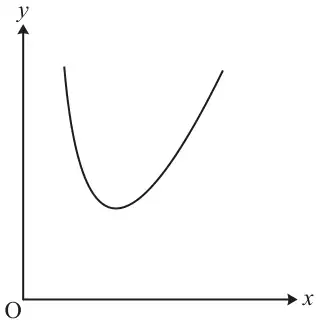
The tangent to the curve \(y = x^2 + \dfrac{1}{x^2}\) at the point \(\left(2, \frac{17}{4}\right)\) meets the \(x\)-axis at A and meets the \(y\)-axis at B. O is the origin.
| Scheme | Marks | AO |
|---|---|---|
| \(\dfrac{\mathrm{d}y}{\mathrm{d}x} = 2x - 2x^{-3}\) | M1 | 3.1a |
| At \(\left(2, \dfrac{17}{4}\right)\) gradient \(= 2 \times 2 - 2 \times 2^{-3} = \dfrac{15}{4}\) | A1 | 1.1 |
| Equation of the tangent \(y - \dfrac{17}{4} = \dfrac{15}{4}(x - 2)\) \(y = \dfrac{15}{4}x - \dfrac{13}{4}\) | M1 | 3.1a |
| Crosses \(x\)-axis when \(y = 0,\ x = \dfrac{13}{15}\) | A1 | 1.1 |
| Crosses \(y\)-axis when \(x = 0,\ y = -\dfrac{13}{4}\) | A1 | 1.1 |
| Area of triangle \(\dfrac{1}{2} \times \dfrac{13}{15} \times \dfrac{13}{4} = \dfrac{169}{120}\) [below the axis] | A1 | 1.1 |
| [6] |
Notes
M1: Attempt to differentiate
A1: Correct value in any form
M1: Using their gradient to find the equation of the tangent
A1: Allow 0.867 or better
A1: any form
A1: FT their values but must be exact. Accept positive or negative value
Note Area 1.41 gets 5/6 marks
| Scheme | Marks | AO |
|---|---|---|
| At a stationary point \(\dfrac{\mathrm{d}y}{\mathrm{d}x} = 2x - 2x^{-3} = 0\) | M1 | 1.1a |
| \(x^4 = 1\) giving \(x = \pm 1\) so there are only two stationary points | A1 | 1.1 |
| \(\dfrac{\mathrm{d}^2y}{\mathrm{d}x^2} = 2 + 6x^{-4}\) | M1 | 1.1a |
| When \(x = 1,\ \dfrac{\mathrm{d}^2y}{\mathrm{d}x^2} = 2 + 6 \times 1^4\ [= 8] > 0\) so minimum point | M1 | 2.1 |
| When \(x = -1,\ \dfrac{\mathrm{d}^2y}{\mathrm{d}x^2} = 2 + 6 \times (-1)^4\ [= 8] > 0\) so also minimum point | A1 | 2.1 |
| The two stationary points are both minimum points so there is no maximum point. | E1 | 2.2a |
| [6] |
Notes
M1: Equating their derivative to zero and attempting to solve
A1: Finding both roots and no others
M1: Differentiating their \(\dfrac{\mathrm{d}y}{\mathrm{d}x}\)
M1: Evaluating at (at least one of) their stationary point(s)
Allow for evaluating gradient at appropriate points either side. Arguing point is minimum from their gradients [incl sketch]
A1: Argues that both points are minimum from correct working. Allow arguing that second derivative is positive everywhere or a symmetry argument
E1: Deduces that there are no maximum points.