
June 2019 Unit 1 Q13
13. A curve \(C\) has equation \(y=\dfrac{1}{9}x^3-kx+5\). A point \(Q\) lies on \(C\) and is such that the tangent to \(C\) at \(Q\) has gradient \(-9\). The \(x\)-coordinate of \(Q\) is 3.
(a) Show that \(k=12\). [3]
(b) Find the coordinates of each of the stationary points of \(C\) and determine their nature. [6]
(c) Sketch the curve \(C\), clearly labelling the stationary points and the point where the curve crosses the \(y\)-axis. [2]
| Scheme | Marks | Comments |
|---|---|---|
| \(\dfrac{\mathrm{d}y}{\mathrm{d}x}=\dfrac{1}{3}x^2-k\) | B1 | |
| When \(x=3\), \(\dfrac{\mathrm{d}y}{\mathrm{d}x}=-9\) | M1 | used |
| \(\dfrac{1}{3}\times 3^2-k=-9\) | ||
| \(k=12\) | A1 | convincing, allow verification |
| Scheme | Marks | Comments |
|---|---|---|
| At stationary points \(\dfrac{\mathrm{d}y}{\mathrm{d}x}=0\) | M1 | used |
| \(\dfrac{1}{3}x^2-12=0,\qquad x^2=36\) | ||
| \(x=-6,\ 6\) | A1 | one correct pair |
| \(y=53,\ -43\) | A1 | second correct pair |
| Note: Allow \(y\) values shown in (c) but do not ft for incorrect \(x\) values. | ||
| \(\dfrac{\mathrm{d}^2y}{\mathrm{d}x^2}=\dfrac{2}{3}x\) | M1 | oe |
| When \(x=-6\), \(\dfrac{\mathrm{d}^2y}{\mathrm{d}x^2}=-4<0\) | ||
| \((-6,\ (53))\) is a maximum point | A1 | ft \(x\) |
| When \(x=6\), \(\dfrac{\mathrm{d}^2y}{\mathrm{d}x^2}=4>0\) | ||
| \((6,\ (-43))\) is a minimum point | A1 | ft \(x\) provided different conclusion |
| Scheme | Marks | Comments |
|---|---|---|
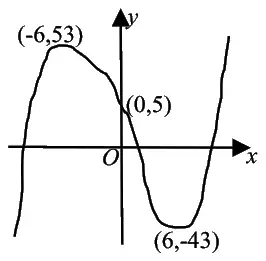 | M1 A1 | +ve cubic curve points, ft if possible |