
C2 June 2014 (R) Q9
9.
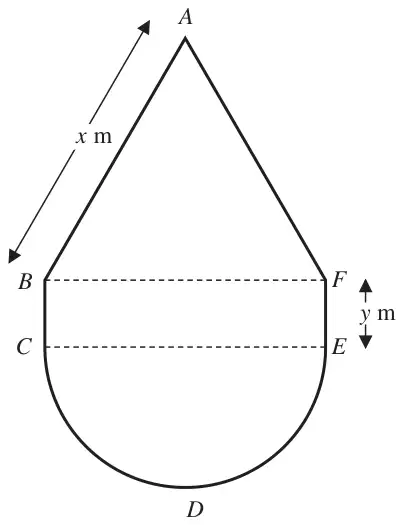
Figure 4 shows the plan of a pool.
The shape of the pool \(ABCDEFA\) consists of a rectangle \(BCEF\) joined to an equilateral triangle \(BFA\) and a semi-circle \(CDE\), as shown in Figure 4.
Given that \(AB = x\) metres, \(EF = y\) metres, and the area of the pool is 50 m2,
| Scheme | Marks |
|---|---|
| \(\{A =\}\ xy + \dfrac{\pi}{2}\left(\dfrac{x}{2}\right)^2 + \dfrac{1}{2}x^2\sin 60^\circ\) | M1A1 |
| \(50 = xy + \dfrac{\pi x^2}{8} + \dfrac{\sqrt{3}x^2}{4} \Rightarrow y = \dfrac{50}{x} - \dfrac{\pi x}{8} - \dfrac{\sqrt{3}x}{4} \Rightarrow \underline{y = \dfrac{50}{x} - \dfrac{x}{8}\left(\pi + 2\sqrt{3}\right)}\) * Correct proof with no errors seen | A1 * |
| (3) |
Notes
M1: An attempt to find 3 areas of the form: \(xy\), \(p\pi x^2\) and \(qx^2\)
A1: Correct expression for \(A\) (terms must be added)
| Scheme | Marks |
|---|---|
| \(\{P =\}\ \dfrac{\pi x}{2} + 2x + 2y\) | B1 |
| \(P = \dfrac{\pi x}{2} + 2x + 2\left(\dfrac{50}{x} - \dfrac{x}{8}\left(\pi + 2\sqrt{3}\right)\right)\) | M1 |
| \(P = \dfrac{\pi x}{2} + 2x + \dfrac{100}{x} - \dfrac{\pi x}{4} - \dfrac{\sqrt{3}}{2}x \Rightarrow P = \dfrac{100}{x} + \dfrac{\pi x}{4} + 2x - \dfrac{\sqrt{3}}{2}x\) | |
| \(\Rightarrow \underline{P = \dfrac{100}{x} + \dfrac{x}{4}\left(\pi + 8 - 2\sqrt{3}\right)}\) | A1 * |
| (3) |
Notes
B1: Correct expression for \(P\) in terms of \(x\) and \(y\)
M1: Substitutes the given expression for \(y\) into an expression for \(P\) where \(P\) is at least of the form \(\alpha x + \beta y\)
A1*: Correct proof with no errors seen
| Scheme | Marks |
|---|---|
| (Note \(\dfrac{\pi + 8 - 2\sqrt{3}}{4} = 1.919\ldots\ldots\)) | |
| (c) and (d) can be marked together | |
| \(\dfrac{\mathrm{d}P}{\mathrm{d}x} = -100x^{-2} + \dfrac{\pi + 8 - 2\sqrt{3}}{4}\) | M1A1 |
| \(-100x^{-2} + \dfrac{\pi + 8 - 2\sqrt{3}}{4} = 0 \Rightarrow x = \ldots\) | M1 |
| \(\Rightarrow x = \sqrt{\dfrac{400}{\pi + 8 - 2\sqrt{3}}} = 7.2180574\ldots\) | A1 |
| \(\{x = 7.218\ldots,\}\ \Rightarrow P = 27.708\ldots\) (m) | A1 |
| (5) |
Notes
M1: Either \(\mu x \to \mu\) or \(\dfrac{100}{x} \to \dfrac{\pm\lambda}{x^2}\)
A1: Correct differentiation (need not be simplified). Allow \(-100x^{-2} + (\text{awrt}\,1{\cdot}92)\)
M1: Their \(P\prime = 0\) and attempt to solve as far as \(x = \ldots.\) (ignore poor manipulation)
A1: \(\sqrt{\dfrac{400}{\pi + 8 - 2\sqrt{3}}}\) or awrt 7.2 and no other values
A1: awrt 27.7
| Scheme | Marks |
|---|---|
| \(\dfrac{\mathrm{d}^2P}{\mathrm{d}x^2} = \dfrac{200}{x^3} \gt 0 \Rightarrow\) Minimum | M1A1ft |
| (2) | |
| Total 13 |
Notes
M1: Finds \(P\prime\prime\) (\(x^n \to x^{n-1}\) allow for constant \(\to 0\)) and considers sign
A1ft: \(\dfrac{200}{x^3}\) (need not be simplified) and \(\gt 0\) and conclusion. Only follow through on a correct \(P\prime\prime\) and a single positive value of \(x\) found earlier.