
C1 June 2018 Q9
9. The curve \(C\) has equation \(y = \mathrm{f}(x)\), where\[\mathrm{f}^{\prime}(x) = (x - 3)(3x + 5)\]Given that the point \(P\,(1, 20)\) lies on \(C\),
| Scheme | Marks |
|---|---|
| \((x - 3)(3x + 5) = 3x^2 - 4x - 15\) Allow \(3x^2 + 5x - 9x - 15\) | B1 |
| \(\mathrm{f}\left(x\right) = x^3 - 2x^2 - 15x + c\) | M1A1 |
| \(x = 1, y = 20 \Rightarrow 20 = 1 - 2 - 15 + c\) \(\Rightarrow c = 36\) | dM1 |
| \(\left(\mathrm{f}(x) =\right)x^3 - 2x^2 - 15x + 36\) | A1 |
| (5) |
Notes
B1: Correct expansion simplified or un-simplified.
M1: \(x^n \to x^{n+1}\) for any term. Follow through on incorrect indices but not for “+ \(c\)”
A1: All terms correct. Need not be simplified. No need for \(+\,c\) here.
dM1: Substitutes \(x = 1\) and \(y = 20\) into their \(\mathrm{f}(x)\) to find \(c\). Must have \(+\,c\) at this stage. Dependent on the first method mark.
A1: Cao \(\left(\mathrm{f}(x) =\right)x^3 - 2x^2 - 15x + 36\) (All together and on one line)
Way 1
| Scheme | Marks |
|---|---|
| \(A = 4\) | B1 |
| \(\mathrm{f}(x) = (x - 3)^2(x + A) = (x^2 - 6x + 9)(x + A)\) \(\mathrm{f}(x) = x^3 + \left(A - 6\right)x^2 + \left(9 - 6A\right)x + 9A\) \(A - 6 = -2 \Rightarrow A = 4 \quad 9 - 6A = -15 \Rightarrow A = 4 \quad 9A = 36 \Rightarrow A = 4\) | M1A1 |
| (3) |
Notes
B1: Correct value (may be implied)
M1: Expands \((x - 3)^2(x + A)\) and compares coefficients with their \(\mathrm{f}(x)\) from part (a) to form 3 equations and attempts to solve at least two of them in an attempt to show that \(A\) is the same in each case or substitutes their \(A\) to show that the coefficients are the same.
A1: Fully correct proof – must use all 3 coefficients
Way 2
| Scheme | Marks |
|---|---|
| \(A = 4\) | B1 |
| \(\mathrm{f}(x) = (x - 3)^2(x + 4) = (x^2 - 6x + 9)(x + 4)\) \(= x^3 - 6x^2 + 4x^2 + 9x - 24x + 36 = x^3 - 2x^2 - 15x + 36\) | M1A1 |
B1: Correct value (may be implied)
M1: Expands \((x - 3)^2(x + \text{"}4\text{"})\) fully in an attempt to show that the expansion gives the same expression found as found in part (a)
A1: Fully correct proof (Condone invisible brackets here e.g. around \(x + 4\) provided sufficient working is shown)
Way 3
| Scheme | Marks |
|---|---|
| \(A = 4\) | B1 |
| \(\left(x^3 - 2x^2 - 15x + 36\right)\div\left(x - 3\right) = x^2 + x - 12\) \(\left(x^2 + x - 12\right)\div\left(x - 3\right) = x + 4\) or \(\left(x^2 + x - 12\right) = \left(x + 4\right)\left(x - 3\right)\) | M1A1 |
B1: Correct value (may be implied)
M1: Divides their \(\mathrm{f}(x)\) from part (a) by \((x - 3)\) and divides their quotient by \((x - 3)\) in an attempt to establish the value of \(A\). Alternatively divides their \(\mathrm{f}(x)\) from part (a) by \((x - 3)^2\) (Allow \(x^2 \pm 6x \pm 9\)) in an attempt to establish the value of \(A\).
A1: Fully correct proof
Note that this is an acceptable proof:
\(A = 4\) (may be implied)
\(x^3 - 2x^2 - 15x + 36 = \left(x - 3\right)\left(x^2 + x - 12\right)\)
\(= \left(x - 3\right)\left(x - 3\right)\left(x + 4\right)\)
\(= \left(x - 3\right)^2\left(x + 4\right)\)
Remember to check the last page for their sketch
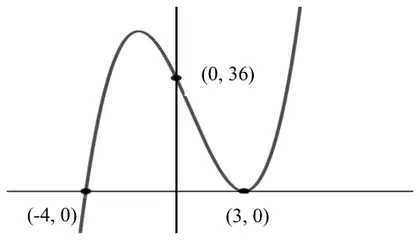
| Scheme | Marks |
|---|---|
| A positive cubic shape. Its position is not important but must be a curve and not straight lines and the “ends” must not clearly turn back in on themselves. | B1 |
| Touches at the point (3, 0) (could be a maximum). Accept 3 marked on the \(x\)-axis and accept (0, 3) as long as it is in the correct place. Allow (3, 0) in the body of the script but it must correspond with the sketch. If ambiguous, the sketch takes precedence. | B1 |
| Crosses or reaches the \(x\)-axis at \(\left(-4, 0\right)\). Accept \(-4\) marked on the \(x\)-axis and accept (0, -4) as long as it is in the correct place. FT on their \(-A\) from part (b) and allow “–\(A\)” and allow a “made up” \(A\). Allow \(\left(-4, 0\right)\) in the body of the script but it must correspond with the sketch. If ambiguous, the sketch takes precedence. | B1ft |
| Crosses the \(y\)-axis at (0, 36) and with a maximum in the second quadrant. Accept 36 marked on the \(y\) – axis and accept (36, 0) as long as it is in the correct place. FT on their numerical ‘\(c\)’ from part (a) only. Allow (0, 36) in the body of the script but it must correspond with the sketch. If ambiguous, the sketch takes precedence. | B1ft |
| (4) | |
| (12 marks) |