
October 2021 Paper 1 Q7
7 The diagram shows part of a curve which passes through the point (1, 0).
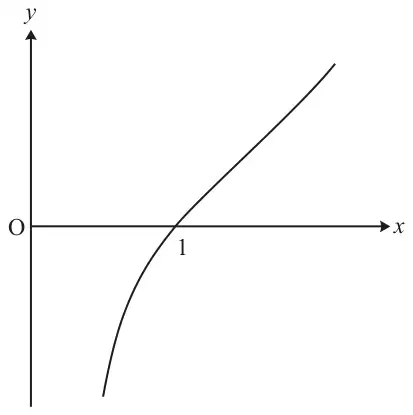
The gradient of the curve is given by \(\dfrac{\mathrm{d}y}{\mathrm{d}x} = 6x + \dfrac{8}{x^3}\).
Determine whether the curve passes through the point (2, 12). [6]
| Scheme | Marks | AO |
|---|---|---|
| \(y = \displaystyle\int \left(6x + \frac{8}{x^3}\right) \mathrm{d}x = \int \left(6x + 8x^{-3}\right) \mathrm{d}x\) | M1 | 2.1 |
| \(= 6 \times \dfrac{x^2}{2} + 8 \times \dfrac{x^{-2}}{-2} + c\) | A1 | 1.1 |
| When \(x = 1,\ y = 0\) \(0 = 3 \times 1^2 - 4 \times 1^{-2} + c\) giving \(c = 1\) | M1 | 2.1 |
| So \(y = 3x^2 - 4x^{-2} + 1\) | A1 | 1.1 |
| When \(x = 2,\ y = 3 \times 2^2 - 4 \times 2^{-2} + 1 = 12 - 1 + 1 = 12\) | M1 | 2.1 |
| So the point (2, 12) lies on the curve. | E1 | 2.2a |
| [6] |
Notes
M1: Attempt to integrate with a negative power. Condone missing \(+c\)
A1: First two terms correct. Condone missing \(+c\)
M1: Attempt to evaluate \(c\)
A1: Correct equation for the curve soi
M1: Using \(x = 2\) in their non-linear equation
E1: Conclusion from their \(y\)-value FT