
C1 June 2007 Q9
9. The curve \(C\) with equation \(y = \mathrm{f}(x)\) passes through the point \((5, 65)\).
Given that \(\mathrm{f}^{\prime}(x) = 6x^2 - 10x - 12\),
| Scheme | Marks |
|---|---|
| \(\mathrm{f}(x) = \dfrac{6x^3}{3} - \dfrac{10x^2}{2} - 12x \quad (+C)\) | M1 A1 |
| \(x = 5: \qquad 250 - 125 - 60 + C = 65 \qquad C = 0\) | M1 A1 |
| (4) |
Notes
1st M1: for attempting to integrate, \(x^n \to x^{n+1}\)
1st A1: for all \(x\) terms correct, need not be simplified. Ignore \(+\,C\) here.
2nd M1: for some use of \(x = 5\) and \(\mathrm{f}(5) = 65\) to form an equation in \(C\) based on their integration.
There must be some visible attempt to use \(x = 5\) and \(\mathrm{f}(5) = 65\). No \(+C\) is M0.
2nd A1: for \(C = 0\). This mark cannot be scored unless a suitable equation is seen.
| Scheme | Marks |
|---|---|
| \(x\left(2x^2 - 5x - 12\right)\) or \(\left(2x^2 + 3x\right)(x - 4)\) or \((2x + 3)\left(x^2 - 4x\right)\) | M1 |
| \(= x(2x + 3)(x - 4) \qquad (*)\) | A1cso |
| (2) |
Notes
M1: for attempting to take out a correct factor or to verify. Allow usual errors on signs.
They must get to the equivalent of one of the given partially factorised expressions or, if verifying, \(x\left(2x^2 + 3x - 8x - 12\right)\) i.e. with no errors in signs.
A1cso: for proceeding to printed answer with no incorrect working seen. Comment not required.
This mark is dependent upon a fully correct solution to part (a) so M1A1M0A0M1A0 for (a) & (b).
Will be common or M1A1M1A0M1A0. To score 2 in (b) they must score 4 in (a).
| Scheme | Marks |
|---|---|
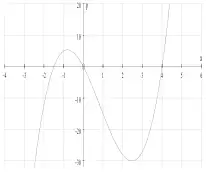
| Shape | B1 |
| Through origin | B1 |
| \(\left(-\dfrac{3}{2}, 0\right)\) and \((4, 0)\) | B1 |
| (3) | |
| (9 marks) |
Notes
1st B1: for positive \(x^3\) shaped curve (with a max and a min) positioned anywhere.
2nd B1: for any curve that passes through the origin (B0 if it only touches at the origin)
3rd B1: for the two points clearly given as coords or values marked in appropriate places on \(x\) axis.
Ignore any extra crossing points (they should have lost first B1).
Condone (1.5, 0) if clearly marked on –ve \(x\)-axis. Condone (0, 4) etc if marked on +ve \(x\) axis.
Curve can stop (i.e. not pass through) at (-1.5, 0) and (4, 0).
A point on the graph overrides coordinates given elsewhere.