
C2 June 2015 Q6
6.
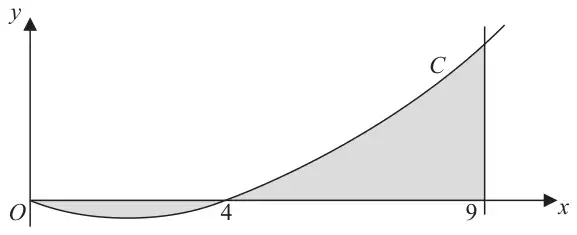
Figure 2 shows a sketch of part of the curve \(C\) with equation\[y = 10x\left(x^{\frac{1}{2}} - 2\right), \quad x \geqslant 0\]
The curve \(C\) starts at the origin and crosses the \(x\)-axis at the point \((4, 0)\).
The area, shown shaded in Figure 2, consists of two finite regions and is bounded by the curve \(C\), the \(x\)-axis and the line \(x = 9\)
| Scheme | Marks |
|---|---|
| May mark (a) and (b) together | |
| Expands to give \(10x^{\frac{3}{2}} - 20x\) | B1 |
| Integrates to give \(\dfrac{10}{\text{"}\frac{5}{2}\text{"}}x^{\text{"}\frac{5}{2}\text{"}} + \dfrac{-\text{"}20\text{"}x^2}{2}\ (+c)\) | M1 A1ft |
| Simplifies to \(4x^{\frac{5}{2}} - 10x^2 (+c)\) | A1cao |
| (4) |
Notes
(a) B1: Expands the bracket correctly
M1: Correct integration process on at least one term after attempt at multiplication. (Follow correct expansion or one slip resulting in \(10x^k - 20x\) where \(k\) may be \(\tfrac{1}{2}\) or \(\tfrac{5}{2}\) or resulting in \(10x^{\frac{3}{2}} - Bx\), where \(B\) may be 2 or 5)
So \(x^{\frac{3}{2}} \to \dfrac{x^{\frac{5}{2}}}{\frac{5}{2}}\) or \(x^{\frac{1}{2}} \to \dfrac{x^{\frac{3}{2}}}{\frac{3}{2}}\) or \(x^{\frac{5}{2}} \to \dfrac{x^{\frac{7}{2}}}{\frac{7}{2}}\) and/or \(x \to \dfrac{x^2}{2}\).
A1: Correct unsimplified follow through for both terms of their integration. Does not need (+ \(c\))
A1: Must be simplified and correct– allow answer in scheme or \(4x^{2\frac{1}{2}} - 10x^2\). Does not need (+ \(c\) )
| Scheme | Marks |
|---|---|
| Use limits 0 and 4 either way round on their integrated function (may only see 4 substituted) | M1 |
| Use limits 4 and 9 either way round on their integrated function | dM1 |
| Obtains either \(\pm -32\) or \(\pm 194\) needs at least one of the previous M marks for this to be awarded | A1 |
| (So area \(= \left|\displaystyle\int_0^4 y\,\mathrm{d}x\right| + \int_4^9 y\,\mathrm{d}x\) ) i.e. \(32 + 194, = 226\) | ddM1,A1 |
| (5) | |
| [9] |
Notes
(b) M1: (does not depend on first method mark) Attempt to substitute 4 into their integral (however obtained but must not be differentiated) or seeing their evaluated number (usually 32) is enough – do not need to see minus zero.
dM1: (depends on first method mark in (a)) Attempt to subtract either way round using the limits 4 and 9
\(A \times 9^{\frac{5}{2}} - B \times 9^2\) with \(A \times 4^{\frac{5}{2}} - B \times 4^2\) is enough – or seeing 162 –( -32) {but not 162 – 32 }
A1: At least one of the values ( 32 and 194) correct (needs just one of the two previous M marks in (b)) or may see 162 + 32 + 32 or 162 + 64 or may be implied by correct final answer if not evaluated until last line of working
ddM1: Adds 32 and 194 (may see 162 + 32 + 32 or may be implied by correct final answer if not evaluated until last line of working). This depends on everything being correct to this point.
A1cao: Final answer of 226 not ( - 226)
Common errors: \(4 \times 4^{\frac{5}{2}} - 10 \times 4^2 + 4 \times 9^{\frac{5}{2}} - 10 \times 9^2 - 4 \times 4^{\frac{5}{2}} - 10 \times 4^2 = \pm 162\) obtains M1 M1 A0 (neither 32 nor 194 seen and final answer incorrect) then M0 A0 so 2/5
Uses correct limits to obtain -32 +162 +32 = +/-162 is M1 M1 A1 (32 seen) M0 A0 so 3/5
Special case: In part (b) Uses limits 9 and 0 = 972 – 810 - 0 = 162 M0 M1 A0 M0A0 scores 1/5
This also applies if 4 never seen.