
C2 June 2013 (R) Q7
7.
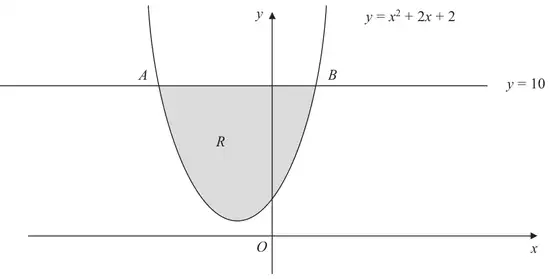
The line with equation \(y = 10\) cuts the curve with equation \(y = x^2 + 2x + 2\) at the points \(A\) and \(B\) as shown in Figure 1. The figure is not drawn to scale.
The shaded region \(R\) is bounded by the line with equation \(y = 10\) and the curve as shown in Figure 1.
| Scheme | Marks |
|---|---|
| \(x^2 + 2x + 2 = 10 \Rightarrow x^2 + 2x - 8 = 0\) ( so \((x + 4)(x - 2) = 0\) ) \(\Rightarrow x = \ldots\ldots..\) | M1 |
| \(x = -4,\ 2\) | A1 |
| (2) |
Notes
M1 Set the curve equation equal to 10 and collect terms. Solves quadratic to \(x = \ldots..\)
A1 cao : Both values correct – allow \(A = -4\), \(B = 2\)
| Scheme | Marks |
|---|---|
| Way 1 | |
| \(\displaystyle\int\left(x^2 + 2x + 2\right)\mathrm{d}x = \frac{x^3}{3} + \frac{2x^2}{2} + 2x\ (+C)\) | M1A1A1 |
| \(\left[\dfrac{x^3}{3} + \dfrac{2x^2}{2} + 2x\right]_{\text{"}-4\text{"}}^{\text{"}2\text{"}} = \left(\dfrac{8}{3} + \dfrac{8}{2} + 4\right) - \left(-\dfrac{64}{3} + \dfrac{32}{2} - 8\right) \quad (= 24)\) | M1 |
| Rectangle: \(10 \times (2 - -4) = 60\) | B1 cao |
| \(R = \text{"}60\text{"} - \text{"}24\text{"}\) | M1 |
| \(= 36\) | A1 |
| (7) | |
| Total 9 |
(b) Way 2
| Scheme | Marks |
|---|---|
| \(\displaystyle\int\left(8 - x^2 - 2x\right)\mathrm{d}x = 8x - \frac{x^3}{3} - \frac{2x^2}{2}\ (+C)\) | M1 A1ft A1 |
| \(\left[8x - \dfrac{x^3}{3} - \dfrac{2x^2}{2}\right]_{\text{"}-4\text{"}}^{\text{"}2\text{"}} = \left(16 - \dfrac{8}{3} - 4\right) - \left(-32 + \dfrac{64}{3} - 16\right) = (9.3 - (-26.7))\) | M1 |
| Implied by final answer of 36 after correct work | B1 |
| \(10 - \left(x^2 + 2x + 2\right) = 8 - x^2 - 2x,\ = 36\) | M1, A1 |
Notes
M1: One correct integration
A1: Two correct integrations( ft slips subtracting in Way 2)
A1: All 3 terms correct (penalise subtraction errors here in Way 2)
M1: Substitute their limits from (a) into the integrated function and subtract (either way round)
B1: Way 1:Find area under the line by integration or area of rectangle – should be 60 here (no follow through)
Way 2: (implied by final correct answer in second method)
M1: Subtract one area from the other (implied by subtraction of functions in second method)- award even after differentiation
A1: Must be 36 not \(-36\).
Special case 1: Combines both methods. Uses Way 2 integration, but continues after reaching “36”to subtract “36” from rectangle giving answer as “24” This loses final M1 A1
Special case 2: Integrates \(\left(x^2 + 2x - 8\right)\) between limits \(-4\) and 2 to get -36 and then changes sign and obtains 36. Do not award final A mark – so M1A1A1M1B1M1A0
If the answer is left as -36, then M1A1A1M1B0M1A0
N.B. Allow full marks for modulus used earlier in working e.g. \(\left|\displaystyle\int_{-4}^{2} x^2 + 2x + 2\,\mathrm{d}x - \int_{-4}^{2} 10\,\mathrm{d}x\right|\) (corrected from the printed mark scheme, which shows \(x^2 + 2x - 2\) here)