4.In this question you must show all stages of your working. Solutions relying entirely on calculator technology are not acceptable.
A fixed point \(O\) lies on a straight line.
A particle \(P\) moves along the straight line.
At time \(t\) seconds, \(t \geqslant 0\), the distance, \(s\) metres, of \(P\) from \(O\) is given by
\[s = 2t^3 - 12t^2 + 18t\]
(a) Find the values of \(t\) for which \(P\) is instantaneously at rest. (4)
(b) Find the total distance travelled by \(P\) in the interval \(0 \leqslant t \leqslant 4\) (3)
(c) Find the maximum speed of \(P\) in the interval \(1 \leqslant t \leqslant 3\) (3)
Mark scheme (a)
Scheme
Marks
AO
N.B. In this question you must show all stages of your working. Solutions relying entirely on calculator technology are not acceptable.
Differentiate \(s\) with respect to \(t\)
M1
1.1b
\((v =)\ 6t^2 - 24t + 18\)
A1
1.1b
Equate their \(v\) to 0 and solve for \(t\)
M1
1.1b
\(t = 1\) or \(t = 3\)
A1
1.1b
(4)
Notes
M1: Differentiate, with at least 2 powers decreasing by 1
A1: Correct expression
M1: Solve a 3 term quadratic \(= 0\), obtained by differentiating \(s\). N.B. Must see some working for this as a calculator solution is not permitted.
A1: cao
Mark scheme (b)
Scheme
Marks
AO
Finds values of \(s\) for \(t = 4\) and their two values of \(t\), in the interval \(0 \leqslant t \leqslant 4\). Their \(t\) values must have come from solving \(v = 0\), a 3 term quadratic. \((s_1 = 8,\ s_3 = 0,\ s_4 = 8\) are the actual values\()\) Could be seen or implied by at least 2 correct \(s\) values for their \(t\) values. Could see: \(f(1),\ f(3),\ f(4)\) where \(f(t) = \displaystyle\int 6t^2 - 24t + 18\ \mathrm{d}t\) but must see this integrated before the substitution. N.B. M0 if one of their two values is not in the interval \(0 \leqslant t \leqslant 4\) Ignore any extra values of \(s\) found.
M1
1.1b
Total distance \(= \big(s_1(-s_0)\big) + (s_1 - s_3) + (s_4 - s_3)\) oe Could see: \(\big[f(t)\big]_0^1 - \big[f(t)\big]_1^3 + \big[f(t)\big]_3^4\) evaluated OR e.g. \(= \big(s_1(-s_0)\big) + (s_1 - s_2) + (s_2 - s_3) + (s_4 - s_3)\)
M1
2.1
\(= 24\ (\mathrm{m})\)
A1
1.1b
(3)
Notes
M1: Clear attempt to find the relevant \(s\) values, ignoring any extras.. Condone if they integrate their \(v\) and obtain an incorrect expression for \(s\).
M1: Correct use of their \(s\) values to find the required distance.
A1: Correct only
Mark scheme (c)
Scheme
Marks
AO
Attempt to find the value of \(t\) for the maximum speed
e.g. by using the symmetry of the function N.B. this can be implied by use of \(t = 2\) to find MAX \(v\).
OR by differentiating \(v\) with respect to \(t\), equating to 0 and solving for \(t\)
OR by completing the square: \(v = 6(t - 2)^2 - 6\)
M1
2.1
\(t = 2\), seen or implied
A1
1.1b
\(v = 6\ (\mathrm{m\,s^{-1}})\) Must be positive.
A1
1.1b
N.B. \(t = 2,\ v = 6\) only, with no working, scores M1A1A1 \(t = 2\) only with no working, is M1A1A0 \(v = 6\) only with no working can score M1A1A1 \((2,\ -6)\) only scores M0.
(3)
(10 marks)
Notes
M1: Any complete method to obtain \(t\) \((a = 12t - 24 = 0 \to t = 2)\)
A1: Seen or implied e.g. in \(6(t - 2)^2 - 6\)
A1: Correct only.
N.B. The first 2 marks can be scored if they are using \(v = t^2 - 4t + 3\)
A1 Correct integration (accept without constant of integration and unsimplified)
DM1 Correct use of ‘limits’, seen or implied. \(\left(2^2 - \dfrac{14}{3} \times 2^{\frac{3}{2}} + 6 \times 2\ (+C)\right) - \left(1^2 - \dfrac{14}{3} \times 1^{\frac{3}{2}} + 6 \times 1\ (+C)\right)\) Condone missing second pair of brackets for this mark N.B. Allow the subtraction the other way round and the use of decimals.
A1* \(= \dfrac{(48 - 28\sqrt{2})}{3} - \dfrac{7}{3} = \dfrac{(41 - 28\sqrt{2})}{3}\ *\) Obtain given answer from correct working including correct use of brackets, with at least one more line of working, including a term in \(\sqrt{2}\). Not available if they use decimals.
In this question you must show all stages of your working.
Solutions relying entirely on calculator technology are not acceptable.
A fixed point \(O\) lies on a straight line.
A particle \(P\) moves along the straight line such that at time \(t\) seconds, \(t \geqslant 0\), after passing through \(O\), the velocity of \(P\), \(v\ \mathrm{m\,s^{-1}}\), is modelled as
\[v = 15 - t^2 - 2t\]
(a) Verify that \(P\) comes to instantaneous rest when \(t = 3\) (1)
(b) Find the magnitude of the acceleration of \(P\) when \(t = 3\) (3)
(c) Find the total distance travelled by \(P\) in the interval \(0 \leqslant t \leqslant 4\) (4)
Mark scheme (a)
Scheme
Marks
AO
\(15 - 3^2 - 2 \times 3 = 0\ *\)
B1*
1.1b
(1)
Notes
B1* Correct expression, correctly evaluated to give 0 OR \(0 = 15 - t^2 - 2t\) \(t = 3\)
Mark scheme (b)
Scheme
Marks
AO
Differentiate \(v\) wrt \(t\)
M1
2.1
\(-2t - 2\)
A1
1.1b
8 \((\mathrm{m\,s^{-2}})\)
A1
1.1b
(3)
Notes
M1 Differentiate \(v\), with at least two powers decreasing by 1
A1 Correct expression
A1 cao (must be positive)
N.B. If they give 8 as their answer, without any working, this can score all 3 marks.
OR \(s_3 + (s_3 - s_4)\) where \(s_3\) means the value of their integral when \(t = 3\). N.B. Allow the negative of this.
M1
3.1a
\(\dfrac{94}{3}\) (m)
A1
1.1b
(4)
(8 marks)
Notes
M1 Integrate \(v\), with at least two powers increasing by 1 (allow if only two terms integrated) .
A1 Correct expression. Ignore (\(+ C\))
M1 Complete method to find the total distance or displacement
A1 Accept 31(m) or better, must be positive
N.B. If the indefinite integral (\(15t - \dfrac{1}{3}t^3 - t^2\)) is never seen, they score nothing, even if the correct answer appears, as this indicates they have used a calculator to do the whole question.
At time \(t\) seconds, \(t \geqslant 0\), the distance, \(s\) metres, of \(P\) from \(O\) is given by
\[s = \frac{1}{3}t^3 - \frac{5}{2}t^2 + 6t\]
(a) Find the acceleration of \(P\) at each of the times when \(P\) is at instantaneous rest. (6)
(b) Find the total distance travelled by \(P\) in the interval \(0 \leqslant t \leqslant 4\) (3)
Mark scheme (a)
Scheme
Marks
AO
Differentiate \(s\) wrt \(t\)
M1
3.1a
\((v =)\ t^2 - 5t + 6\)
A1
1.1b
Equate their \(v\) to 0 and solve
M1
1.1b
\(t = 2\) or 3
A1
1.1b
\((a =)\ 2t - 5\)
B1ft
2.1
\(a = 1\) and \(-1\) (m s−2) isw (A0 if extras)
A1
1.1b
(6)
Notes
M1 Differentiate, with at least 2 powers decreasing by 1
A1 Correct expression
M1 Must have attempted to differentiate \(s\) to find \(v\) and be solving a 3 term quadratic
A1 Both values needed
B1ft Follow their \(v\) (must be differentiating)
A1 cao
Mark scheme (b)
Scheme
Marks
AO
Attempt to find values of \(s\) for \(t = 2\), 3 and 4 oe Correct values are \(\left(s_2 = \dfrac{14}{3},\ s_3 = \dfrac{9}{2} \text{ and } s_4 = \dfrac{16}{3}\right)\) Could be implied by correct values for: \(s_2\), \((s_3 - s_2)\) and \((s_4 - s_3)\) which are \(\dfrac{14}{3}\), \(\left(-\dfrac{1}{6}\right)\) and \(\dfrac{5}{6}\)
DM1This mark is dependent on the 2nd M1 in part (a) and their \(t\) values are between 0 and 4. Clear attempt to find all three \(s\) values (may integrate their \(v\) incorrectly) N.B. No penalty for extra values.
M1 Complete method using their \(s\) values Do NOT condone sign errors.
A1 Any equivalent fraction, 5.7 or better.
S.C. Correct answer, with no working, scores all 3 marks, since \(\displaystyle\int_0^4 \left|t^2 - 5t + 6\right|\,\mathrm{d}t\) entered on a calculator will give \(\dfrac{17}{3}\)
M1: Differentiate, with both powers decreasing by 1
A1: Correct expression
Mark scheme (b)
Scheme
Marks
AO
Solve problem using \(v = 0\) when \(t = 6\)
M1
3.1a
\(0 = 10t - t^2 - 24\)
A1
1.1b
Solve quadratic oe to find other value of \(t\)
M1
1.1b
\(t = 4\)
A1
1.1b
(4)
Notes
M1: Put \(t = 6\) OR use \((t - 6)(t - x) = t^2 - 10t + k\) oe
A1: Correct expression (unsimplified) for \(v\) OR \(v = -(t - 6)(t - 4)\) (corrected from the printed mark scheme: printed as \(v = (t - 6)(t - 4)\), which has the wrong sign)
M1: Put \(v = 0\) to give quadratic in \(t\) and solve for other value of \(t\)
3. A particle \(P\) moves along a straight line such that at time \(t\) seconds, \(t \geqslant 0\), after leaving the point \(O\) on the line, the velocity, \(v\ \mathrm{m\,s^{-1}}\), of \(P\) is modelled as
\[v = (7 - 2t)(t + 2)\]
(a) Find the value of \(t\) at the instant when \(P\) stops accelerating. (4)
(b) Find the distance of \(P\) from \(O\) at the instant when \(P\) changes its direction of motion. (5)
In this question, solutions relying on calculator technology are not acceptable.
Mark scheme (a)
Scheme
Marks
AO
\(v = 3t - 2t^2 + 14\) and differentiate
M1
3.1a
\(a = \dfrac{\mathrm{d}v}{\mathrm{d}t} = 3 - 4t\) or \((7 - 2t) - 2(t + 2)\) using product rule
A1
1.1b
\(3 - 4t = 0\) and solve for \(t\)
M1
1.1b
\(t = \dfrac{3}{4}\) oe
A1
1.1b
(4)
Notes
M1 Multiply out and attempt to differentiate, with at least one power decreasing
A1 Correct expression
M1 Equate their \(a\) to 0 and solve for \(t\)
A1 cao
Mark scheme (b)
Scheme
Marks
AO
Solve problem using \(v = 0\) to find a value of \(t\) \(\left(t = \dfrac{7}{2}\right)\)
M1
3.1a
\(v = 3t - 2t^2 + 14\) and integrate
M1
1.1b
\(s = \dfrac{3t^2}{2} - \dfrac{2t^3}{3} + 14t\)
A1
1.1b
Substitute \(t = \dfrac{7}{2}\) into their \(s\) expression (M0 if using suvat)
3. A particle, \(P\), moves along a straight line such that at time \(t\) seconds, \(t \geqslant 0\), the velocity of \(P\), \(v\ \mathrm{m\,s^{-1}}\), is modelled as\[v = 12 + 4t - t^2\]
Find
(a) the magnitude of the acceleration of \(P\) when \(P\) is at instantaneous rest, (5)
(b) the distance travelled by \(P\) in the interval \(0 \leqslant t \leqslant 3\) (3)
8. A particle, \(P\), moves along the \(x\)-axis. At time \(t\) seconds, \(t \geqslant 0\), the displacement, \(x\) metres, of \(P\) from the origin \(O\), is given by \(x = \dfrac{1}{2}t^2\left(t^2 - 2t + 1\right)\)
(a) Find the times when \(P\) is instantaneously at rest. (5)
(b) Find the total distance travelled by \(P\) in the time interval \(0 \leqslant t \leqslant 2\) (3)
(c) Show that \(P\) will never move along the negative \(x\)-axis. (2)
Mark scheme (a)
Scheme
Marks
AO
Multiply out and differentiate wrt to time (or use of product rule i.e. must have two terms with correct structure)
M1
1.1a
\(v = 2t^3 - 3t^2 + t\)
A1
1.1b
\(2t^3 - 3t^2 + t = 0\) and solve: \(t(2t - 1)(t - 1) = 0\)
DM1
1.1b
\(t = 0\) or \(t = \dfrac{1}{2}\) or \(t = 1\); any two
A1
1.1b
All three
A1
1.1b
(5)
Notes
M1: Must have 3 terms and at least two powers going down by 1
A1: A correct expression
DM1: Dependent on first M, for equating to zero and attempting to solve a cubic
A1: Any two of the three values (Two correct answers can imply a correct method)
A1: The third value
Mark scheme (b)
Scheme
Marks
AO
Find \(x\) when \(t = 0, \dfrac{1}{2}, 1\) and 2 : \(\left(0, \dfrac{1}{32}, 0, 2\right)\)
M1
2.1
Distance \(= \dfrac{1}{32} + \dfrac{1}{32} + 2\)
M1
2.1
\(2\dfrac{1}{16}\) (m) oe or 2.06 or better
A1
1.1b
(3)
Notes
M1: For attempting to find the values of \(x\) (at least two) at their \(t\) values found in (a) or at \(t = 2\) or equivalent e.g. they may integrate their \(v\) and sub in at least two of their \(t\) values
M1: Using a correct strategy to combine their distances (must have at least 3 distances)
A1: \(2\dfrac{1}{16}\) (m) oe or 2.06 or better
Mark scheme (c)
Scheme
Marks
AO
\(x = \dfrac{1}{2}t^2(t - 1)^2\)
M1
3.1a
\(\dfrac{1}{2}\) perfect square so \(x \geqslant 0\) i.e. never negative
A1 cso
2.4
(2)
(10 marks)
Notes
M1: Identify strategy to solve the problem such as: (i) writing \(x\) as \(\dfrac{1}{2} \times\) perfect square (ii) or using \(x\) values identified in (b). (iii) or using calculus i.e. identifying min points on \(x\)–\(t\) graph. (iv) or using \(x\)-\(t\) graph.
A1 cso: Fully correct explanation to show that \(x \geqslant 0\) i.e. never negative
16 A toy remote control speed boat is launched from one edge of a small pond and moves in a straight line across the pond’s surface.
The boat’s velocity, \(v\) m s−1, is modelled in terms of time, \(t\) seconds after the boat is launched, by the expression
\[v = 0.9 + 0.16t - 0.06t^2\]
(a) Find the acceleration of the boat when \(t = 2\) [3 marks]
(b) Find the displacement of the boat, from the point where it was launched, when \(t = 2\) [4 marks]
Mark scheme (a)
Scheme
Marks
AO
Differentiates to find expression for acceleration with at least one term correct. PI by −0.08 or 0.08
M1
3.4
Obtains a fully correct expression for acceleration. PI by −0.08
A1
1.1b
Finds their acceleration of the boat when \(t = 2\) FT their expression for \(a\) Must have differentiated at least one term. Correct units must be stated.
A1F
3.2a
(3)
Typical solution
\[a = 0.16 - 0.12t\]
\(a = -0.08\) ms−2
Mark scheme (b)
Scheme
Marks
AO
Integrates \(v\) with at least one term correct. PI by 1.96
M1
3.1b
Obtains a fully correct integral. Condone omission of constant PI by 1.96
A1
1.1b
Substitutes \(t = 0\) and \(t = 2\) into their expression for \(s\) Must have integrated at least one term. PI by 1.96
14 A particle, P, is moving along a straight line such that its acceleration \(a\) m s−2, at any time, \(t\) seconds, may be modelled by\[a = 3 + 0.2t\]
When \(t = 2\), the velocity of P is \(k\) m s−1
(a) Show that the initial velocity of P is given by the expression \((k - 6.4)\) m s−1[4 marks]
(b) The initial velocity of P is one fifth of the velocity when \(t = 2\)
Find the value of \(k\). [2 marks]
Mark scheme (a)
Scheme
Marks
AO
Integrates given expression to find \(v\) with at least one term correct
M1
3.4
Obtains an expression for \(v\) with both terms correct condone omission of \(+\,c\)
A1
1.1b
Substitutes \(t = 2\) and \(v = k\) into their integrated expression (must include constant of integration)
M1
1.1a
Completes rigorous argument with no slips to obtain \(v = k - 6.4\) when \(t = 0\)
R1
2.1
(4)
Typical solution
\[v = \int a\,dt\]\[= 3t + 0.1t^2 + c\]
When \(t = 2\), \(v = k\)
\[k = 6 + 0.4 + c\]\[c = k - 6.4\]\[v = 3t + 0.1t^2 + k - 6.4\]
Since \(v = c\) when \(t = 0\) the initial velocity is \(k - 6.4\)
Mark scheme (b)
Scheme
Marks
AO
Forms equation using \(k\), \(k - 6.4\), and 0.2 or 5
13 A car, starting from rest, is driven along a horizontal track.
The velocity of the car, \(v\) m s−1, at time \(t\) seconds, is modelled by the equation\[v = 0.48t^2 - 0.024t^3 \quad \text{for } 0 \leqslant t \leqslant 15\]
(a) Find the distance the car travels during the first 10 seconds of its journey. [3 marks]
(b) Find the maximum speed of the car.
Give your answer to three significant figures. [4 marks]
(c) Deduce the range of values of \(t\) for which the car is modelled as decelerating. [2 marks]
Mark scheme (a)
Scheme
Marks
AO
Integrates given velocity equation, with at least one term correct PI
M1
3.4
Obtains fully correct integral PI
A1
1.1b
Substitutes correct limits to obtain correct answer. CAO. Condone omission of units.
9 An athlete runs with velocity \(v\,\mathrm{m\,s^{-1}}\) along a horizontal straight running track \(AB\). At time \(t\) seconds after passing \(A\), \(v = 0.05t^2 - 0.4t + k\), where \(k\) is a constant.
(a) Find the acceleration of the athlete when \(t = 6\). [2]
(b) Given that the minimum velocity of the athlete is \(6.6\,\mathrm{m\,s^{-1}}\), show that \(k = 7.4\). [3]
The athlete runs in a straight line from \(A\) to \(B\) in 13.1 seconds.
M1: Correct integral expression for the required distance or attempt to integrate – at least one term with power increased by 1 and a change in coefficient of that term, and use of 13.1 (0 may be implied) which indicates that they are trying to do the correct integral Can be implied by correct answer
11 A man \(P\) runs in a straight line from \(O\) to \(A\), leaving \(O\) at time \(t = 0\). At time \(t\) seconds his velocity \(v\,\mathrm{m\,s^{-1}}\) is given by \(v = 5 + 0.003t^2\).
Another man \(Q\) runs from \(O\) to \(A\) at a constant speed of \(7.08\,\mathrm{m\,s^{-1}}\), starting 5 seconds after \(P\).
(a) Show that the times \(T\,\mathrm{s}\) when \(P\) and \(Q\) are the same distance from \(O\) satisfy the equation \[T^3 - 2080T + 35400 = 0.\] [5]
(b)In this question you must show detailed reasoning.
As they run from \(O\) to \(A\) there are two times at which \(P\) and \(Q\) are the same distance from \(O\). The second of these is when \(T = 30\).
Find the acceleration of \(P\) at the first of these times. [5]
M1*: Attempt to integrate given expression for \(v\) (either one term correct or both powers increased by 1)
B1: Correct expression for the displacement of \(Q\)
M1dep*: Equate integrated expression from given \(v\) and \(7.08(t \pm 5)\) only Allow \(t\) for \(T\)
A1:AG - sufficient working must be shown (e.g. at least one line of working from setting correct (un-simplified) expressions equal to each other to obtaining the given answer)
M1*: Factorising given cubic equation using given linear factor and obtaining a three-term quadratic factor of the form \((T^2 + kT - 1180)\) for some \(k \neq 0\) Or obtains a three-term quadratic from using long division (errors in working may mean the remainder is not zero)
A1: Correct quadratic expression
A1: Correct value of \(T\) (so not the negative value or 30) Condone lack of explicitly rejecting negative root \((-52.48\ldots)\)
B1: Correct expression for the acceleration of \(P\) at time \(t\)
10 A particle \(P\) is moving in a straight line. At time \(t\) seconds, where \(t \geqslant 0\), \(P\) has velocity \(v\,\mathrm{m\,s^{-1}}\) and acceleration \(a\,\mathrm{m\,s^{-2}}\) where \(a = 4t - 9\). It is given that \(v = 2\) when \(t = 1\).
(a) Find an expression for \(v\) in terms of \(t\). [3]
The particle \(P\) is instantaneously at rest when \(t = t_1\) and \(t = t_2\), where \(t_1 \lt t_2\).
(b) Find the values of \(t_1\) and \(t_2\). [2]
(c) Determine the total distance travelled by \(P\) between times \(t = 0\) and \(t = t_2\). [3]
A particle \(P\) moves along the \(x\)-axis. At time \(t\) seconds, where \(t \geqslant 0\), the velocity of \(P\) in the positive \(x\)-direction is \(v\,\mathrm{m\,s^{-1}}\). It is given that \(v = t(t - 3)(8 - t)\).
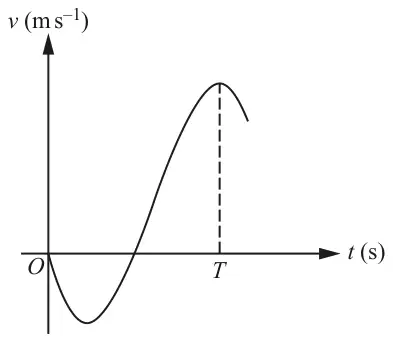
\(P\) attains its maximum velocity at time \(T\) seconds. The diagram shows part of the velocity-time graph for the motion of \(P\).
(a) State the acceleration of \(P\) at time \(T\). [1]
(b)In this question you must show detailed reasoning.
Determine the value of \(T\). [5]
(c) Find the total distance that \(P\) travels between times \(t = 0\) and \(t = T\). [3]
Mark scheme (a)
Scheme
Marks
AO
\(0\ (\mathrm{m\,s^{-2}})\)
B1
1.2
[1]
Mark scheme (b)
Scheme
Marks
AO
DR \(v = t\left(-t^2 + 11t - 24\right)\) \(\Rightarrow v = -t^3 + 11t^2 - 24t\)
A particle \(P\) moves in a straight line. At time \(t\) seconds, where \(t \geqslant 0\), the velocity of \(P\) is \(v\,\mathrm{m\,s^{-1}}\). It is given that \(v = -3t^2 + 24t + k\), where \(k\) is a positive constant.
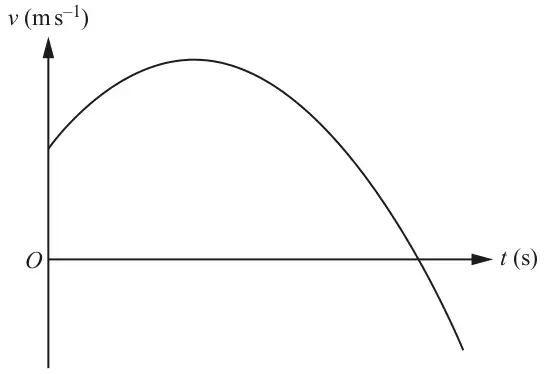
The diagram shows the velocity-time graph for the motion of \(P\).
\(P\) attains its maximum velocity at time \(T\) seconds. Given that the distance travelled by \(P\) between times \(t = 1\) and \(t = T\) is \(297\,\mathrm{m}\), determine the time when \(P\) is instantaneously at rest. [7]
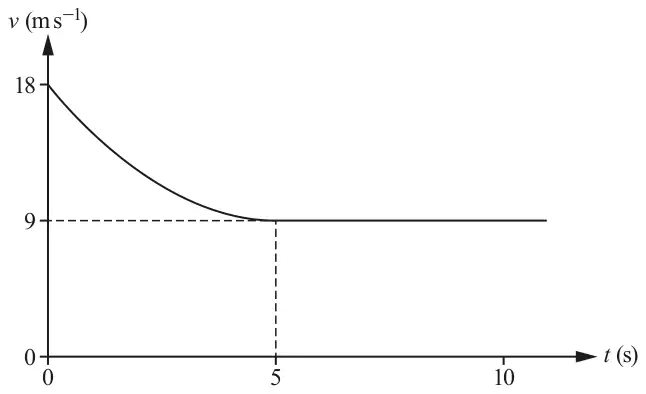
The diagram shows the velocity-time graph modelling the velocity of a car as it approaches, and drives through, a residential area.
The velocity of the car, \(v\,\text{m}\,\text{s}^{-1}\), at time \(t\) seconds for the time interval \(0 \leqslant t \leqslant 5\) is modelled by the equation \(v = pt^2 + qt + r\), where \(p\), \(q\) and \(r\) are constants.
It is given that the acceleration of the car is zero at \(t = 5\) and the speed of the car then remains constant.
(a) Determine the values of \(p\), \(q\) and \(r\). [5]
(b) Calculate the distance travelled by the car from \(t = 2\) to \(t = 10\). [3]
Mark scheme (a)
Scheme
Marks
AO
\(v = pt^2 + qt + r\) \(t = 0, v = 18 \Rightarrow r = 18\)
A particle \(P\) is moving along a straight line with constant acceleration. Initially the particle is at \(O\). After \(9\,\text{s}\), \(P\) is at a point \(A\), where \(OA = 18\,\text{m}\) (see diagram) and the velocity of \(P\) at \(A\) is \(8\,\text{m}\,\text{s}^{-1}\) in the direction \(\overrightarrow{OA}\).
(i)
(a) Show that the initial speed of \(P\) is \(4\,\text{m}\,\text{s}^{-1}\). [2]
(b) Find the acceleration of \(P\). [2]
\(B\) is a point on the line such that \(OB = 10\,\text{m}\), as shown in the diagram.
(ii) Show that \(P\) is never at point \(B\). [4]
A second particle \(Q\) moves along the same straight line, but has variable acceleration. Initially \(Q\) is at \(O\), and the displacement of \(Q\) from \(O\) at time \(t\) seconds is given by
\[x = at^3 + bt^2 + ct,\]
where \(a\), \(b\) and \(c\) are constants.
It is given that
the velocity and acceleration of \(Q\) at the point \(O\) are the same as those of \(P\) at \(O\),
\(Q\) reaches the point \(A\) when \(t = 6\).
(iii) Find the velocity of \(Q\) at \(A\). [5]
Mark scheme (i)(a)
Scheme
Marks
AO
\(18 = \left(\dfrac{8 + u}{2}\right)(9)\)
M1
3.4
\(u = -4\) therefore the speed of \(P\) is 4 \((\text{m}\,\text{s}^{-1})\)
M1: Use of \(v = u + at\) with their \(u\) or \(s = vt - \frac{1}{2}at^2\) or \(v^2 = u^2 + 2as\) with their \(u\) or \(s = ut + \frac{1}{2}at^2\) with their \(u\)
M1: Attempt to differentiate once. Two terms differentiated correctly
M1: Attempt to differentiate again and substitute \(t = 0\) into both equations and substitute their acceleration in their second derivative and their \(u\) in their first derivative. Two terms differentiated correctly following through from their first derivative
A1ft: \(b = 0.5 \times\) their accel. and \(c = \pm 4\). Allow \(b = 0.665\) from accel. \(= 1.33\)
A1ft: Allow \(a = -\dfrac{5}{36}, -\dfrac{7}{108}, \dfrac{1}{108}\) which come from \(u = 4\)
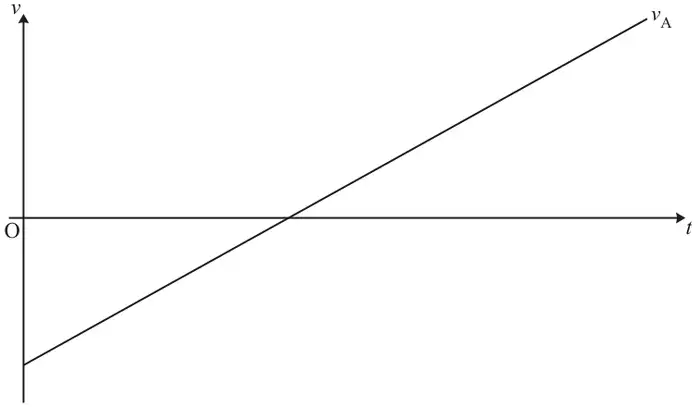
13 Particles A and B are moving along the same straight line. The graph below is the velocity–time graph for particle A with velocity \(v_{\text{A}}\ \text{m s}^{-1}\) at time \(t\) s. Particle A travels with constant acceleration. It has an initial velocity of \(-3\ \text{m s}^{-1}\) and is instantaneously at rest when \(t = 4\).
The velocity for particle B at time \(t\) s is given by \(v_{\text{B}} = 1.5 + 0.03t^2\ \text{m s}^{-1}\). The particles are first travelling at the same velocity at time \(t = T\) s. You are given that A and B do not collide.
(a) Show that \(T = 10\). [3]
(b) Hence, or otherwise, determine which particle has travelled the greater distance by time \(T\) s and by how much. [6]
Mark scheme (a)
Scheme
Marks
AO
Acceleration of A is 0.75 Velocity of A is \([v_A =]\ {-3} + 0.75t\)
B1
3.1b
Same velocity when \(t = T\) \(-3 + 0.75T = 1.5 + 0.03T^2\)
M1
3.1a
\(T = 10\) or \(\sout{T = 15}\) So \(T = 10\)
A1
2.1
[3]
Notes
B1: Correct expression for velocity from graph
M1: Equated velocities and attempts to solve.
A1:AG Must see exclusion of \(T = 15\)
If M0A0 awarded, SC1 can be awarded if \(T = 10\) substituted into both velocity equations and are shown to be equal. Can be awarded if \(v_A = 4.5\) calculated at \(t = 10\) and used to calculate the time for \(v_B = 4.5\) or vice versa. (Beware circular argument) “First time” equal is not established by these methods
Mark scheme (b)
Scheme
Marks
AO
At \(T = 10\) A has travelled a distance \(\left|\dfrac{1}{2}(-3 \times 4)\right| + \dfrac{1}{2}(10 - 4) \times 4.5\)
M1 A1
3.4 1.1
\(= 6 + 13.5 = 19.5\) m
A1
1.1
At \(T = 10\) B has travelled \(\displaystyle\int_0^{10} (1.5 + 0.03t^2)\,\mathrm{d}t = 25\)
M1 A1
3.1a 1.1
So B has travelled 5.5 m further than A
A1FT
1.1
[6]
Notes
M1: Attempting to find at least one area under the velocity-time graph
A1: At least one part correct allowing sign errors
A1: soi
M1: Attempts definite integral to calculate distance
A1: Cao
A1FT: FT their distances (dep on both method marks)
Alternative method for finding the distance for A
Scheme
Marks
AO
\(u = -3, a = 0.75, t = 4\) so \(s = -6\) \(u = 0, a = 0.75, t = 10 - 4\) so \(s = 13.5\)
M1 A1
So total distance is 19.5 m
A1
M1: Uses suvat equations for \(0 \lt t \lt 4\) or \(4 \lt t \lt 10\) or \(0 \lt t \lt 10\) using \(u = -3\), and their \(a = 0.75\),
A1: Correct displacement or distance for either part
M1: Attempt to find definite integral \(0 \lt t \lt 4\) or \(4 \lt t \lt 10\) or \(0 \lt t \lt 10\). FT their \(v_A\)
A1: Correct displacement or distance for either part
A1: soi BC may give total area so allow \(\int_0^{10} \left|-3 + 0.75t\right|\,\mathrm{d}t = 19.5\) (corrected from the printed mark scheme, which omits the modulus signs: \(\int_0^{10} (-3 + 0.75t)\,\mathrm{d}t\) is 7.5, not 19.5)
7 The velocity of a particle moving in a straight line is modelled by \(v = 0.6t^2 - 2.1t + 1.5\) where \(v\) is the velocity in metres per second and \(t\) is the time in seconds.
(a) Determine the times at which the particle is stationary. [2]
(b) Find the acceleration of the particle at the first of the times at which it is stationary. [2]
(c) Find the distance travelled by the particle between the times at which it is stationary. [2]
Mark scheme (a)
Scheme
Marks
AO
\(v = 0.6t^2 - 2.1t + 1.5 = 0\)
M1
3.1b
So stationary when \(t = 1,\ 2.5\)
A1
1.1
[2]
Notes
M1: Form quadratic equation and attempt to solve by any method.
A1: Cao. May be implied by correct times
Mark scheme (b)
Scheme
Marks
AO
\(a = 1.2t - 2.1\)
M1
3.4
When \(t = 1,\ a = -0.9\) \(\text{m s}^{-2}\)
A1FT
1.1
[2]
Notes
M1: Attempt to differentiate \(v\). Do not allow if \(0.6t\) seen
11 A sports car accelerates along a straight road from rest. After 5 s its velocity is 9 \(\text{m s}^{-1}\).
In model A, the acceleration is assumed to be constant.
(a) Calculate the distance travelled by the car in the first 5 seconds according to model A. [2]
In model B, the velocity \(v\) in \(\text{m s}^{-1}\) is given by \(v = 0.05t^3 + kt\), where \(t\) is the time in seconds after the start and \(k\) is a constant.
(b) Find the value of \(k\) which gives the correct value of \(v\) when \(t = 5\). [2]
(c) Using this value of \(k\) in model B, calculate the acceleration of the car when \(t = 5\). [2]
The car travels 16 m in the first 5 seconds.
(d) Show that model B, with the value of \(k\) found in part (b), better fits this information than model A does. [3]
Mark scheme (a)
Scheme
Marks
AO
Using \(s = \frac{1}{2}(u + v)t\) with \(u = 0,\ v = 9,\ t = 5\)
M1
3.4
\(s = \frac{1}{2}(0 + 9)5 = 22.5\) m
A1*
1.1b
[2]
Notes
M1: Allow for any sequence of suvat equations leading to a value for \(s\) (\(a = 1.8\) may be seen)
Mark scheme (b)
Scheme
Marks
AO
Substituting \(t = 5,\ v = 9\) into \(v = 0.05t^3 + kt\) \(9 = 0.05 \times 5^3 + 5k\)
M1
3.3
\(k = 0.55\)
A1
1.1b
[2]
Notes
M1: Uses \(t = 5,\ v = 9\) to form an equation for \(k\)
Model B distance 14.7 is closer to 16 m than model A (22.5 m) so B models this better
E1 (dep)
3.5a
[3]
Notes
M1: Definite integral oe. Do not allow for \(s = 0.05\dfrac{t^4}{4} + 0.55\dfrac{t^2}{2} + c\) unless limits used, or there is an attempt to evaluate \(c\)
A1*: FT their \(k\). BC acceptable
E1 (dep): Comment which quotes at least two values. Dependent on both A marks indicated *
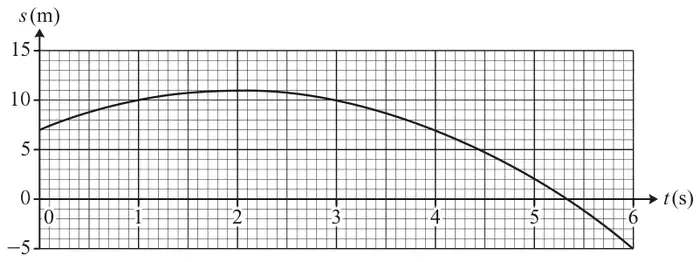
6 The displacement of a particle is modelled by the equation \(s = 7 + 4t - t^2\), where \(s\) metres is the displacement from the origin at time \(t\) seconds. The diagram shows part of the displacement-time graph for the particle. The point (2, 11) is the maximum point on the graph.
(a) Kai argues that the point (2, 11) is on the graph, so the particle has travelled a distance of 11 metres in the first 2 seconds.
Comment on the validity of Kai’s argument. [1]
(b) Determine the total distance the particle travels in the first 10 seconds. [3]
(c) Find an expression for the velocity of the particle at time \(t\). [2]
(d) Find the speed of the particle when \(t = 10\). [2]
Mark scheme (a)
Scheme
Marks
AO
(2, 11) on the graph tells Kai that the displacement from the origin at that time is 11 m and not the distance travelled. [The particle starts 7 m from the origin, so actual distance travelled is 11 – 7 = 4 m]
E1
2.3
[1]
Notes
E1: Draws a clear distinction between displacement from the origin at \(t = 2\) and the distance travelled
Allow for a statement that the displacement during the first 2 s is 4 m
Mark scheme (b)
Scheme
Marks
AO
When \(t = 10,\ s = -53\)
M1
1.1
Distance travelled is 53 + 11 + 4
M1
1.1
= 68 m
A1
1.1
[3]
Notes
M1: Evaluating displacement or distance from the origin at \(t = 10\) soi
May be implied by substitution seen or by −53 seen or by [distance of] 53 m
M1: Adds at least one distance to their 53m
Mark scheme (c)
Scheme
Marks
AO
\(v = \dfrac{\mathrm{d}s}{\mathrm{d}t} = 4 - 2t\)
M1 A1
1.1a 1.1
[2]
Notes
M1: Attempt to differentiate
Mark scheme (d)
Scheme
Marks
AO
When \(t = 10\) \(v = 4 - 2 \times 10\) [ −16 ] therefore the speed is 16 \(\text{m s}^{-1}\)
M1 A1
3.4 3.2a
[2]
Notes
M1: Substitution of \(t = 10\) soi
A1: Allow for speed = 16 \(\text{m s}^{-1}\) seen www
Allow M1A0 for speed \(-16\) \(\text{m s}^{-1}\) seen or for \(4 - 2 \times 10 = 16\)
6In this question you must show detailed reasoning.
A particle moves in a straight line. Its velocity \(v\) \(\text{m s}^{-1}\) after \(t\) s is given by \(v = t^3 - 5t^2\).
(a) Find the times at which the particle is stationary. [2]
(b) Find the total distance travelled by the particle in the first 6 seconds. [3]
Mark scheme (a)
Scheme
Marks
AO
DR
\(v = t^3 - 5t^2 = 0\) \(t^2(t - 5) = 0\)
M1
1.1a
So at rest when \(t = 0\) or 5 s
A1
1.1
[2]
Notes
M1: Attempt to solve \(v = 0\)
Allow M1 for at least one root found by substitution
A1: Both roots and no others
Mark scheme (b)
Scheme
Marks
AO
DR
There is a change of direction when \(t = 5\) \(\displaystyle\int_0^5 \left(t^3 - 5t^2\right) \mathrm{d}t = \left[\frac{t^4}{4} - \frac{5t^3}{3}\right]_0^5 = -\frac{625}{12}\)
9In this question you must show detailed reasoning.
A car accelerates from rest along a straight level road. The velocity of the car after 8 s is 25.6 \(\text{m s}^{-1}\).
In one model for the motion, the velocity \(v\) \(\text{m s}^{-1}\) at time \(t\) seconds is given by \(v = 1.2t^2 - kt^3\), where \(k\) is a constant and \(0 \leqslant t \leqslant 8\).
(a) The model gives the correct velocity of 25.6 \(\text{m s}^{-1}\) at time 8 s. Show that \(k = 0.1\). [2]
A second model for the motion uses constant acceleration.
(b) Find the value of the acceleration which gives the correct velocity of 25.6 \(\text{m s}^{-1}\) at time 8 s. [2]
(c) Show that these two models give the same value for the displacement in the first 8 s. [5]
Mark scheme (a)
Scheme
Marks
AO
DR
Using given values in \(v = 1.2t^2 - kt^3\): \(25.6 = 1.2 \times 8^2 - k \times 8^3\)
M1
3.3
\(k = \dfrac{25.6 - 76.8}{-8^3} = 0.1\)
A1
2.1
[2]
Notes
M1: method must be clear
A1: AG
Allow M1 for substitution of \(t = 8,\ k = 0.1\) to obtain \(v = 25.6\); A1 for comment made that \(k = 0.1\) is correct value.
Mark scheme (b)
Scheme
Marks
AO
DR
Uses \(v = u + at\quad u = 0,\ v = 25.6,\ t = 8\) \(\Rightarrow 25.6 = 0 + 8a\)
M1
3.3
\(a = 3.2\) \(\text{m s}^{-2}\)
A1
1.1
[2]
Notes
A1: Cao
Mark scheme (c)
Scheme
Marks
AO
DR
First model \(s = \displaystyle\int_0^8 (1.2t^2 - 0.1t^3)\,\mathrm{d}t = \Big[0.4t^3 - 0.025t^4\Big]_0^8\)
Second model: use suvat equation(s) with 3 from \(u = 0,\ v = 25.6,\ t = 8,\ a =\) their value, giving e.g. \(s = 0 \times 8 + \frac{1}{2} \times 3.2 \times 8^2\) or \(s = \dfrac{1}{2}(0 + 25.6)8\)
M1
3.4
\(= 102.4\) m, [which is the same value as for 1st model]
A1
1.1
[5]
Notes
M1: Attempt to integrate – expression for indefinite integral must be seen
Allow SC1 for \(\displaystyle\int_0^8 (1.2t^2 - 0.1t^3)\,\mathrm{d}t = 102.4\)
M1: Both limits seen or establishes that \(c = 0\) if indefinite integral used.
9. A small toy car, which may be modelled as a particle, is moving along a straight horizontal track as shown below. Two points \(A\) and \(B\) are positioned along the track.
The velocity of the car, \(v\text{ cms}^{-1}\), at time \(t\) seconds, is given by
8. A particle, of mass \(4\text{ kg}\), moves in a straight line under the action of a single force \(F\text{ N}\), whose magnitude at time \(t\) seconds is given by
(a) Find the acceleration of the particle when \(t=9\). [2]
(b) Given that the particle has velocity \(-1\text{ ms}^{-1}\) when \(t=4\), find an expression for the velocity of the particle at \(t\text{ s}\). [3]
(c) Determine whether the speed of the particle is increasing or decreasing when \(t=9\). [2]
Mark scheme (a)
Scheme
Marks
Comments
Using N2L, \(4a=12\sqrt{t}-32\) \(a=3\sqrt{t}-8\) When \(t=9\), \(a=3\sqrt{9}-8\)
M1
Used
\(a=1\) \((\text{ms}^{-2})\)
A1
cao
[2]
Alternative (Method 2)
Scheme
Marks
Comments
When \(t=9\), \(F=12\sqrt{9}-32\) \(F=4\) Using N2L, \(4a=4\)
7. A particle moves along the horizontal \(x\)-axis so that its velocity \(v\) ms–1 at time \(t\) seconds is given by \[v=6t^{2}-8t-5.\]
At time \(t=1\), the particle’s displacement from the origin is \(-4\) m. Find an expression for the displacement of the particle at time \(t\) seconds. [3]
We'd like to use Google Analytics cookies to count visits and see which pages help most. They're optional, and the site works exactly the same either way. Privacy policy