B1 Seen or implied, with \(\mathbf{i}\)’s and \(\mathbf{j}\)’s collected
M1 Using Pythagoras, with or without the root, on their resultant force N.B. This mark is available even if they’ve subtracted the two forces.
M1 Use of \(F = ma\) to obtain an equation in \(c\) only.
OR
M1 Using \(\mathbf{F} = m\mathbf{a}\) with their resultant force to obtain \(\mathbf{a}\) with \(\mathbf{i}\)’s and \(\mathbf{j}\)’s collected N.B. This mark is available even if they’ve subtracted the two forces.
M1 Using Pythagoras, with or without the root, on their \(\mathbf{a}\) to obtain an equation in \(c\) only
\(\dfrac{(4 + p)}{(q - 6)} = \dfrac{2}{1}\) or \(-\dfrac{2}{1}\) (or \(\dfrac{1}{2}\) or \(-\dfrac{1}{2}\))
DM1 A1
\(2q - 12 = 4 + p\)
\(p - 2q = -16\) GIVEN ANSWER
DM1 A1
(5)
Notes
Allow column vectors throughout
First M1 for adding the two forces, with i’s and j’s collected, seen or implied
Second DM1, dependent on first M1, for an equation in \(p\) and \(q\) only. Allow \(\dfrac{1}{2}\) or \(-\dfrac{1}{2}\) or \(-\dfrac{2}{1}\) instead of \(\dfrac{2}{1}\)
First A1 for a correct equation in any form
Third DM1, dependent on the second M1, for (at least)one correct intermediate line of working
Second A1 for correct given answer
Mark scheme (b)
Scheme
Marks
\(q = 3 \Rightarrow p = -10\)
B1
EITHER \(\ 0.5\mathbf{a} = -6\mathbf{i} - 3\mathbf{j}\) OR \(\ |\mathbf{R}| = \sqrt{(-6)^2 + (-3)^2}\)
M1 for use of a relevant trig ratio from their \(\mathbf{a}\) or their \(\mathbf{R}\) (may not be the sum of the two forces) or \(-2\mathbf{i} - \mathbf{j}\)
First A1 for any relevant correct angle coming from a correct \(\mathbf{a}\) or \(\mathbf{R}\) or from \(-2\mathbf{i} - \mathbf{j}\)
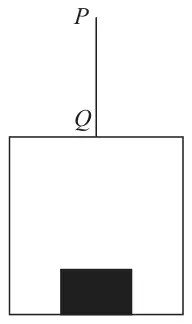
A lift of mass 250 kg is being raised by a vertical cable attached to the top of the lift. A woman of mass 60 kg stands on the horizontal floor inside the lift, as shown in Figure 3. The lift ascends vertically with constant acceleration 2 m s\(^{-2}\). There is a constant downwards resistance of magnitude 100 N on the lift. By modelling the woman as a particle,
(a) find the magnitude of the normal reaction exerted by the floor of the lift on the woman. (3)
The tension in the cable must not exceed 10 000 N for safety reasons, and the maximum upward acceleration of the lift is 3 m s\(^{-2}\). A typical occupant of the lift is modelled as a particle of mass 75 kg and the cable is modelled as a light inextensible string. There is still a constant downwards resistance of magnitude 100 N on the lift.
(b) Find the maximum number of typical occupants that can be safely carried in the lift when it is ascending with an acceleration of 3 m s\(^{-2}\). (7)
Mark scheme (a)
Scheme
Marks
\(R - 60g = 60 \times 2\)
M1A1
\(R = 708\) N or 710 N (must be positive)
A1
(3)
Notes
M1 for equation in \(R\) only, with usual rules
First A1 for a correct equation
Second A1 for 710 or 708 (N not needed)
Mark scheme (b)
Scheme
Marks
\(75n\)
B1
\(10000 - Mg - 100 = M \times 3\)
M1A2
using \(M = 250 + 75n \Rightarrow n = 6.9..\)
DM1A1
so 6 people
A1ft
(7)
(10 marks)
Notes
B1 for \(75n\) oe seen or implied
First M1 for an equation in one unknown in the form \(10000 - Mg - 100 = M \times a\) with usual rules (must be using 10000) where \(M\) can be any (relevant) number e.g. 250, 75, etc
First A1 and second A1 for a correct equation with \(a = 3\), A1A0 if one error (e.g. Use of \(a = 2\) loses 1 A mark)
Second DM1, dependent on first M1, for using \(M = 250 + 75n\) and solving for \(n\)
Third A1 for 6.9… (A0 for 7)
Fourth A1ft for no. of people, ft on their \(n\) value (A0 for < 7)
N.B. If no incorrect work seen, the third A mark can be implied by a correct answer (\(n = 6\))
SC: They may use Trial and Error to find the critical value of \(n\), by writing down equations for the tension when \(n = 1, 2, 3, \ldots\) until the tension exceeds 10000 oe
This method can score the final DM1 A1 A1 if done fully correctly up to and including \(n = 7\), with a correct answer given.
It could also score some or all of the first 4 marks.
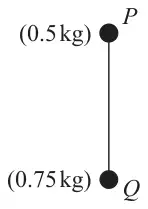
A vertical light rod \(PQ\) has a particle of mass 0.5 kg attached to it at \(P\) and a particle of mass 0.75 kg attached to it at \(Q\), to form a system, as shown in Figure 2. The system is accelerated vertically upwards by a vertical force of magnitude 15 N applied to the particle at \(Q\). Find the thrust in the rod. (6)
Mark scheme
Scheme
Marks
\(T - 0.5g = 0.5a\)
M1 A1
\(15 - T - 0.75g = 0.75a\)
M1 A1
(OR: \(15 - 0.5g - 0.75g = 1.25a\))
(\(a = 2.2\) m s\(^{-2}\))
\(T = 6\) N
M1 A1
(6 marks)
Notes
First M1 for an equation of motion for either \(P\) or \(Q\) with usual rules i.e. correct no. of terms, dimensionally correct but condone sign errors
First A1 for a correct equation (allow \(T\) replaced by \(-T\) and/or \(a\) replaced by \(-a\))
Second M1 for another equation of motion (for either \(P\) or \(Q\) or whole system) with usual rules as above
Second A1 for a correct equation (allow \(T\) consistently replaced by \(-T\) and/or \(a\) consistently replaced by \(-a\) )
Third M1 for solving two THREE term equations of motion for \(T\)
Third A1 for 6 (N). Must be positive but allow a change from −6 to 6, if they have consistently used \(-T\) instead of \(T\).
1. Three forces, \((15\mathbf{i} + \mathbf{j})\) N, \((5q\mathbf{i} - p\mathbf{j})\) N and \((-3p\mathbf{i} - q\mathbf{j})\) N, where \(p\) and \(q\) are constants, act on a particle. Given that the particle is in equilibrium, find the value of \(p\) and the value of \(q\). (6)
First M1 for equating the sum of the three forces to zero (can be implied by subsequent working)
Second M1 for equating the sum of the \(\mathbf{i}\) components to zero AND the sum of the \(\mathbf{j}\) components to zero oe to produce TWO equations, each one being in \(p\) and \(q\) ONLY.
First A1 for TWO correct equations (in any form)
N.B. It is possible to obtain TWO equations by using \(\lambda(3p - 5q - 15) = \mu(p + q - 1)\) with TWO different pairs of values for \(\lambda\) and \(\mu\), with one pair not a multiple of the other e.g \(\lambda = 1\), \(\mu = 1\) AND \(\lambda = 1\), \(\mu = 2\).
Third M1(independent) for attempt (either by substitution or elimination) to produce an equation in either \(p\) ONLY or \(q\) ONLY.
Second A1 for \(p = 2.5\) (any equivalent form, fractions do not need to be in lowest terms)
Third A1 for \(q = -1.5\) (any equivalent form, fractions do not need to be in lowest terms)
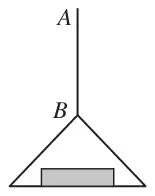
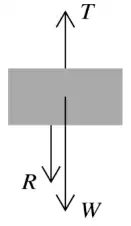
A vertical rope \(AB\) has its end \(B\) attached to the top of a scale pan. The scale pan has mass 0.5 kg and carries a brick of mass 1.5 kg, as shown in Figure 1. The scale pan is raised vertically upwards with constant acceleration 0.5 m s\(^{-2}\) using the rope \(AB\). The rope is modelled as a light inextensible string.
(a) Find the tension in the rope \(AB\). (3)
(b) Find the magnitude of the force exerted on the scale pan by the brick. (3)
Mark scheme (a)
Scheme
Marks
\(T - 0.5g - 1.5g = 2 \times 0.5\)
M1 A1
\(T = 20.6\) (N) or 21 (N)
A1
(3)
Notes
N.B. In both parts of this question use the mass which is being used to guide you as to which part of the system is being considered
M1 is for an equation for whole system in \(T\) only, with usual rules
First A1 for a correct equation
Second A1 for 20.6 or 21
Mark scheme (b)
Scheme
Marks
\(R - 1.5g = 1.5 \times 0.5\)
M1 A1
Force = 15.5 (N) or 15 (N)
A1
OR: \(T - R - 0.5g = 0.5 \times 0.5\)
OR M1 A1
Force = 15.5 (N) or 15 (N)
A1
(3)
(6 marks)
Notes
N.B. In both parts of this question use the mass which is being used to guide you as to which part of the system is being considered
First M1 is for an equation for the brick only (1st alternative) or for the scale pan only (2nd alternative) with usual rules.
First A1 for a correct equation (in the second alternative \(T\) does not need to be substituted)
Second A1 for 15.5 or 15
N.B. If \(R\) is replaced by \(-R\) in either equation, can score M1A1. This would lead to \(R = -15.5\) or \(-15\). The second A1 can then only be scored if the candidate explains why the –ve sign is being ignored.
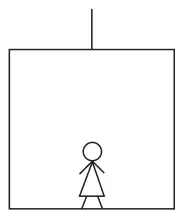
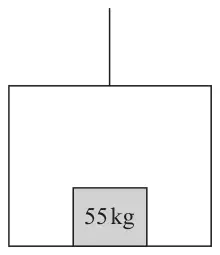
A lift of mass 200 kg is being lowered into a mineshaft by a vertical cable attached to the top of the lift. A crate of mass 55 kg is on the floor inside the lift, as shown in Figure 2. The lift descends vertically with constant acceleration. There is a constant upwards resistance of magnitude 150 N on the lift. The crate experiences a constant normal reaction of magnitude 473 N from the floor of the lift.
(a) Find the acceleration of the lift. (3)
(b) Find the magnitude of the force exerted on the lift by the cable. (4)
Mark scheme (a)
Scheme
Marks
For crate, \(55g - 473 = 55a\)
M1 A1
\(a = 1.2\) m s\(^{-2}\)
A1
(3)
Notes
M1 for an equation in \(a\) only, with usual rules.
First A1 for a correct equation
Second A1 for 1.2 (m s\(^{-2}\)). Allow −1.2 (m s\(^{-2}\)) if appropriate
Mark scheme (b)
Scheme
Marks
For system, \(55g + 200g \pm T - 150 = 255a\)
M1 A2
Magnitude = 2040 N or 2000 N
A1
OR
For lift, \(200g + 473 - 150 \pm T = 200a\)
M1 A2
Magnitude = 2040 N or 2000 N
A1
(4)
(7 marks)
Notes
M1 for an equation, in \(T\) and \(a\), for the system or the lift only, with usual rules. (\(a\) does not need to be a numerical value)
A2 (-1 each error) for a correct equation (Allow \(\pm T\)). We do not need to see a numerical value for \(a\).
Third A1 for 2040 (N) or 2000 (N)
N.B. In both parts of this question use the mass which is being used to guide you as to which part of the system is being considered.
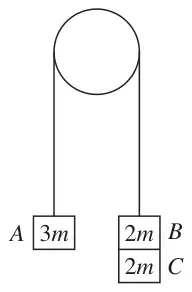
Three particles \(A\), \(B\) and \(C\) have masses \(3m\), \(2m\) and \(2m\) respectively. Particle \(C\) is attached to particle \(B\). Particles \(A\) and \(B\) are connected by a light inextensible string which passes over a smooth light fixed pulley. The system is held at rest with the string taut and the hanging parts of the string vertical, as shown in Figure 5. The system is released from rest and \(A\) moves upwards.
(a)
(i) Show that the acceleration of \(A\) is \(\dfrac{g}{7}\)
(ii) Find the tension in the string as \(A\) ascends. (7)
At the instant when \(A\) is 0.7 m above its original position, \(C\) separates from \(B\) and falls away. In the subsequent motion, \(A\) does not reach the pulley.
(b) Find the speed of \(A\) at the instant when it is 0.7 m above its original position. (2)
(c) Find the acceleration of \(A\) at the instant after \(C\) separates from \(B\). (4)
(d) Find the greatest height reached by \(A\) above its original position. (3)
Mark scheme (a)
Scheme
Marks
\(4mg - T = 4ma\)
M1A1
\(T - 3mg = 3ma\)
M1A1
Condone the use of \(4mg - 3mg = 4ma + 3ma\) in place of one of these equations.
M1A1
Reach given answer \(a = \dfrac{g}{7}\) correctly ***
A1
Form an equation in \(T\): \(T = 3mg + 3\left(mg - \dfrac{T}{4}\right)\), \(T = 3mg + 3m\dfrac{g}{7}\), or \(T = 4mg - 4m\dfrac{g}{7}\)
M1
\(T = \dfrac{24}{7}mg\) or equivalent, \(33.6m\), \(34m\)
A1
(7)
Notes
First M1 for resolving vertically (up or down) for \(B + C\), with correct no. of terms.
First A1 for a correct equation.
Second M1 for resolving vertically (up or down) for \(A\), with correct no. of terms.
Second A1 for a correct equation.
Third A1 for \(g/7\), obtained correctly. Given answer (1.4 A0)
Third M1 for an equation in \(T\) only
Fourth A1 for \(24mg/7\) oe or \(33.6m\) or \(34m\)
N.B. If they omit \(m\) throughout (which gives \(a = g/7\)), can score max M1A0M1A0A0M1A0 for part (a) BUT CAN SCORE ALL OF THE MARKS in parts (b), (c) and (d).
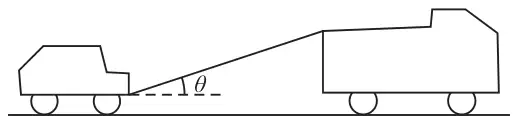
A truck of mass 1750 kg is towing a car of mass 750 kg along a straight horizontal road. The two vehicles are joined by a light towbar which is inclined at an angle \(\theta\) to the road, as shown in Figure 4. The vehicles are travelling at 20 m s\(^{-1}\) as they enter a zone where the speed limit is 14 m s\(^{-1}\). The truck’s brakes are applied to give a constant braking force on the truck. The distance travelled between the instant when the brakes are applied and the instant when the speed of each vehicle is 14 m s\(^{-1}\) is 100 m.
(a) Find the deceleration of the truck and the car. (3)
The constant braking force on the truck has magnitude \(R\) newtons. The truck and the car also experience constant resistances to motion of 500 N and 300 N respectively. Given that \(\cos\theta = 0.9\), find
(b) the force in the towbar, (4)
(c) the value of \(R\). (4)
Mark scheme (a)
Scheme
Marks
Use of \(v^2 = u^2 + 2as\)
M1
\(14^2 = 20^2 - 2a \times 100\)
A1
Deceleration is 1.02(m s\(^{-2}\))
A1
(3)
Notes
M1 for a complete method to produce an equation in \(a\) only.
First A1 for a correct equation.
Second A1 for 1.02 (ms\(^{-2}\)) oe. must be POSITIVE.
Mark scheme (b)
Scheme
Marks
Horizontal forces on the car: \(\pm T\cos\theta - 300 = 750 \times -1.02 = -765\) \(T = -1550/3\)
M1A2 f.t.
The force in the tow-bar is 1550/3, 520 (N) or better (allow –ve answer)
A1
(4)
Notes
M1 for considering the car ONLY horizontally to produce an equation in \(T\) only, with usual rules. i.e. correct no. of terms AND \(T\) resolved:
\(\pm T\cos\theta - 300 = 750 \times -1.02\)
A2 ft on their \(a\) for a correct equation (300 and \(a\) must have same sign); -1 each error (treat cos 0.9 as an A error)
A1 for 1550/3 oe, 520 or better (N) N.B. Allow a negative answer.
Mark scheme (c)
Scheme
Marks
Horizontal forces on the truck: \(\pm T\cos\theta - 500 - R = 1750 \times -1.02\)
M1A2 f.t.
Braking force \(R = 1750\) (N)
A1
(4)
(11 marks)
Notes
M1 for considering the truck ONLY horizontally to produce an equation, with usual rules. i.e. correct no. of terms AND \(T\) resolved:
\(\pm T\cos\theta - 500 - R = 1750 \times -1.02\)
A2 ft on their \(T\) and \(a\) for a correct equation (500, \(a\) and \(R\) must have same sign); -1 each error (treat cos 0.9 as an A error)
A1 for 1750 (N).
OR
M1 for considering the whole system to produce an equation in \(R\) only, with usual rules. i.e. correct no. of terms.
A2 ft on their \(a\) for a correct equation (\(a\) and \(R\) must have same sign) -1 each error
A1 for 1750 (N).
N.B. If 300 and 500 are given separately, penalise any sign errors only ONCE.
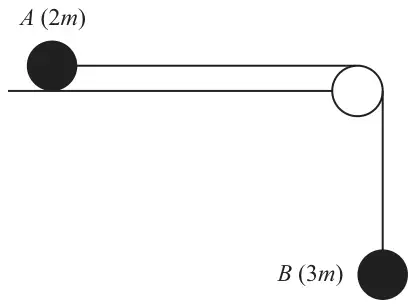
Two particles \(A\) and \(B\) have masses \(2m\) and \(3m\) respectively. The particles are attached to the ends of a light inextensible string. Particle \(A\) is held at rest on a smooth horizontal table. The string passes over a small smooth pulley which is fixed at the edge of the table. Particle \(B\) hangs at rest vertically below the pulley with the string taut, as shown in Figure 2.
Particle \(A\) is released from rest. Assuming that \(A\) has not reached the pulley, find
(a) the acceleration of \(B\), (5)
(b) the tension in the string, (1)
(c) the magnitude and direction of the force exerted on the pulley by the string. (4)
Mark scheme (a)
Scheme
Marks
For \(A\), \(T = 2ma\)
B1
For \(B\), \(3mg - T = 3ma\)
M1 A1
\(3mg = 5ma\)
DM1
\(\dfrac{3g}{5} = a\) (5.9 or 5.88 m s\(^{-2}\))
A1
(5)
Notes
B1 for \(T = 2ma\)
First M1 for resolving vertically (up or down) for \(B\), with correct no. of terms. (allow omission of \(m\), provided 3 is there)
First A1 for a correct equation.
Second M1, dependent on first M1, for eliminating \(T\), to give an equation in \(a\) only.
Second A1 for 0.6g, 5.88 or 5.9.
N.B. ‘Whole system’ equation: \(3mg = 5ma\) earns first 4 marks but any error loses all 4.
Direction clearly marked on a diagram, with an arrow, and 45\(^\circ\) (oe) marked
B1
(4)
(10 marks)
Notes
M1 \(\sqrt{(T^2 + T^2)}\) or \(\dfrac{T}{\sin 45^\circ}\) or \(\dfrac{T}{\cos 45^\circ}\) or \(2T\cos 45^\circ\) or \(2T\sin 45^\circ\) (allow if \(m\) omitted)
(M0 for \(T\sin 45^\circ\))
First A1 ft on their \(T\).
Second A1 cao for \(\dfrac{6mg\sqrt{2}}{5}\) oe, \(1.7mg\) (or better), \(16.6m\), \(17m\)
B1 for the direction clearly shown on a diagram with an arrow and 45\(^\circ\) marked.
2. A woman travels in a lift. The mass of the woman is 50 kg and the mass of the lift is 950 kg. The lift is being raised vertically by a vertical cable which is attached to the top of the lift. The lift is moving upwards and has constant deceleration of 2 m s\(^{-2}\). By modelling the cable as being light and inextensible, find
(a) the tension in the cable, (3)
(b) the magnitude of the force exerted on the woman by the floor of the lift. (3)
(In both parts, use the mass to decide which part of the system is being considered and M marks can only be scored if an equation contains only forces acting on that part of the system)
M1 is for a complete method for finding \(T\) i.e. for an equation in \(T\) only, dimensionally correct, with the correct number of terms.
First A1 for a correct equation.
Second A1 for 7800 (N).
Mark scheme (b)
Scheme
Marks
For woman, \((\uparrow)\), \(R - 50g = 50 \times -2\)
M1 A1
\(R = 390\) N
A1
(3)
(6 marks)
Notes
M1 is for a complete method for finding \(R\) i.e. for an equation in \(R\) only, dimensionally correct, with the correct number of terms.
First A1 for a correct equation.
Second A1 for 390 (N).
N.B. Equation for lift only is: \(T - 950g - R = 950 \times (-2)\)
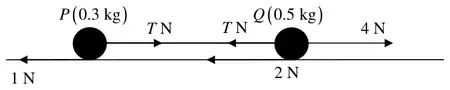
Two particles \(P\) and \(Q\), of mass 0.3 kg and 0.5 kg respectively, are joined by a light horizontal rod. The system of the particles and the rod is at rest on a horizontal plane. At time \(t = 0\), a constant force \(\mathbf{F}\) of magnitude 4 N is applied to \(Q\) in the direction \(PQ\), as shown in Figure 3. The system moves under the action of this force until \(t = 6\) s. During the motion, the resistance to the motion of \(P\) has constant magnitude 1 N and the resistance to the motion of \(Q\) has constant magnitude 2 N.
Find
(a) the acceleration of the particles as the system moves under the action of \(\mathbf{F}\), (3)
(b) the speed of the particles at \(t = 6\) s, (2)
(c) the tension in the rod as the system moves under the action of \(\mathbf{F}\). (3)
At \(t = 6\) s, \(\mathbf{F}\) is removed and the system decelerates to rest. The resistances to motion are unchanged. Find
(d) the distance moved by \(P\) as the system decelerates, (4)
(e) the thrust in the rod as the system decelerates. (3)
Mark scheme (a)
Scheme
Marks
For system N2L \(4 - 3 = 0.8a\)
M1 A1
\(a = 1.25\) (m s\(^{-2}\)), 1.3
A1
(3)
Notes
(In parts (a), (c), (d) and (e) use the value of the mass being used to guide you as to which part of the system is being considered, and mark equation(s) accordingly)
M1 for resolving horizontally to produce an equation in \(a\) ONLY.
First A1 for a correct equation
Second A1 for 1.25
Mark scheme (b)
Scheme
Marks
\(v = u + at\ \Rightarrow\ v = 0 + 1.25 \times 6 = 7.5\) (m s\(^{-1}\))
M1 A1
(2)
Notes
M1 for a complete method to find the speed
A1 cao 7.5
Mark scheme (c)
Scheme
Marks
For \(P\) N2L \(T - 1 = 0.3 \times 1.25\) ft their \(a\)
M1 A1ft
\(T = 1.375\) (N) 1.38, 1.4
A1
(3)
Notes
M1 for resolving horizontally, for either \(P\) or \(Q\), to produce an equation in \(T\) only.
First A1ft for a correct equation, ft on their \(a\)
Second A1 cao for 1.38 (N) or 1.375 (N)
OR
For \(Q\) N2L \(4 - 2 - T = 0.5 \times 1.25\)
Mark scheme (d)
Scheme
Marks
For system N2L \(-3 = 0.8a\ \Rightarrow\ a = -3.75\)
First M1 for resolving horizontally to produce an equation in \(a\) ONLY.
First A1cao for \(-3.75\) (or 3.75)
Second M1 for use of \(v^2 = u^2 + 2as\), with \(v = 0\), \(u =\) their (b) and their \(a\), (or any other complete method which produces an equation in \(s\) only)
M0 if they haven’t calculated a value of \(a\).
Second A1 for 7.5 m
Mark scheme (e)
Scheme
Marks
For \(P\) N2L \(T^{\prime} + 1 = 0.3 \times 3.75\)
M1 A1
\(T^{\prime} = 0.125\) (N), 0.13
A1
(3)
(15 marks)
Notes
M1 for resolving horizontally, for either \(P\) or \(Q\), to produce an equation in \(T\) only.
M0 if they haven’t calculated a value of \(a\)
First A1cao for a correct equation
Second A1 cao for 0.125 or 0.13 (N) (must be positive)
Alternative for (e)
For \(Q\) N2L \(2 - T^{\prime} = 0.5 \times 3.75\)
5. A particle \(P\) is projected vertically upwards from a point \(A\) with speed \(u\) m s\(^{-1}\). The point \(A\) is 17.5 m above horizontal ground. The particle \(P\) moves freely under gravity until it reaches the ground with speed 28 m s\(^{-1}\).
(a) Show that \(u = 21\) (3)
At time \(t\) seconds after projection, \(P\) is 19 m above \(A\).
(b) Find the possible values of \(t\). (5)
The ground is soft and, after \(P\) reaches the ground, \(P\) sinks vertically downwards into the ground before coming to rest. The mass of \(P\) is 4 kg and the ground is assumed to exert a constant resistive force of magnitude 5000 N on \(P\).
(c) Find the vertical distance that \(P\) sinks into the ground before coming to rest. (4)
First M1 for a complete method for finding at least one \(t\) value i.e. for producing an equation in \(t\) only. (condone sign errors but not missing terms)
First A1 for a correct quadratic equation in \(t\) only or TWO correct linear equations in \(t\) only.
Second DM1, dependent on first M1, for attempt to solve the quadratic or one of the linear equations.
Second A1 for 3.0 or 3 or 2.99
Third A1 for 1.3 or 1.30
Mark scheme (c)
Scheme
Marks
N2L \(4g - 5000 = 4a\) \((a = -1240.2)\)
M1 A1
\(v^2 = u^2 + 2as\ \Rightarrow\ 0^2 = 28^2 - 2 \times 1240.2 \times s\) Leading to \(s = 0.316\) (m) or 0.32
M1 A1
(4)
(12 marks)
Notes
First M1 for resolving vertically with usual rules.
First A1 for a correct equation
Second M1 for use of \(v^2 = u^2 + 2as\), with \(v = 0\), \(u = 28\) or \(u = 0\) and \(v = 28\) and their \(a\), (or any other complete method which produces an equation in \(s\), which could be negative)
M0 if they haven’t calculated a value of \(a\).
Second A1 for 0.32 or 0.316. (must be positive since it’s a distance)
6. A car of mass 800 kg pulls a trailer of mass 200 kg along a straight horizontal road using a light towbar which is parallel to the road. The horizontal resistances to motion of the car and the trailer have magnitudes 400 N and 200 N respectively. The engine of the car produces a constant horizontal driving force on the car of magnitude 1200 N. Find
(a) the acceleration of the car and trailer, (3)
(b) the magnitude of the tension in the towbar. (3)
The car is moving along the road when the driver sees a hazard ahead. He reduces the force produced by the engine to zero and applies the brakes. The brakes produce a force on the car of magnitude \(F\) newtons and the car and trailer decelerate. Given that the resistances to motion are unchanged and the magnitude of the thrust in the towbar is 100 N,
2. A particle is acted upon by two forces \(\mathbf{F}_1\) and \(\mathbf{F}_2\), given by
\[\mathbf{F}_1 = (\mathbf{i} - 3\mathbf{j})\text{ N},\]\[\mathbf{F}_2 = (p\mathbf{i} + 2p\mathbf{j})\text{ N, where } p \text{ is a positive constant.}\]
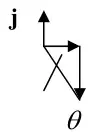
(a) Find the angle between \(\mathbf{F}_2\) and \(\mathbf{j}\). (2)
The resultant of \(\mathbf{F}_1\) and \(\mathbf{F}_2\) is \(\mathbf{R}\). Given that \(\mathbf{R}\) is parallel to \(\mathbf{i}\),
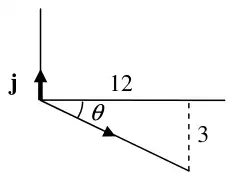
6. Two forces, \((4\mathbf{i} - 5\mathbf{j})\) N and \((p\mathbf{i} + q\mathbf{j})\) N, act on a particle \(P\) of mass \(m\) kg. The resultant of the two forces is \(\mathbf{R}\). Given that \(\mathbf{R}\) acts in a direction which is parallel to the vector \((\mathbf{i} - 2\mathbf{j})\),
(a) find the angle between \(\mathbf{R}\) and the vector \(\mathbf{j}\), (3)
(b) show that \(2p + q + 3 = 0\). (4)
Given also that \(q = 1\) and that \(P\) moves with an acceleration of magnitude \(8\sqrt{5}\) m s\(^{-2}\),
17 A particle, \(P\), is initially at rest on a smooth horizontal surface.
A resultant force of \(\begin{bmatrix} 12 \\ 9 \end{bmatrix}\) N is then applied to \(P\), so that it moves in a straight line.
(a) Find the magnitude of the resultant force. [1 mark]
(b) Two fixed points \(A\) and \(B\) have position vectors\[\overrightarrow{OA} = \begin{bmatrix} 3 \\ 7 \end{bmatrix}\text{ metres} \qquad \text{and} \qquad \overrightarrow{OB} = \begin{bmatrix} k \\ k - 1 \end{bmatrix}\text{ metres}\]
with respect to a fixed origin, \(O\)
\(P\) moves in a straight line parallel to \(\overrightarrow{AB}\)
(i) Find \(\overrightarrow{AB}\) in terms of \(k\) [1 mark]
(ii) Find the value of \(k\) [2 marks]
Mark scheme (a)
Scheme
Marks
AO
Finds correct magnitude of force.
Condone omission of units
B1
1.1b
(1)
Typical solution
\[\sqrt{12^2 + 9^2} = 15\text{ N}\]
Mark scheme (b)
Scheme
Marks
AO
(i) Forms correct expression for \(\overrightarrow{AB}\)
Condone omission of units
B1
1.1b
(1)
(ii) Deduces \(\overrightarrow{AB}\) is a scalar multiple of \(\begin{bmatrix} 12 \\ 9 \end{bmatrix}\)
M1
2.2a
Deduces \(k = 23\)
FT their answer to part (b)(i)
A1F
2.2a
(2)
(4 marks)
Typical solution
(i)
\[\overrightarrow{AB} = \begin{bmatrix} k - 3 \\ k - 8 \end{bmatrix}\text{ metres}\]
(ii)
Since direction of movement is in direction of force then \(\overrightarrow{AB}\) is a scalar multiple of \(\begin{bmatrix} 12 \\ 9 \end{bmatrix}\)
15 A cyclist, Laura, is travelling in a straight line on a horizontal road at a constant speed of 25 km h−1
A second cyclist, Jason, is riding closely and directly behind Laura. He is also moving with a constant speed of 25 km h−1
(a) The driving force applied by Jason is likely to be less than the driving force applied by Laura.
Explain why. [1 mark]
(b)
Jason has a problem and stops, but Laura continues at the same constant speed.
Laura sees an accident 40 m ahead, so she stops pedalling and applies the brakes.
She experiences a total resistance force of 40 N
Laura and her cycle have a combined mass of 64 kg
(i) Determine whether Laura stops before reaching the accident.
Fully justify your answer. [4 marks]
(ii) State one assumption you have made that could affect your answer to part (b)(i). [1 mark]
Mark scheme (a)
Scheme
Marks
AO
States that the resistance is less for the second rider so the force required for equilibrium is also less, or mention of slipstreaming OE
E1
2.4
(1)
Typical solution
Jason experiences less air resistance than Laura.
Mark scheme (b)
Scheme
Marks
AO
(i) Models situation by using given mass and total resistance force to form equation of motion PI
M1
3.3
Uses appropriate suvat formula. May include \(u = 25\).
M1
3.4
States correct value for \(s\) (AWFW 38.5 to 38.6) Or maximum \(u = 7.07\) m s−1 or 25.5 km/h (AWRT) Or \(a\) needs to be \(\lt -0.603\) (AWRT) Or Resistance needs to be \(\gt 38.5\) N (AWFW 38.4 to 38.6) Or \(v^2\) is \(-1.8\) (AWRT) when \(s = 40\)
A1
1.1b
Makes appropriate comparison to conclude that Laura stops in time. Not necessary to see \(38.6 \lt 40\), but comparison for other variables must be clear.
E1
3.2a
(ii) States an assumption that, if incorrect, would contradict the conclusion in (i). (eg reaction time, diminishing resistive force as speed drops OE)
9 A particle \(P\) of mass \(2.5\,\mathrm{kg}\) is in equilibrium under the action of three horizontal forces \(\mathbf{F}_1 = \begin{pmatrix} 3 \\ -7 \end{pmatrix}\mathrm{N}\), \(\mathbf{F}_2 = \begin{pmatrix} -5 \\ 10 \end{pmatrix}\mathrm{N}\) and \(\mathbf{F}_3\).
(a) Find the force \(\mathbf{F}_3\). [2]
The force \(\mathbf{F}_3\) is changed to \(\begin{pmatrix} 8 \\ 1 \end{pmatrix}\mathrm{N}\).
(b) Find the acceleration of \(P\), giving your answer in column vector form. [2]
M1: Use \(\mathbf{F}_1 + \mathbf{F}_2 + \mathbf{F}_3 = \mathbf{0}\) Correct answer implies this mark Allow sign errors. One correct component for \(\mathbf{F}_3\) can imply this mark
A1: cao – isw if magnitude of the force is found after correct vector seen oe e.g. \(-\begin{pmatrix} -2 \\ 3 \end{pmatrix}\), \(2\mathbf{i} - 3\mathbf{j}\)
M1: Use of \(\mathbf{F} = m\mathbf{a}\) with \(m = 2.5\) and at least one correct component for \(\mathbf{F} = \begin{pmatrix} 6 \\ 4 \end{pmatrix}\) (either stated or implied by working)
A1: cao – isw if magnitude of the acceleration is found after correct vector seen
9 A crane lifts a car vertically. The car is inside a crate which is raised by the crane by means of a strong cable. The cable can withstand a maximum tension of 9500 N without breaking. The crate has a mass of 55 kg and the car has a mass of 830 kg.
(a) Find the maximum acceleration with which the crate and car can be raised. [2]
(b) Show on a clearly labelled diagram the forces acting on the crate while it is in motion. [1]
(c) Determine the magnitude of the reaction force between the crate and the car when they are ascending with maximum acceleration. [3]
Mark scheme (a)
Scheme
Marks
AO
\(9500 - 55g - 830g = 885a\)
M1
3.3
\(a = 0.934\ \text{m s}^{-2}\)
A1
1.1
[2]
Notes
M1: Attempt at Newton’s second law – correct number of terms (condone sign errors) Weight and mass correctly used
A1: Allow 827/885 0.9344632768…
Mark scheme (b)
Scheme
Marks
AO
B1
3.3
[1]
Notes
Correct diagram – three forces (tension in the cable vertically upwards, weight of the crate vertically downwards and normal contact force acting vertically downwards)
Note – all three forces labelled somehow, either numerically or with letters, with no extras.
Corresponding values not required but if present must be correct
Mark scheme (c)
Scheme
Marks
AO
M1
3.3
\(9500 - 55g - R = 55(0.9344\ldots)\) or \(R - 830g = 830(0.9344\ldots)\)
A1ft
3.4
\(R = 8910\) N
A1
1.1
[3]
Notes
M1: Attempt at Newton’s second law for either the crate or car – correct number of terms (accept sign errors) Allow in terms of \(a\) Weight and mass correctly used
A1ft: Correct application of N2L following through their value of \(a\) from (a)
9 Three forces \(\begin{pmatrix} 7 \\ -6 \end{pmatrix}\,\text{N}\), \(\begin{pmatrix} 2 \\ 5 \end{pmatrix}\,\text{N}\) and \(\mathbf{F}\,\text{N}\) act on a particle.
Given that the particle is in equilibrium under the action of these three forces, calculate \(\mathbf{F}\). [2]
9 In this question the horizontal unit vectors \(\mathbf{i}\) and \(\mathbf{j}\) are in the directions east and north respectively.
A model ship of mass \(2\,\text{kg}\) is moving so that its acceleration vector \(\mathbf{a}\,\text{m}\,\text{s}^{-2}\) at time \(t\) seconds is given by \(\mathbf{a} = 3(2t - 5)\mathbf{i} + 4\mathbf{j}\). When \(t = T\), the magnitude of the horizontal force acting on the ship is \(10\,\text{N}\).
Find the possible values of \(T\). [4]
Mark scheme
Scheme
Marks
AO
\(F = \sqrt{36(2T - 5)^2 + 64}\)
M1*
3.3
\(36(2T - 5)^2 = 36\)
A1
1.1
\(2T - 5 = \pm 1 \Rightarrow T = \ldots\)
Dep*M1
1.1
\(T = 2\) and \(T = 3\)
A1
2.2a
[4]
Notes
M1*: Correct use of \(\mathbf{F} = m\mathbf{a}\) and Pythagoras
A1: Correct equation(s) for both values of \(T\) e.g. \(10 = 2\sqrt{9(2T - 5)^2 + 16}\) Allow \(t\) throughout
Dep*M1: Attempt to solve a quadratic leading to at least one value for \(T\)
In the \(\mathbf{j}\) direction \(-3g + k - 5 = 0\) [so \(k = 34.4\)]
M1
3.1b
\(\mathbf{i}\) direction \(h + k = 0\) so \(h = -34.4\)
A1
1.1
[3]
Notes
B1: Accept \(-29.4\mathbf{j}\). May be implied by the use of weight (with correct sign) in their vertical equation and not their horizontal equation. May be implied by \(k = 34.4\) seen with no equation
Vector equation need not be seen explicitly
M1: Uses the \(\mathbf{j}\)-direction to find a value for \(k\). Allow only sign errors. Need not be simplified. May be implied by \(k = 34.4\) seen
A1: Cao
Mark scheme (c)
Scheme
Marks
AO
\(h\mathbf{i} - 3g\mathbf{j} = 3\mathbf{a}\)
B1FT
2.5
[1]
Notes
B1FT: Must be vector equation FT their \(h\) from (b) and accept numerical equivalents (e.g. note \(-34.4\mathbf{i} - 29.4\mathbf{j} = 3\mathbf{a}\) is fully correct) ISW if \(\mathbf{a}\) is evaluated
8 On the planet Mars, acceleration due to gravity is \(3.71\ \text{m s}^{-2}\).
(a) Calculate the time it would take an object to fall to the planet’s surface from rest from a point 2 m above the surface. There are no resistances to the motion of the object. [2]
(b) The mass of the object is 2.5 kg.
Calculate the magnitude of the normal contact force when the object is at rest on the planet’s surface. [1]
Mark scheme (a)
Scheme
Marks
AO
\(s = 2, u = 0, a = 3.71\) \(s = ut + \frac{1}{2}at^2\) gives \(2 = \frac{1}{2} \times 3.71t^2\)
M1
3.4
So \(t = 1.04\) s
A1
1.1
[2]
Notes
M1: Uses suvat equation(s) leading to a value of \(t\) with \(a = \pm 3.71\) Soi
A1: Www. Accept 1.0 but not 1
Mark scheme (b)
Scheme
Marks
AO
Normal reaction = weight = \(2.5 \times 3.71 = 9.275\) N (9.28 to 3 s.f.)
12 Points A, B and C lie in a straight line in that order on horizontal ground. A box of mass 5 kg is pushed from A to C by a horizontal force of magnitude 8 N. The box is at rest at A and takes 3 seconds to reach B. The ground is smooth between A and B. Between B and C the ground is rough and the resistance to motion is 28 N. The box comes to rest at C.
Determine the distance AC. [8]
Mark scheme
Scheme
Marks
AO
For AB, Newton’s second law \(8 = 5a\) acceleration is 1.6 \(\text{m s}^{-2}\)
B1
3.1b
for AB \(u = 0,\ a = 1.6,\ t = 3\) \(s = \dfrac{1}{2}at^2 = \dfrac{1}{2} \times 1.6 \times 3^2 = 7.2\) m
M1
1.1a
velocity at B \(v = at = 1.6 \times 3 = 4.8\) \(\text{m s}^{-1}\)
M1
3.1b
for BC Newton’s second law \(8 - 28 = 5a\)
M1
3.1b
acceleration is \(-4\) \(\text{m s}^{-2}\)
A1
1.1b
for BC \(u = 4.8,\ v = 0,\ a = -4\) \(0^2 = 4.8^2 - 2 \times 4s\)
M1
1.1a
\(s = 2.88\) m
A1
1.1b
distance AC is \(7.2 + 2.88 = 10.08\) m
A1
1.1b
[8]
Notes
B1: Uses Newton’s second law to calculate acceleration
M1: Uses suvat equation(s) and their \(a\) leading to a value for \(s\)
M1: Uses suvat equation(s) and their \(a\) leading to a value for velocity at B
M1: Uses Newton’s second law to calculate acceleration. Condone missing 8N force. Allow sign errors.
A1: soi
M1: Uses suvat equation(s) and their \(a\) leading to a value for \(s\).
A1: FT their negative \(a\) and their positive velocity at B
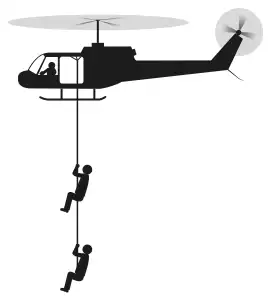
10 A rescue worker is lowered from a helicopter on a rope. She attaches a second rope to herself and to a woman in difficulties on the ground. The helicopter winches both women upwards with the rescued woman vertically below the rescue worker, as shown in the diagram.
The model for this motion uses the following modelling assumptions:
each woman can be modelled as a particle;
the ropes are both light and inextensible;
there is no air resistance to the motion;
the motion is in a vertical line.
(a) Explain what it means when the women are each ‘modelled as a particle’. [1]
(b) Explain what ‘light’ means in this context. [1]
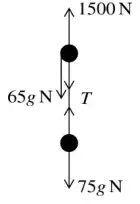
The tension in the rope to the helicopter is 1500 N. The rescue worker has a mass of 65 kg and the rescued woman has a mass of 75 kg.
(c) Draw a diagram showing the forces on the two women. [2]
(d) Write down the equation of motion of the two women considered as a single particle. [2]
(e) Calculate the acceleration of the women. [1]
(f) Determine the tension in the rope connecting the two women. [3]
Mark scheme (a)
Scheme
Marks
AO
The size/shape of the women are not taken into account
E1
3.3
[1]
Notes
E1: Allow women are modelled as point masses
Allow model only involves their mass/weight
Mark scheme (b)
Scheme
Marks
AO
The mass (weight) of the rope is negligible [compared to that of the women]
E1
3.3
[1]
Notes
E1: Allow either mass or weight used. Allow “no weight” oe
Mark scheme (c)
Scheme
Marks
AO
B1
B1
3.3
3.3
[2]
Notes
B1: Draw and label the correct weights
B1: Draw and label the given tension and the tension in the second rope. No extra forces
Mark scheme (d)
Scheme
Marks
AO
Total mass 140 kg
M1
3.3
\(1500 - 65g - 75g = 140a\)
A1
1.1
[2]
Notes
M1: Attempt to form N2L equation with \((65 + 75)a\). Condone one missing force
A1: All correct
Mark scheme (e)
Scheme
Marks
AO
\(a = \frac{32}{35} = 0.914\) \(\text{m s}^{-2}\)
B1
1.1
[1]
Notes
B1: cao Allow from the solution of two separate equations
10 An astronaut on the surface of the moon drops a ball from a point 2 m above the surface.
(a) Without any calculations, explain why a standard model using \(g = 9.8\) \(\text{m s}^{-2}\) will not be appropriate to model the fall of the ball. [1]
The ball takes 1.6 s to hit the surface.
(b) Find the acceleration of the ball which best models its motion. Give your answer correct to 2 significant figures. [2]
(c) Use this value to predict the maximum height of the ball above the point of projection when thrown vertically upwards with an initial velocity of 15 \(\text{m s}^{-1}\). [2]
Mark scheme (a)
Scheme
Marks
AO
Acceleration due to gravity is not a constant but depends on location in the universe.
B1
3.5b
[1]
Notes
B1: Allow any sensible comment that \(g\) might be different on the moon
Mark scheme (b)
Scheme
Marks
AO
Using \(s = 2,\ u = 0,\ t = 1.6\) and \(s = ut + \frac{1}{2}at^2\) Downwards as the positive direction \(2 = \dfrac{1}{2} \times 1.6^2 a\) giving \([a = 1.5625]\)
M1
3.3
which 1.6 \(\text{m s}^{-2}\) to 2 sf
A1
1.1
[2]
Notes
M1: Allow any sign convention
A1: Allow −1.6 \(\text{m s}^{-2}\) if upwards is clearly indicated as positive. Must be 2 significant figures.
Mark scheme (c)
Scheme
Marks
AO
Using \(u = 15,\ v = 0,\ a = -1.6\) and \(v^2 = u^2 + 2as\) Upwards as the positive direction \(0 = 15^2 - 2 \times 1.6s\)
M1
3.4
\(s = 70.3\) m
A1
1.1
[2]
Notes
M1: Use of suvat equation(s) leading to a value for \(s\). Allow sign errors
A1: Must follow from correct working and if negative, explained.
7 A toy boat of mass 1.5 kg is pushed across a pond, starting from rest, for 2.5 seconds. During this time, the boat has an acceleration of 2 \(\text{m s}^{-2}\). Subsequently, when the only horizontal force acting on the boat is a constant resistance to motion, the boat travels 10 m before coming to rest. Calculate the magnitude of the resistance to motion. [6]
using the distance to find the time it takes to stop using areas (second triangle): \(\dfrac{1}{2}(T - 2.5) \times 5 = 10\) \(T = 6.5\) so time to stop is 4 s. So \(0 = 5 + 4a\) Giving \(a = -1.25\ \text{m s}^{-2}\)
M1 A1
\([-R] = 1.5 \times (-1.25) = -1.875\) Magnitude of \(R\) = 1.875 N (1.88 to 3sf)
M1 A1
[6]
M1: Use of suvat equation(s) to find velocity. Do not allow if \(s = 10\) used
M1: Use of area and suvat equation(s) to find acceleration
A1: Must be correct sign
M1: Use of Newton’s second law.
A1: FT their \(a\), \(a \neq 2\). Must be positive
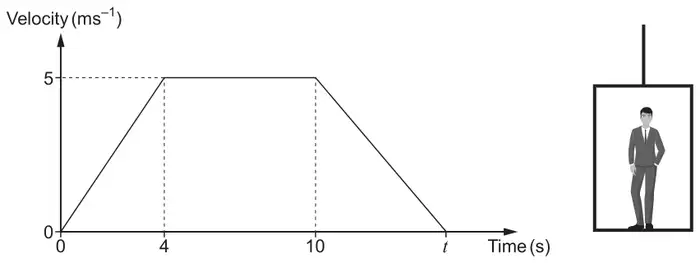
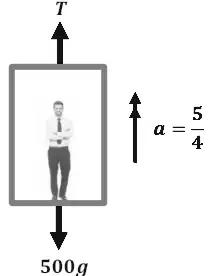
10. A lift is pulled upwards by means of a single cable, as shown in the diagram on the right. A person of mass \(80\text{ kg}\) is standing in the lift. The mass of the lift is \(420\text{ kg}\).
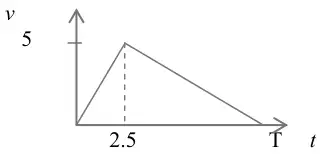
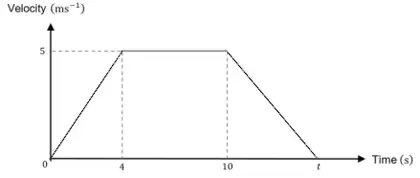
The diagram on the left shows a sketch of the velocity-time graph for the journey of the lift for a period of \(t\) seconds.
(a) Find the tension in the cable while the lift is accelerating. [4]
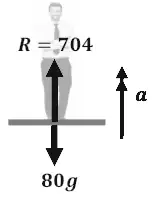
(b) While the lift is decelerating, the magnitude of the reaction of the floor of the lift on the person is \(704\text{ N}\). Determine the deceleration of the lift and hence show that \(t=15\). [5]
(c) Calculate the distance travelled by the lift during the entire 15 s journey. [2]
Mark scheme (a)
Scheme
Marks
Comments
Accelerating from \(t=0\) to \(t=4\), acceleration = gradient \(=\frac{5}{4}\) or \(1{\cdot}25\) \((\text{ms}^{-2})\)
B1
cao, any form
\((420+80)g=500g\) \(=4900\)
No extra forces
N2L applied to lift, upwards positive \(T-500g=500a\) \((T-4900=500a)\)
M1 A1
Dimensionally correct equation \(T\) and \(500g\) opposing Correct equation
For \(10<\text{time}<t\), acceleration = gradient \(=-1\) \((1=)\ \dfrac{5-0}{t-10}\)
M1
oe, gradient calculation
\(t=15\)
A1
Convincing
[5]
Note
Award SC1 if \(a=1\) is derived from assuming that \(t=15\)
Further Notes
Alternative Solution to show that \(t=15\)
Scheme
Marks
Comments
Starting from \(t=10\) \(v=u+at,\ u=5,\ v=0,\ a=-1\) \(0=5+(-1)t\) \(t=5\)
M1
Used
\(t=10+5=15\)
A1 [2]
Convincing
Corrected by Westie's Workshop
The board's mark scheme printed “\(T=10+5=15\)”. Changed to “\(t=10+5=15\)” because the quantity being found is the time \(t\) (there is no tension \(T\) in this question).
Original: see the board's mark scheme PDF (link above).
Mark scheme (c)
Scheme
Marks
Comments
Distance = area \(=\begin{cases}\frac{1}{2}\big((10-4)+15\big)(5)\\[4pt] \frac{1}{2}(4)(5)+(10-4)(5)+\frac{1}{2}(15-10)(5)\end{cases}\)
M1
Attempt to find relevant area Trapezium OR Composite parts
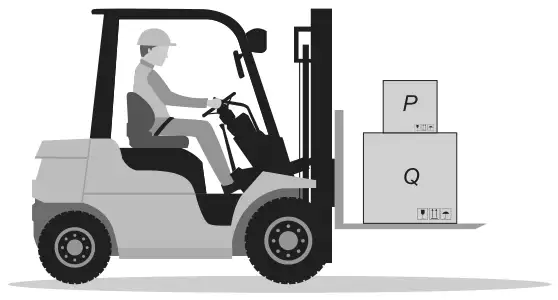
7. The diagram below shows a forklift truck being used to raise two boxes, \(P\) and \(Q\), vertically. Box \(Q\) rests on horizontal forks and box \(P\) rests on top of box \(Q\). Box \(P\) has mass \(25\text{ kg}\) and box \(Q\) has mass \(55\text{ kg}\).
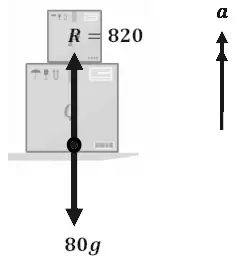
(a) When the boxes are moving upwards with uniform acceleration, the reaction of the horizontal forks on box \(Q\) is \(820\text{ N}\). Calculate the magnitude of the acceleration. [3]
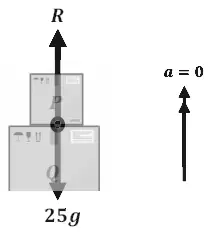
(b) Calculate the reaction of box \(Q\) on box \(P\) when they are moving vertically upwards with constant speed. [1]
Mark scheme (a)
Scheme
Marks
Comments
N2L applied to BOTH boxes, upwards positive
M1
Dimensionally correct equation \(R/820\) and \(80g\) opposing
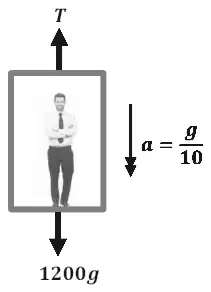
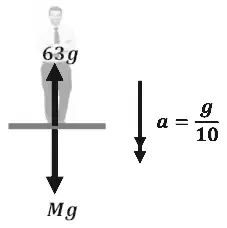
7. A person is standing in a lift which is descending with a constant acceleration of \(\dfrac{g}{10}\text{ ms}^{-2}\). The lift is supported by a single cable.
(a) The total mass of the lift and the person is \(1200\text{ kg}\). Find the tension in the lift cable. [3]
(b) The mass of the person is \(M\text{ kg}\). Given that the magnitude of the reaction of the floor of the lift on the person is \(63g\text{ N}\), find the value of \(M\). [3]
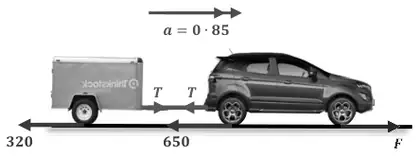
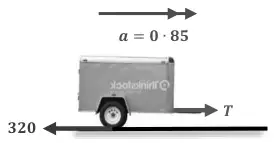
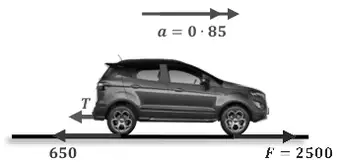
7. The diagram below shows a vehicle of mass \(1300\text{ kg}\) towing a trailer of mass \(500\text{ kg}\) by means of a light horizontal tow bar. The vehicle is moving forward along a straight horizontal road such that a constant resistance of magnitude \(650\text{ N}\) acts on the vehicle and a constant resistance of magnitude \(320\text{ N}\) acts on the trailer. The vehicle’s engine produces a constant driving force of \(F\text{ N}\).
Given that the acceleration of the vehicle and trailer is \(0{\cdot}85\text{ ms}^{-2}\), show that \(F=2500\) and determine the tension in the tow bar. [6]
Mark scheme
Scheme
Marks
Comments
Method 1 (Combining as one particle)
Apply N2L to vehicle and trailer combined
M1
Dimensionally correct equation \(F\) and 970 opposing
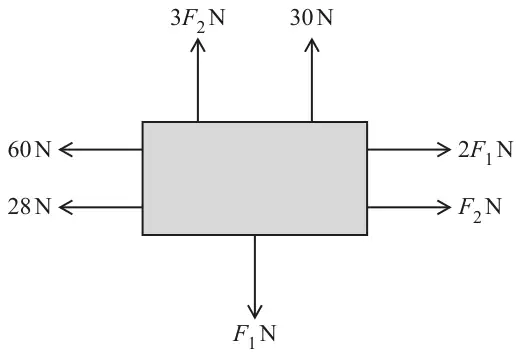
(a) Given that the acceleration of the body is \((7\mathbf{i}-3\mathbf{j})\) ms–2, find the values of the constants \(a\), \(b\). [4]
(b) A fourth force, \(\mathbf{F}_4\), is then applied to the body causing it to move with constant velocity. Find \(\mathbf{F}_4\), giving your answer in vector form. [2]
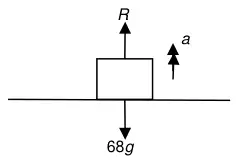
10. A person, of mass 68 kg, stands in a lift which is moving upwards with constant acceleration. The lift is of mass 770 kg and the tension in the lift cable is 8000 N.
(a) Determine the acceleration of the lift, giving your answer correct to two decimal places. [3]
(b) State whether the lift is getting faster, staying at the same speed or slowing down. [1]
(c) Calculate the magnitude of the reaction of the floor of the lift on the person. [3]
Mark scheme (a)
Scheme
Marks
Comments
Apply N2L to lift and man
M1
Dim correct equation. Tension and wt opposing.
\(8000-(770+68)g=(770+68)a\)
A1
correct equation.
\(a=-0.25\) (ms-2) (correct to 2 d.p.)
A1
cao
SC
Scheme
Marks
Comments
(a) Apply N2L to lift only
M1
Dim correct equation. Tension and wt opposing.
\(8000-770g=770a\)
\(a=0.59\) (ms-2) (correct to 2 d.p.)
A1
cao
Mark scheme (b)
Scheme
Marks
Comments
As the acceleration is negative, the lift is slowing down.
B1
depends on M1 in (a)
B0 if SC in (a)
Mark scheme (c)
Scheme
Marks
Comments
Apply N2L to man
M1
Dim correct equation. Reaction and weight opposing.
We'd like to use Google Analytics cookies to count visits and see which pages help most. They're optional, and the site works exactly the same either way. Privacy policy