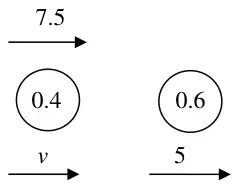
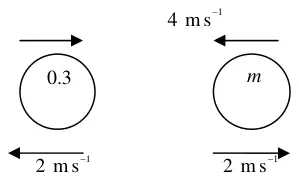
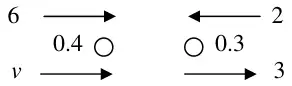
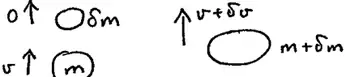
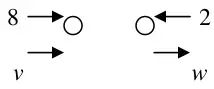
3. A particle \(P\) of mass 0.4 kg is moving with velocity \(7\mathbf{i}\ \text{m s}^{-1}\) when it receives an impulse of magnitude \(\sqrt{1.6}\ \text{N s}\).
The velocity of \(P\) immediately after it receives the impulse is \(\lambda(2\mathbf{i} + \mathbf{j})\ \text{m s}^{-1}\), where \(\lambda\) is a constant.
M1: Form an expression for change in momentum in \(\lambda\), correct number of terms and dimensionally correct. Must use velocities and both components. Subtraction may be either way round. If present, ignore LHS. For the M mark, condone poor expanding of the velocity i.e. \((0.8\lambda\mathbf{i} + 0.4\mathbf{j})\) or \((0.8\mathbf{i} + 0.4\lambda\mathbf{j})\) M0 if speed is used
A1: Correct unsimplified expression for change in momentum, accept terms either way round. Must use conventional vector notation ie column vector form or i-j form. If present, ignore LHS. A0 for unconventional vector notation, unless recovered.
M1: Correct use of Pythagoras (squaring and adding) to form an equation for magnitude of impulse. Must use the given magnitude, \(\sqrt{1.6}\), and the change in momentum components, to form an equation in \(\lambda\) only. Other unknowns may be introduced to represent the impulse components. E.g. \(\begin{pmatrix} a \\ b \end{pmatrix} = 0.4\begin{pmatrix} 2\lambda \\ \lambda \end{pmatrix} - 0.4\begin{pmatrix} 7 \\ 0 \end{pmatrix}\) However, the M mark is only awarded when Pythagoras is used correctly to form an equation in \(\lambda\) only. E.g. \(\left(\sqrt{1.6}\right)^2 = a^2 + b^2 \;\Rightarrow\; 1.6 = (0.8\lambda - 2.8)^2 + (0.4\lambda)^2\)
A1: Correct unsimplified equation in \(\lambda\) only.
dM1: Dependent on previous two M’s. Complete method using the change in momentum and magnitude of impulse to form a 3TQ in \(\lambda\) only and solve to find two \(\lambda\) values. No need to see the method for solving 3TQ. Must reach \(\lambda = \ldots\)
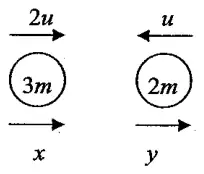
2. A particle \(Q\) of mass \(3m\) is at rest on a smooth horizontal plane. A particle \(P\) of mass \(m\) is moving along the plane when it collides directly with \(Q\).
The speed of \(P\) immediately before the collision is \(u\).
The direction of motion of \(P\) is reversed by the collision.
The coefficient of restitution between \(P\) and \(Q\) is \(e\).
(a) Show that the speed of \(P\) immediately after the collision is \(\dfrac{u(3e-1)}{4}\) (6)
(b) State the full range of possible values of \(e\). (1)
Given that \(e = \dfrac{1}{2}\)
(c) find, in terms of \(m\) and \(u\), the magnitude of the impulse exerted by \(P\) on \(Q\) in the collision. (3)
Mark scheme (a)
Scheme
Marks
AO
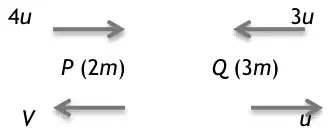
\[\begin{array}{ccc} u \rightarrow & \qquad & \rightarrow 0 \\ (P)\ m & & 3m\ (Q) \\ v \leftarrow & & \rightarrow w \end{array}\]
Use of CLM
M1
3.1a
\(-mv + 3mw = mu\)
A1
1.1b
Use of NEL
M1
3.4
\(v + w = eu\)
A1
1.1b
Solve for \(v\):
M1
1.1b
\(\dfrac{u(3e-1)}{4}\)*
A1*
2.2a
(6)
Notes
N.B. When checking for consistency between their equations, mark the CLM equation FIRST.
M1: Use of CLM, with correct no. of terms, condone sign errors and consistent missing \(m\)’s
A1: Correct unsimplified equation. Allow \(v\) replaced by \(-v\)
M1: Use of NEL with \(e\) on the correct side of the equation, condone sign errors.
A1: Correct unsimplified equation consistent with CLM equation.
M1: Solve for \(v\) (must be dimensionally correct but allow slips in algebra)
A1*: Given answer correctly obtained, with no errors seen. Allow \(\dfrac{u}{4}(3e-1)\) or \(\dfrac{1}{4}u(3e-1)\) or \(\dfrac{u}{4}(-1+3e)\) or \(\dfrac{1}{4}u(-1+3e)\) or \(\dfrac{u(-1+3e)}{4}\) If they have \(v\) in the initial direction of \(P\) and obtain \(v = \dfrac{u(1-3e)}{4}\), we need to see a clear explanation of why the signs are changed.
Mark scheme (b)
Scheme
Marks
AO
\(1 \geqslant e \gt \dfrac{1}{3}\)
B1
2.2a
(1)
Notes
B1: cao
Mark scheme (c)
Scheme
Marks
AO
Use of impulse-momentum for \(P\) or \(Q\)
M1
3.1a
\(P\): \(\pm m(v+u)\) OR \(Q\): \(\pm 3mw\)
A1
1.1b
\(\dfrac{9mu}{8}\) or \(1\dfrac{1}{8}mu\)
A1
1.1b
(3)
(10 marks)
Notes
M1: Condone sign errors but must have correct terms (M0 if \(m\) omitted). M0 if \(m\) is used with \(w\) or \(3m\) is used with \(v\).
A1: \(\pm m(v+u)\) or \(\pm 3mw\). N.B. \(v\) and \(w\) do not need to be substituted.
A1: Accept \(1.1mu\) or better. N.B. Must be of form \(kmu\) and must be positive.
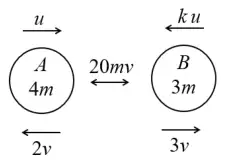
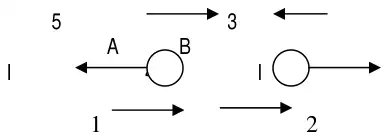
1. A particle \(A\) has mass \(4m\) and a particle \(B\) has mass \(3m\). The particles are moving along the same straight line on a smooth horizontal table. The particles are moving in opposite directions towards each other when they collide directly.
As a result of the collision, the direction of motion of each particle is reversed.
Immediately before the collision, the speed of \(A\) is \(u\) and the speed of \(B\) is \(ku\), where \(k\) is a constant.
Immediately after the collision, the speed of \(A\) is \(2v\) and the speed of \(B\) is \(3v\).
The magnitude of the impulse received by \(A\) in the collision is \(20mv\).
(a) Find \(u\) in terms of \(v\) only. (3)
(b) Find the exact value of \(k\). (3)
Mark scheme (a)
Scheme
Marks
AO
Impulse-momentum equation for \(A\) or other complete method to form an equation in \(u\) and \(v\) only (and \(m\))
M1
3.4
For \(A\): \(20mv = 4m\big(2v - (-u)\big)\)
A1
1.1b
\(u = 3v\)
A1
1.1b
(3)
Notes
Working in parts (a) and (b) may be marked together.
M1: Use of \(I = m(v-u)\) on \(A\) or equivalent complete method to form an equation in terms of \(u\) and \(v\) (and \(m\)) only (not \(k\)). Must consider change in momenta but condone in the wrong order or velocity sign errors. Might see \((2v+u)\) rather than \((2v - -u)\). Dimensionally correct equation with correct mass and velocities pairings. If CLM equation is formed in (a), then an impulse-equation must also be used to eliminate \(k\) for this mark. Allow consistent omission of \(m\).
A1: Correct unsimplified equation in \(u\) and \(v\) (and \(m\))
A1: Correct only, ISW after \(u = 3v\) A0 for only \(v = \dfrac{u}{3}\)
Mark scheme (b)
Scheme
Marks
AO
Impulse momentum equation for \(B\) or use of CLM to form an equation in \(k\) (and \(u\), \(v\), \(m\))
M1
3.4
Either For \(B\): \(20mv = 3m\big(3v - (-ku)\big)\) Or CLM: \(4m(u) - 3m(ku) = 3m(3v) - 4m(2v)\)
A1ft
1.1b
\(k = \dfrac{11}{9}\)
A1
1.1b
(3)
(6 marks)
Notes
Working in parts (a) and (b) may be marked together.
M1: Correct use of impulse-momentum equation or CLM to form an equation in \(k\), \(u\), \(v\) (and \(m\)). All terms required, allow consistent omission of \(m\). Dimensionally correct.
A1ft: Correct unsimplified equation in \(k\), \(u\) and \(v\). No need to replace \(u\) and \(v\) (follow through their positive \(u\) if substituted)
A1: Correct exact value. Accept \(1\dfrac{2}{9}\) or recurring decimal \(1.\dot{2}\) with correct notation.
1.[In this question, \(\mathbf{i}\) and \(\mathbf{j}\) are horizontal perpendicular unit vectors.]
A particle \(A\) has mass 3 kg and a particle \(B\) has mass 2 kg.
The particles are moving on a smooth horizontal plane when they collide directly.
Immediately before the collision, the velocity of \(A\) is \((3\mathbf{i} - \mathbf{j})\ \text{m s}^{-1}\) and the velocity of \(B\) is \((-6\mathbf{i} + 2\mathbf{j})\ \text{m s}^{-1}\)
Immediately after the collision the velocity of \(A\) is \(\left(-2\mathbf{i} + \dfrac{2}{3}\mathbf{j}\right)\ \text{m s}^{-1}\)
(a) Find the total kinetic energy of the two particles before the collision. (3)
(b) Find, in terms of \(\mathbf{i}\) and \(\mathbf{j}\), the impulse exerted on \(A\) by \(B\) in the collision. (3)
(c) Find, in terms of \(\mathbf{i}\) and \(\mathbf{j}\), the velocity of \(B\) immediately after the collision. (3)
M1: Form an expression for total KE, correct number of terms and dimensionally correct. Must add 2 KE terms of the correct structure. Allow missing minus signs on components when squaring. M0 for use of \((3\mathbf{i} - \mathbf{j})^2\) unless recovered. M0 if KE terms are never added together. M0 for using \(\tfrac{1}{2}mv\) unless the correct KE formula is also stated. (Note that \(\tfrac{1}{2}mv\) is not dimensionally correct)
A1: Correct unsimplified expression for the total KE. If the 2 KE terms are incorrect when the total is formed, this is A0.
N.B. Only penalise use of column vectors in final answers once across (b) and (c). Penalise the first occurrence. Allow column vectors throughout working in (b) and (c).
M1: Use of change in momentum, dimensionally correct (mass \(\times\) velocity). Must subtract momenta but condone in wrong order. Must use mass of 3kg with velocities of \(A\) or mass of 2kg with velocities of \(B\). M0 if speeds are used.
A1: Correct unsimplified expression for impulse
A1: Correct answer in i and j form. Penalise first occurrence if answer is given as a column vector. ISW if they continue and find the magnitude.
N.B. Only penalise use of column vectors in final answers once across (b) and (c). Penalise the first occurrence. Allow column vectors throughout working in (b) and (c).
M1:Either: Use of impulse-momentum equation with their Impulse. Must subtract momenta (mass \(\times\) velocity) but condone in wrong order. Condone sign error on LHS.
A1: Correct unsimplified equation
A1: Correct answer in i and j form. Penalise first occurrence if answer is given as a column vector.
M1:Or: Use of CLM equation with correct number of terms, condone sign errors. Masses and velocities must be paired correctly. M0 if speeds are used.
A1: Correct unsimplified equation
A1: Correct answer in i and j form. Penalise first occurrence if answer is given as a column vector.
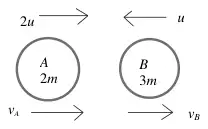
1. A particle \(A\) has mass \(2m\) and a particle \(B\) has mass \(3m\). The particles are moving in opposite directions along the same straight line and collide directly.
Immediately before the collision, the speed of \(A\) is \(2u\) and the speed of \(B\) is \(u\). Immediately after the collision, the speed of \(A\) is \(0.5u\) and the speed of \(B\) is \(w\).
Given that the direction of motion of each particle is reversed by the collision,
(a) find \(w\) in terms of \(u\) (3)
(b) find the coefficient of restitution between the particles, (3)
(c) find, in terms of \(m\) and \(u\), the magnitude of the impulse received by \(A\) in the collision. (3)
Mark scheme (a)
Scheme
Marks
AO
Use of CLM:
M1
3.1a
\(2m \times 2u - 3mu = -2m \times 0.5u + 3mw\)
OR: \((I =)\ \ 2m(0.5u - -2u) = 3m(w - -u)\)
A1
1.1b
\(w = \dfrac{2u}{3}\) accept \(0.67u\) or better
A1
1.1b
(3)
Notes
M1: Use of CLM, with correct no. of terms, condone consistent extra \(g\)’s, sign errors, cancelled \(m\)’s, to produce an equation in (\(m\)), \(u\) and \(w\) only. OR: Use of two imp-mom equations, with \(I\) then eliminated, to produce an equation in (\(m\)), \(u\) and \(w\) only, condone consistent extra \(g\)’s, sign errors, cancelled \(m\)’s. N.B. Allow the use of another letter for \(w\) in the working.
A1: Correct equation in (\(m\)), \(u\) and their \(w\) only.
A1: Cao. Must see \(w = ku\)
Mark scheme (b)
Scheme
Marks
AO
Use of NEL
M1
3.4
\(e = \dfrac{0.5u + \dfrac{2u}{3}}{2u + u}\)
A1ft
1.1b
\(\dfrac{7}{18}\) accept 0.39 or better
A1
1.1b
(3)
Notes
M1: Use of NEL, must be the right way up with the ‘correct’ terms but condone sign errors. Allow without the \(u\)’s
A1ft: Correct unsimplified expression, ft on their \(w\)
A1: cao
Mark scheme (c)
Scheme
Marks
AO
Use of impulse-momentum principle for \(A\) or \(B\)
M1
3.1a
\(\pm 2m(0.5u - -2u)\) OR \(\pm 3m\left(\dfrac{2u}{3} - -u\right)\)
A1
1.1b
\(5mu\)
A1
1.1b
(3)
(9 marks)
Notes
M1: Correct structure but condone sign errors (M0 if \(g\) included or \(m\)’s missing) Can score this mark if they use \(m\) for the mass with a ‘correct’ pair of velocities.
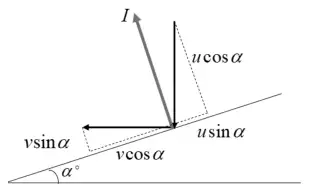
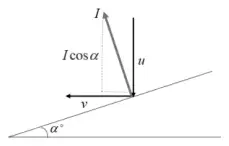
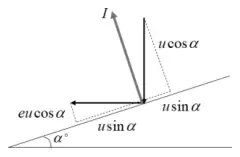
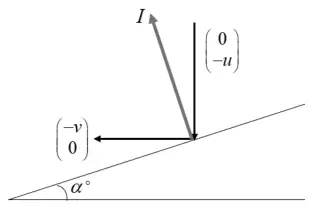
6. A particle \(P\) of mass \(m\) is falling vertically when it strikes a fixed smooth inclined plane. The plane is inclined to the horizontal at an angle \(\alpha\), where \(0 < \alpha \leqslant 45^\circ\)
At the instant immediately before the impact, the speed of \(P\) is \(u\).
At the instant immediately after the impact, \(P\) is moving horizontally with speed \(v\).
(a) Show that the magnitude of the impulse exerted on the plane by \(P\) is \(mu\sec\alpha\) (5)
The coefficient of restitution between \(P\) and the plane is \(e\), where \(e > 0\)
(b) Show that \(v^2 = u^2(\sin^2\alpha + e^2\cos^2\alpha)\) (3)
(c) Show that the kinetic energy lost by \(P\) in the impact is \[\frac{1}{2}mu^2(1 - e^2)\cos^2\alpha\] (2)
(d) Hence find, in terms of \(m\), \(u\) and \(e\) only, the kinetic energy lost by \(P\) in the impact. (2)
M1: Correct no. of terms, dimensionally correct, mass × velocity, condone sin/cos confusion.
A1: Correct equation
M1: Dimensionally correct. Must be subtracting, but condone subtracting in the wrong order and sin/cos confusion
A1: Correct unsimplified equation
A1*: Given answer correctly obtained. Must be EXACT factorisation.
6(a) alt1
Scheme
Marks
AO
Impulse-momentum vertically.
M1 M1
3.1a 3.1a
\(I\cos\alpha = m(0 - -u)\)
A1 A1
1.1b 1.1b
\(I = mu\sec\alpha\) *
A1*
2.2a
(5)
6(a) alt 2
Scheme
Marks
AO
Introduce and use an expression for \(e\)
CLM along the plane:
M1
3.1a
\(u\sin\alpha\) unchanged
A1
1.1b
Finds an expression for \(e\) together with Impulse-momentum perpendicular to the plane \(\quad \tan\alpha = \dfrac{eu\cos\alpha}{u\sin\alpha} \Rightarrow e = \tan^2\alpha\) and \(I = m(eu\cos\alpha - (-u\cos\alpha))\)
\((m)u\sin\alpha = (m)v\cos\alpha\) (this leads to \(v = u\tan\alpha\))
A1
1.1b
Impulse-momentum as a vector equation followed by Pythagoras to find the magnitude. \(I = m\begin{pmatrix} -v \\ u \end{pmatrix}\) and \(|I| = m\sqrt{v^2 + u^2}\)
Squaring and adding their expressions for \(v\sin\alpha\) and \(v\cos\alpha\).
M1
1.1b
\(v^2 = u^2(\sin^2\alpha + e^2\cos^2\alpha)\) *
A1*
1.1b
(3)
Notes
M1: Attempt at NEL
M1: Squaring and adding their expressions for \(v\sin\alpha\) and \(v\cos\alpha\) to obtain \(v^2\).
A1*: Given answer correctly obtained. Must be EXACT.
Mark scheme (c)
Scheme
Marks
AO
KE loss = \(\dfrac{1}{2}mu^2 - \dfrac{1}{2}mu^2(\sin^2\alpha + e^2\cos^2\alpha)\).
M1
2.1
Use \(\sin^2\alpha + \cos^2\alpha = 1\) to give \(\qquad\) KE loss = \(\dfrac{1}{2}mu^2(1 - e^2)\cos^2\alpha\) *
A1*
1.1b
(2)
Notes
M1: Expression for difference of KE in terms of \(m\), \(u\), \(\alpha\) and \(e\)
A1*: Given answer correctly obtained. Factorisation must be EXACT.
Mark scheme (d)
Scheme
Marks
AO
Use \(\tan^2\alpha = e\) oe to eliminate \(\alpha\) in given expression from (c)
M1
3.1a
KE Loss = \(\dfrac{1}{2}mu^2(1 - e)\) or \(\dfrac{1}{2}mu^2\dfrac{1}{1 + e}(1 - e^2)\)
A1
1.1b
(2)
(12 marks)
Notes
M1: Complete method to eliminate \(\alpha\) e.g. using \(\tan^2\alpha = e\) to eliminate \(\alpha\) Any trig identity used must be correct eg \(\sec^2\alpha = 1 + e\) or \(\cos^2\alpha = \dfrac{1}{1 + e}\)
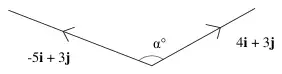
1. A particle \(P\) of mass 2 kg is moving with velocity \((-4\mathbf{i} + 3\mathbf{j})\ \text{m s}^{-1}\) when it receives an impulse \((-6\mathbf{i} + 42\mathbf{j})\ \text{N s}\).
(a) Find the speed of \(P\) immediately after receiving the impulse. (4)
The angle through which the direction of motion of \(P\) has been deflected by the impulse is \(\alpha^\circ\)
Find magnitude of their v: \(\sqrt{(-7)^2 + 24^2}\)
M1
1.1b
\(25\ (\text{m s}^{-1})\)
A1
1.1b
(4)
Notes
M1: Dimensionally correct, mass \(\times\) velocity. Must be subtracting momenta but condone subtracting in the wrong order. M0 if \(g\) is included.
A1: Correct unsimplified equation.
M1: Correct application of Pythagoras to find the magnitude of their \(v\). M0 for an incorrect speed if there is no evidence of Pythagoras being used on their velocity.
A1: Correct answer following the correct velocity.
M1: Complete method to find the required angle. Correct use of scalar product with their v. The formula must be correct, \(\cos\alpha = \dfrac{\mathbf{u} \cdot \mathbf{v}}{|\mathbf{u}||\mathbf{v}|}\) M0 if the fraction is up the wrong way. Do not ISW.
A1: cao in degrees
1(b) alt 1
Scheme
Marks
AO
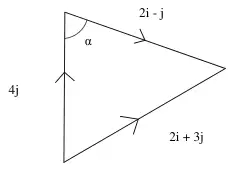
Use cosine rule in a vector triangle: \(\cos\alpha = \dfrac{\{(-4)^2 + 3^2\} + \{(-7)^2 + 24^2\} - (3^2 + (-21)^2)}{2 \times 5 \times \sqrt{(-7)^2 + 24^2}}\)
M1
3.1a
\(\alpha = 37\) or better
A1
1.1b
(2)
M1: Complete method to find the required angle. Correct use of cosine rule on \((\mathbf{v} - \mathbf{u})\) or \((\mathbf{u} - \mathbf{v})\) vector triangle for their v. M0 if using \((\mathbf{v} + \mathbf{u})\). Do not ISW.
M1: Complete method to find the required angle. Correct use of inverse tan formulae for their v. Do not ISW. M0 for \(\tan^{-1}\left(\dfrac{3}{4}\right)\) alone which also gives the value 36.869…
1. Two particles, \(P\) and \(Q\), of masses \(3m\) and \(2m\) respectively, are moving on a smooth horizontal plane. They are moving in opposite directions along the same straight line when they collide directly.
Immediately before the collision, \(P\) is moving with speed \(2u\).
The magnitude of the impulse exerted on \(P\) by \(Q\) in the collision is \(\dfrac{9mu}{2}\)
(a) Find the speed of \(P\) immediately after the collision. (3)
The coefficient of restitution between \(P\) and \(Q\) is \(e\).
Given that the speed of \(Q\) immediately before the collision is \(u\),
(b) find the value of \(e\). (5)
Mark scheme (a)
Scheme
Marks
AO
\[\begin{array}{cccc} & 2u \rightarrow & \leftarrow u & \\ \dfrac{9mu}{2} \longleftarrow & (P)\ 3m & (Q)\,2m & \longrightarrow \dfrac{9mu}{2} \\ & \rightarrow v & \rightarrow y & \end{array}\]
Use of Impulse-momentum principle for \(P\)
M1
3.1a
\(-\dfrac{9mu}{2} = 3m(v - 2u)\)
A1
1.1b
\(v = \dfrac{u}{2}\)
A1
1.1b
(3)
Notes
M1: Use of Impulse-momentum principle for \(P\), condone sign errors but M0 if dimensionally incorrect e.g. if \(m\) missing or \(g\) included.
A1: Correct unsimplified equation (may have \(-v\))
A1: cao (must be positive)
Mark scheme (b)
Scheme
Marks
AO
Use of Impulse-momentum principle for \(Q\) or CLM
M1: Use of Impulse-momentum principle for \(Q\), must be using \(2m\), condone sign errors but M0 if dimensionally incorrect e.g. \(g\) included Or use of CLM, condone sign errors and consistent omission of \(m\)’s or consistent extra \(g\)’s, with their \(v\). Must be using correct masses on all four terms.
A1: Correct unsimplified equation
M1: Use of NEL with their \(v\) and their \(y\), condone sign errors but M0 if ratio for \(e\) is inverted
A1: Correct unsimplified equation in \(u\) and \(e\) only
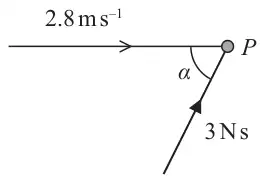
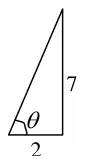
A particle \(P\) of mass 0.5 kg is moving in a straight line with speed \(2.8\ \text{m s}^{-1}\) when it receives an impulse of magnitude 3 N s. The angle between the direction of motion of \(P\) immediately before receiving the impulse and the line of action of the impulse is \(\alpha\), where \(\tan\alpha = \dfrac{4}{3}\), as shown in Figure 2.
Find the speed of \(P\) immediately after receiving the impulse. (5)
Alternative working parallel and perpendicular to the impulse: \(\begin{pmatrix} 3 \\ 0 \end{pmatrix} = \dfrac{1}{2}\begin{pmatrix} v_1 - 2.8 \times \cos\alpha \\ v_2 \pm 2.8 \times \sin\alpha \end{pmatrix}\) \(v_1 = 7.68,\ v_2 = \pm 2.24\) \(v = \sqrt{7.68^2 + 2.24^2} = 8\ (\text{m s}^{-1})\)
(5)
(5 marks)
Notes
M1: Use of \(\mathbf{I} = m\mathbf{v} - m\mathbf{u}\) in two dimensions. (i.e. resolving used) Dimensionally correct. Allow for a combined equation in vector format or for just one component. Condone sin/cos confusion. Allow if \(m\) seen but not substituted.
A1 A1: Equation for one component correct unsimplified Equations for both components correct unsimplified Allow A1A1 for a correct unsimplified vector equation Allow A marks if in terms of \(m\) and \(\alpha\)
M1: Correct use of Pythagoras for their components to obtain the numerical value of the speed This may be seen or implied: an alert candidate might spot the 3, 4, 5 triangle.
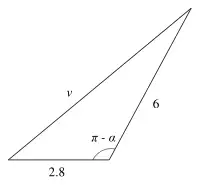
M1: Correct use of cosine rule in a dimensionally correct triangle. The lengths of the sides must be consistent, i.e. \(v\), 2.8 and 6 or \(\tfrac{1}{2}v\), 1.4 and 3 and it must be a correct vector triangle (vectors combined correctly)
A1 A1: Unsimpified equation with at most one error Correct unsimplified equation
2. Two particles, \(A\) and \(B\), have masses \(m\) and \(3m\) respectively. The particles are moving in opposite directions along the same straight line on a smooth horizontal plane when they collide directly.
Immediately before they collide, \(A\) is moving with speed \(2u\) and \(B\) is moving with speed \(u\).
The direction of motion of each particle is reversed by the collision.
In the collision, the magnitude of the impulse exerted on \(A\) by \(B\) is \(\dfrac{9mu}{2}\)
(a) Find the value of the coefficient of restitution between \(A\) and \(B\). (7)
(b) Hence, write down the total loss in kinetic energy due to the collision, giving a reason for your answer. (1)
Mark scheme (a)
Scheme
Marks
AO
\[\begin{array}{cccc} & 2u \rightarrow & \leftarrow u & \\ \dfrac{9mu}{2} \longleftarrow & m & 3m & \longrightarrow \dfrac{9mu}{2} \\ & v \leftarrow & \rightarrow w & \end{array}\]
Use of Impulse-momentum principle for \(A\) or \(B\)
N.B.Ignore diagrams if it helps the candidate. Equations need to be consistent, where appropriate, to earn A marks.
M1: Use of Impulse-momentum principle for \(A\) or \(B\), condone sign errors but M0 if dimensionally incorrect e.g. if \(m\) missing
A1: Correct unsimplified equation
M1: Use of Impulse-momentum principle for other particle or CLM, condone sign errors but M0 if dimensionally incorrect e.g. if \(m\) missing from impulse For CLM, allow consistent missing \(m\)’s or extra \(g\)’s.
A1: Correct unsimplified equation
A1: Cao for both. Allow one or both negative if correct for their symbols.
M1: Use of NEL to obtain \(e = \ldots\), condone sign errors in numerator but must be terms in \(u\) only AND must be \((2u + u)\) in denominator. M0 if inverted
A1: cso
ALTERNATIVE
Scheme
Marks
AO
NEL is written down before \(v\) and \(w\) are found: \(v + w = 3ue\)
3rd M1
Use of Impulse-momentum principle for \(A\) or \(B\)
Use of Impulse-momentum principle for \(B\) or \(A\) or CLM
2nd M1
\(\dfrac{9mu}{2} = 3m(w - -u)\) or \(\dfrac{9mu}{2} = m(v - -2u)\) or \(2mu - 3mu = -mv + 3mw\)
2nd A1
An equation (not an identity) in \(u\) and \(e\) only is produced
3rd A1
\(e = 1\)
A1cso
Mark scheme (b)
Scheme
Marks
AO
Perfectly elastic (or the coefficient of restitution is 1) so no loss in kinetic energy. Allow a direct evaluation of the KE loss i.e. \(\dfrac{1}{2}m(2u)^2 + \dfrac{1}{2} \times 3mu^2 - \left(\dfrac{1}{2}m\left(\dfrac{5u}{2}\right)^2 + \dfrac{1}{2} \times 3m\left(\dfrac{u}{2}\right)^2\right) = 0\) B0 if incorrect extras
DB1
2.4
(1)
(8 marks)
Notes
N.B.Ignore diagrams if it helps the candidate. Equations need to be consistent, where appropriate, to earn A marks.
DB1: Dependent on \(e = 1\) correctly obtained in (a) A correct statement e.g. zero, 0 etc and a correct reason
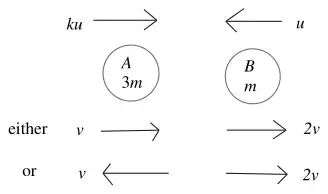
1. A particle \(A\) of mass \(3m\) and a particle \(B\) of mass \(m\) are moving along the same straight line on a smooth horizontal surface. The particles are moving in opposite directions towards each other when they collide directly.
Immediately before the collision, the speed of \(A\) is \(ku\) and the speed of \(B\) is \(u\). Immediately after the collision, the speed of \(A\) is \(v\) and the speed of \(B\) is \(2v\).
The magnitude of the impulse received by \(B\) in the collision is \(\dfrac{3}{2}mu\).
(a) Find \(v\) in terms of \(u\) only. (3)
(b) Find the two possible values of \(k\). (5)
Mark scheme (a)
Scheme
Marks
AO
Note that if they start with their 2v to the left this creates an impossible situation (the particles need to pass through each other). The maximum score is M1M1M1.
Impulse received by \(B\):
M1
3.4
\(\dfrac{3}{2}mu = m\big(2v - (-u)\big)\)
A1
1.1b
\(v = \dfrac{u}{4}\)
A1
1.1b
(3)
Notes
M1: Form impulse-momentum equation for \(B\) (or \(A\)). May be expressed as either \(\mathbf{I} = m\mathbf{v} - m\mathbf{u}\) or \(\mathbf{I} + m\mathbf{u} = m\mathbf{v}\). Dimensionally correct. Must be considering difference in velocities Must have a correct combination of mass and velocity: pairing velocity of one with the mass of the other scores M0 Allow for subtraction the wrong way round or impulse in the wrong direction. Assuming that you have not seen an incorrect formula stated, allow for \(2v + u\) without overt evidence of subtraction. Allow if the common factor of \(m\) is not seen
A1: Correct unsimplified equation for \(B\) (or \(A\)). Allow without \(m\)
A1: Correct answer only
Mark scheme (b)
Scheme
Marks
AO
Use of CLM or Impulse-momentum for one option for \(A\):
M1
3.4
\(3kmu - mu = 2mv + 3mv\left(= \dfrac{5mu}{4}\right)\) or \(3m(v - ku) = -\dfrac{3mu}{2}\) \(\left(3mu\left(\dfrac{1}{4} + \dfrac{1}{2}\right) = 3mku\right)\)
A1ft
1.1b
\(k = \dfrac{3}{4}\)
A1
1.1b
Form a second equation in \(k\) \(\left(3mku - mu = 2mv - 3mv\left(= -\dfrac{mu}{4}\right)\ \text{or}\ 3m(v + ku) = \dfrac{3mu}{2}\right)\)
M1
3.1a
\(k = \dfrac{1}{4}\)
A1
1.1b
(5)
(8 marks)
Notes
M1: Correct method to form an equation in \(k\). Must be dimensionally correct Condone sign errors in CLM. Allows marks for CLM equation here if seen in (a) and used correctly to find \(k\) here. Rules for impulse-momentum as above. M1 is available if they have not reversed the direction of the impulse. An equation which allows for the change in direction by using \(\mathbf{u} - \mathbf{v}\) can score full marks. Could be working with either option for the direction of motion of \(A\)
A1ft: Correct unsimplified equation in \(u\), \(v\) or their \(v\)
A1: One correct solution Be aware that a sign error in the impulse-momentum equation for \(A\) can lead to a fortuitous answer. A fortuitous answer scores A0 (FYI the incorrect answers are \(\tfrac{-7}{4}\) and \(\tfrac{1}{4}\))
M1: Correct method to form a second equation in \(k\) (reversing the direction of motion of \(A\))
M1: Use of \(\mathbf{I} = m\mathbf{v} - m\mathbf{u}\) with velocities or perpendicular components of velocities. Must be subtracting but allow subtraction in either order.
4. A particle \(P\) has mass 0.5 kg. It is moving in the \(xy\) plane with velocity \(8\mathbf{i}\ \text{m s}^{-1}\) when it receives an impulse \(\lambda(-\mathbf{i} + \mathbf{j})\) N s, where \(\lambda\) is a positive constant.
The angle between the direction of motion of \(P\) immediately before receiving the impulse and the direction of motion of \(P\) immediately after receiving the impulse is \(\theta^\circ\)
Immediately after receiving the impulse, \(P\) is moving with speed \(4\sqrt{10}\ \text{m s}^{-1}\)
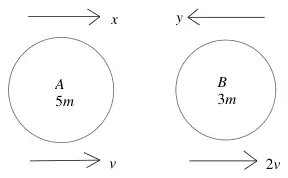
2. Two particles, \(A\) and \(B\), are moving in opposite directions along the same straight line on a smooth horizontal surface when they collide directly.
Particle \(A\) has mass \(5m\) and particle \(B\) has mass \(3m\).
The coefficient of restitution between \(A\) and \(B\) is \(e\), where \(e \gt 0\)
Immediately after the collision the speed of \(A\) is \(v\) and the speed of \(B\) is \(2v\).
Given that \(A\) and \(B\) are moving in the same direction after the collision,
(a) find the set of possible values of \(e\). (8)
Given also that the kinetic energy of \(A\) immediately after the collision is 16% of the kinetic energy of \(A\) immediately before the collision,
(b) find
(i) the value of \(e\),
(ii) the magnitude of the impulse received by \(A\) in the collision, giving your answer in terms of \(m\) and \(v\).
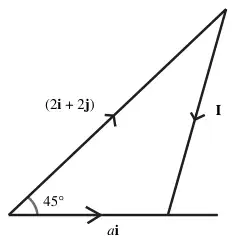
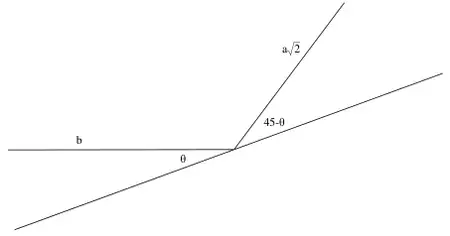
Use of scalar product \((-3\mathbf{i} + 2\mathbf{j}).(2\mathbf{i} + 3\mathbf{j}) = -6 + 6 = 0\)
M1
1.1b
Hence impulse perpendicular to \((2\mathbf{i} + 3\mathbf{j})\), so \(AB\) must be parallel to \((2\mathbf{i} + 3\mathbf{j})\). *
A1*
2.2a
(4)
Notes
Correction: In Alternative (a) 2 the ratio is \(b = \dfrac{3}{2}a\) (corrected from the printed mark scheme: \(b = \dfrac{2}{3}a\)).
M1: Must be finding the difference between two momenta or two velocities
A1: Correct unsimplified equation for the impulse or for change in velocity
M1: Use of scalar product or equivalent. In the alt method allow full marks if \(\sqrt{13}\) not used.
A1*: Reach given conclusion from correct working
If working with angles, score M1 for correct method to find components parallel to the wall A1 for \(\sqrt{53}\cos 40.36..^\circ\) and \(\sqrt{37}\cos 24.23..^\circ\) M1 for comparing the two values A0 because the work has involved decimal approximations (since working towards an exact given answer). Alternative: Could use \(e\tan 24.2..^\circ = \tan 40.36..^\circ\)
Alternative (a)
Scheme
Marks
AO
Components of velocities parallel to \((2\mathbf{i} + 3\mathbf{j})\):
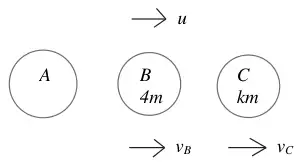
3. Three particles \(A\), \(B\) and \(C\) are at rest on a smooth horizontal plane. The particles lie along a straight line with \(B\) between \(A\) and \(C\).
Particle \(B\) has mass \(4m\) and particle \(C\) has mass \(km\), where \(k\) is a positive constant. Particle \(B\) is projected with speed \(u\) along the plane towards \(C\) and they collide directly.
The coefficient of restitution between \(B\) and \(C\) is \(\dfrac{1}{4}\)
(a) Find the range of values of \(k\) for which there would be no further collisions. (8)
The magnitude of the impulse on \(B\) in the collision between \(B\) and \(C\) is \(3mu\)
1. A particle \(P\) of mass 0.5 kg is moving with velocity \((4\mathbf{i} + 3\mathbf{j})\ \text{m s}^{-1}\) when it receives an impulse \(\mathbf{J}\) N s. Immediately after receiving the impulse, \(P\) is moving with velocity \((-\mathbf{i} + 6\mathbf{j})\ \text{m s}^{-1}\).
(a) Find the magnitude of \(\mathbf{J}\). (4)
The angle between the direction of the impulse and the direction of motion of \(P\) immediately before receiving the impulse is \(\alpha^\circ\)
M1: Correct use of trig to find a relevant angle using \(4\mathbf{i} + 3\mathbf{j}\) and their \(\mathbf{J}\) i.e. \(\alpha^\circ\) or \(180^\circ - \alpha^\circ\) Allow \(\left|\dfrac{\mathbf{a}.\mathbf{b}}{|\mathbf{a}||\mathbf{b}|}\right|\)
A1ft: Correct unsimplified expression for the required angle. Follow their \(\mathbf{J}\) A0 for \(\left|\dfrac{\mathbf{a}.\mathbf{b}}{|\mathbf{a}||\mathbf{b}|}\right|\) Do not ISW
A1: 110 or better (112.166…..) or accept \(247.8\ldots^\circ\)
Alternative (b)
Scheme
Marks
AO
Use scalar product of \(\mu\mathbf{J}\) and \(4\mathbf{i} + 3\mathbf{j}\) to find the angle
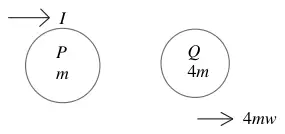
1. Two particles \(P\) and \(Q\) have masses \(m\) and \(4m\) respectively. The particles are at rest on a smooth horizontal plane. Particle \(P\) is given a horizontal impulse, of magnitude \(I\), in the direction \(PQ\). Particle \(P\) then collides directly with \(Q\). Immediately after this collision, \(P\) is at rest and \(Q\) has speed \(w\). The coefficient of restitution between the particles is \(e\).
(a) Find \(I\) in terms of \(m\) and \(w\). (2)
(b) Show that \(e = \dfrac{1}{4}\) (1)
(c) Find, in terms of \(m\) and \(w\), the total kinetic energy lost in the collision between \(P\) and \(Q\). (2)
Mark scheme (a)
Scheme
Marks
AO
Use of CLM: \(m \times \dfrac{I}{m} = 4mw\)
M1
3.1a
\(I = 4mw\)
A1
1.1b
(2)
Notes
M1: Correct no. of terms, condone extra \(g\) s, sign errors (must be equation in \(I\), \(m\) and \(w\) only)
A1: Correct equation
Answer not given, so a correct answer with no clear error seen will score M1A1 An answer that relies on an impulse-momentum equation using \(4m\) will score M0
Mark scheme (b)
Scheme
Marks
AO
\(e = \dfrac{w}{4w} = \dfrac{1}{4}\) *
B1*
3.4
(1)
Notes
B1*: Use of NLR to obtain given answer
Mark scheme (c)
Scheme
Marks
AO
KE Loss \(= \dfrac{1}{2}m(4w)^2 - \dfrac{1}{2}4mw^2\)
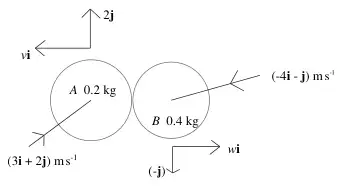
6. [In this question \(\mathbf{i}\) and \(\mathbf{j}\) are perpendicular unit vectors in a horizontal plane.]
A smooth uniform sphere \(A\) has mass 0.2 kg and another smooth uniform sphere \(B\), with the same radius as \(A\), has mass 0.4 kg.
The spheres are moving on a smooth horizontal surface when they collide obliquely. Immediately before the collision, the velocity of \(A\) is \((3\mathbf{i} + 2\mathbf{j})\ \text{m s}^{-1}\) and the velocity of \(B\) is \((-4\mathbf{i} - \mathbf{j})\ \text{m s}^{-1}\)
At the instant of collision, the line joining the centres of the spheres is parallel to \(\mathbf{i}\)
The coefficient of restitution between the spheres is \(\dfrac{3}{7}\)
(a) Find the velocity of \(A\) immediately after the collision. (7)
(b) Find the magnitude of the impulse received by \(A\) in the collision. (2)
(c) Find, to the nearest degree, the size of the angle through which the direction of motion of \(A\) is deflected as a result of the collision. (3)
Alternative method: \(180^\circ - \tan^{-1}\dfrac{2}{3} - \tan^{-1}\dfrac{6}{11}\) Or \(\tan^{-1}\dfrac{3}{2} + \tan^{-1}\dfrac{11}{6}\)
(3)
(12 marks)
Notes
M1: Complete method for finding the required angle. Allow for \(\tan^{-1}\dfrac{3}{2}\) or \(\tan^{-1}\dfrac{2}{3}\) and \(\tan^{-1}\dfrac{6}{11}\) or \(\tan^{-1}\dfrac{11}{6}\)
A1ft: A correct unsimplified expression Follow their \(\mathbf{v}_A\). Do not ISW
A1: Correct answer only. (Q asks for the nearest degree) Do not ISW
3. A particle \(P\), of mass 0.5 kg, is moving with velocity \((4\mathbf{i} + 4\mathbf{j})\ \text{m s}^{-1}\) when it receives an impulse \(\mathbf{I}\) of magnitude 2.5 N s.
As a result of the impulse, the direction of motion of \(P\) is deflected through an angle of \(45^\circ\)
Given that \(\mathbf{I} = (\lambda\mathbf{i} + \mu\mathbf{j})\) N s, find all the possible pairs of values of \(\lambda\) and \(\mu\). (9)
Mark scheme
Scheme
Marks
AO
Momentum of \(P\) after impulse \(= a\mathbf{i}\) (or \(a\mathbf{j}\))
B1
2.2a
Either Use of \(\mathbf{I} = m(\mathbf{v} - \mathbf{u})\): \((\mathbf{I} =)\ 0.5\big(2a\mathbf{i} - (4\mathbf{i} + 4\mathbf{j})\big)\ \big(= (a - 2)\mathbf{i} - 2\mathbf{j}\big)\)
2. Two particles, \(A\) and \(B\), of masses \(2m\) and \(3m\) respectively, are moving on a smooth horizontal plane. The particles are moving in opposite directions towards each other along the same straight line when they collide directly. Immediately before the collision the speed of \(A\) is \(2u\) and the speed of \(B\) is \(u\). In the collision the impulse of \(A\) on \(B\) has magnitude \(5mu\).
(a) Find the coefficient of restitution between \(A\) and \(B\). (9)
(b) Find the total loss in kinetic energy due to the collision. (4)
Could find \(v_A\) before \(v_B\): M1A1A1 for first velocity, M1A1A1 for second M1A1A1 for \(e\) found correctly
Candidates are approaching this in many different ways. They need - two of momentum impulse equation for each particle and CLM - impact law M1A1 for each correct equation (in the order seen) Of the remaining 3 A marks, A1 for a correct expression for \(v_A\) or \(v_B\) A1 for a correct expression in \(e\) A1 for the correct answer
M1: Correct no. of terms and must be a difference. Must be dimensionally correct at the point when they state their expression for the loss (change) in KE
A1ft: Unsimplified expression in \(u\) with at most 1 error, ft on their speeds from (a)
A1ft: Correct unsimplified expression in \(u\). (These first 3 marks can be scored for a correct loss or gain in KE), ft on their speeds from (a)
1. A small ball of mass 0.3 kg is released from rest from a point 3.6 m above horizontal ground. The ball falls freely under gravity, hits the ground and rebounds vertically upwards.
In the first impact with the ground, the ball receives an impulse of magnitude 4.2 N s. The ball is modelled as a particle.
(a) Find the speed of the ball immediately after it first hits the ground. (5)
(b) Find the kinetic energy lost by the ball as a result of the impact with the ground. (3)
Mark scheme (a)
Scheme
Marks
AO
Speed just before impact: \(v^2 = u^2 + 2as = 2 \times 9.8 \times 3.6\ (= 70.56)\)
M1
3.4
\(v = 8.4\ (\text{m s}^{-1})\)
A1
1.1b
Use of \(I = mv - mu\): \(4.2 = 0.3\big(w - (-8.4)\big)\)
M1
3.1b
Follow their 8.4
A1ft
1.1b
\(w = 5.6\ (\text{m s}^{-1})\)
A1
1.1b
(5)
Notes
M1: Use the model and suvat or energy to find speed before impact
M1: A complete strategy to find \(w\): Use the model and impulse-momentum equation using given impulse and their speed of impact. Must be using a difference in velocities. Be vigilant for sign fudges that make the original equation incorrect.
A1ft: Correct unsimplified equation using their speed
A1: Correct positive answer
Mark scheme (b)
Scheme
Marks
AO
KE lost \(= \dfrac{1}{2}m\left(v^2 - w^2\right)\)
M1
3.3
\(= \dfrac{0.3}{2}\left(8.4^2 - 5.6^2\right)\) Follow their 8.4 and 5.6
A1ft
1.1b
\(= 5.88\ (\text{J})\)
A1
1.1b
(3)
(8 marks)
Notes
M1: Correct method to find the KE lost in the impact. Need to be using speeds immediately before and immediately after impact.
A1ft: Correct expression for their speeds. Accept subtraction either way round
7. Two smooth uniform spheres \(A\) and \(B\), of mass 2 kg and 3 kg respectively, and of equal radius, are moving on a smooth horizontal plane when they collide.
Immediately before the collision the velocity of \(A\) is \((3\mathbf{i} + \mathbf{j})\) m s\(^{-1}\) and the velocity of \(B\) is \((-\mathbf{i} + 2\mathbf{j})\) m s\(^{-1}\). Immediately after the collision the velocity of \(A\) is \((\mathbf{i} + 3\mathbf{j})\) m s\(^{-1}\).
(a) Show that, at the instant when \(A\) and \(B\) collide, their line of centres is parallel to \(-\mathbf{i} + \mathbf{j}\). (4)
(b) Find the velocity of \(B\) immediately after the collision. (3)
(c) Find the coefficient of restitution between \(A\) and \(B\). (6)
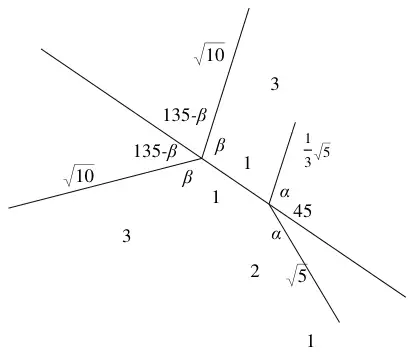
Components of velocities parallel to \(-\mathbf{i} + \mathbf{j}\): \(A\) before : \((3\mathbf{i} + \mathbf{j})\cdot\dfrac{1}{\sqrt{2}}(-\mathbf{i} + \mathbf{j}) = \dfrac{-2}{\sqrt{2}}\) \(A\) after : \((\mathbf{i} + 3\mathbf{j})\cdot\dfrac{1}{\sqrt{2}}(-\mathbf{i} + \mathbf{j}) = \dfrac{2}{\sqrt{2}}\) \(B\) before : \((-\mathbf{i} + 2\mathbf{j})\cdot\dfrac{1}{\sqrt{2}}(-\mathbf{i} + \mathbf{j}) = \dfrac{3}{\sqrt{2}}\) \(B\) after : \(\dfrac{1}{3}(\mathbf{i} + 2\mathbf{j})\cdot\dfrac{1}{\sqrt{2}}(-\mathbf{i} + \mathbf{j}) = \dfrac{1}{3\sqrt{2}}\) follow through from 7(b) NB: the marks are all available if the unit vector \(\left(\sqrt{2}\right)\) is not used.
M1A3
Coefficient of restitution: \(\dfrac{1}{\sqrt{2}}\left(2 - \dfrac{1}{3}\right) = \dfrac{e}{\sqrt{2}}(3 + 2)\)
5. At time \(t = 0\) a rocket is launched. The rocket has initial mass \(M\), of which mass \(\lambda M\), \(0 \lt \lambda \lt 1\), is fuel. The rocket is launched vertically upwards, from rest, from the surface of the Earth. The rocket burns fuel and the burnt fuel is ejected vertically downwards with constant speed \(U\) relative to the rocket. At time \(t\), the rocket has mass \(m\) and velocity \(v\). Ignoring air resistance and any variation in \(g\),
(a) show, from first principles, that until all the fuel is used, \[m\frac{\mathrm{d}v}{\mathrm{d}t} + U\frac{\mathrm{d}m}{\mathrm{d}t} = -mg\] (4)
The rocket accelerates vertically upwards with constant acceleration \(g\).
(b) Show that \(m = M\mathrm{e}^{\frac{-2gt}{U}}\) (4)
(c) Find, in terms of \(M\), \(U\) and \(\lambda\), an expression for the kinetic energy of the rocket at the instant when all of the fuel has been used. (6)
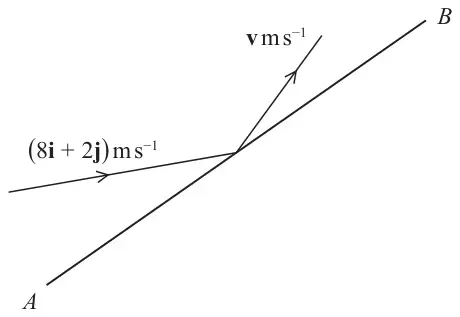
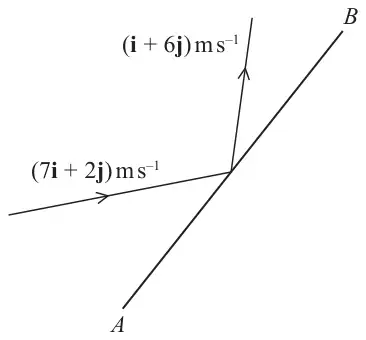
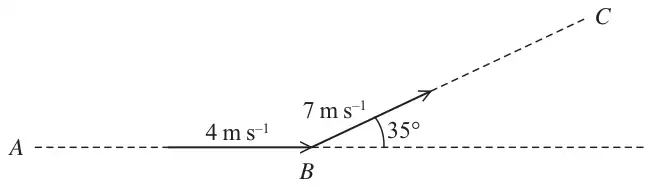
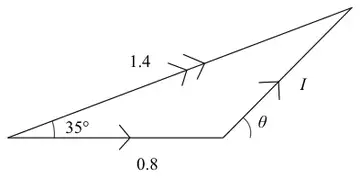
The points \(A\), \(B\) and \(C\) lie on a smooth horizontal plane. A small ball of mass 0.2 kg is moving along the line \(AB\) with speed 4 m s\(^{-1}\). When the ball is at \(B\), the ball is given an impulse. Immediately after the impulse is given, the ball moves along the line \(BC\) with speed 7 m s\(^{-1}\). The line \(BC\) makes an angle of 35\(^\circ\) with the line \(AB\), as shown in Figure 1.
(a) Find the magnitude of the impulse given to the ball. (4)
(b) Find the size of the angle between the direction of the impulse and the original direction of motion of the ball. (3)
Mark scheme (a)
Scheme
Marks
Using column vectors or \(\mathbf{i}\) and \(\mathbf{j}\): \(\begin{pmatrix}I\cos\theta\\I\sin\theta\end{pmatrix} = 0.2\begin{pmatrix}7\cos 35\\7\sin 35\end{pmatrix} - 0.2\begin{pmatrix}4\\0\end{pmatrix}\)
1. Two particles, \(P\) and \(Q\), have masses \(3m\) and \(m\) respectively. They are moving in opposite directions towards each other along the same straight line on a smooth horizontal plane and collide directly. The speeds of \(P\) and \(Q\) immediately before the collision are \(2u\) and \(4u\) respectively. The magnitude of the impulse received by each particle in the collision is \(\dfrac{21mu}{4}\).
(a) Find the speed of \(P\) after the collision. (3)
(b) Find the speed of \(Q\) after the collision. (3)
Mark scheme (a)
Scheme
Marks
For \(P\): \(\ -\dfrac{21mu}{4} = 3m(v_P - 2u)\)
M1A1
\(v_P = \dfrac{u}{4}\)
A1
(3)
Notes
M1 for using Impulse = Change in Momentum of \(P\) (must have \(3m\) in both terms) (M0 if clearly adding momenta or if \(g\) is included) but condone sign errors.
First A1 for a correct equation. (N.B. Could have \(-v_P\) in place of \(v_P\))
Second A1 for \(\dfrac{u}{4}\) oe (must be positive)
N.B. If they try to find \(v_Q\) first and then use CLM to find \(v_P\), M1 for a complete method to find \(v_P\), A1 for correct equations, A1 for the answer for \(v_P\).
If an incorrect \(v_Q\) is then just stated in (b), award relevant marks if seen in working for (a).
If no attempt at (b), then no marks for (b).
Mark scheme (b)
Scheme
Marks
For \(Q\): \(\ \dfrac{21mu}{4} = m(v_Q - -4u)\)
M1A1
\(v_Q = \dfrac{5u}{4}\)
A1
(3)
(6 marks)
Notes
M1 for using Impulse = Change in Momentum of \(Q\) (must have \(m\) in both terms) (M0 if clearly adding momenta or if \(g\) is included) but condone sign errors.
First A1 for a correct equation. (N.B. Could have \(-v_Q\) in place of \(v_Q\))
Second A1 for \(\dfrac{5u}{4}\) oe (must be positive)
OR:
M1 for CLM with correct no. of terms, condone missing \(m\)’s or extra \(g\)’s and sign errors
First A1 for a correct equation
Second A1 for \(\dfrac{5u}{4}\) oe (must be positive)
6. A small object \(P\), of mass \(m_0\), is projected vertically upwards from the ground with speed \(U\). As \(P\) moves upwards it picks up droplets of moisture from the atmosphere. The droplets are at rest immediately before they are picked up. In a model of the motion, \(P\) is modelled as a particle, air resistance is assumed to be negligible and the acceleration due to gravity is assumed to have the constant value of \(g\). When \(P\) is at a height \(x\) above the ground, the combined mass of \(P\) and the moisture is \(m_0(1 + kx)\), where \(k\) is a constant, and the speed of \(P\) is \(v\).
(a) Show that, while \(P\) is moving upwards \[\frac{\mathrm{d}}{\mathrm{d}x}\left(v^2\right) + \frac{2kv^2}{(1 + kx)} = -2g\] (7)
The general solution of this differential equation is given by \(v^2 = \dfrac{A}{(1 + kx)^2} - \dfrac{2g}{3k}(1 + kx)\), where \(A\) is an arbitrary constant.
Given that \(U = \sqrt{2gh}\) and \(k = \dfrac{7}{3h}\)
(b) find, in terms of \(h\), the height of \(P\) above the ground when \(P\) first comes to rest. (5)
First M1 for differentiating \(m\) wrt to \(t\), and using \(v = \dfrac{\mathrm{d}x}{\mathrm{d}t}\)
First A1 for correct expression for \(\dfrac{\mathrm{d}m}{\mathrm{d}t}\) in terms of \(v\)
Second M1 for impulse-momentum principle
Second A1 for a correct diff equn in \(m\), \(v\) and \(t\).
Third M1 for sub for \(m\) and \(\dfrac{\mathrm{d}m}{\mathrm{d}t}\)
Fourth M1 for changing \(\dfrac{\mathrm{d}v}{\mathrm{d}t}\) to \(v\dfrac{\mathrm{d}v}{\mathrm{d}x}\) to \(\dfrac{1}{2}\dfrac{\mathrm{d}(v^2)}{\mathrm{d}x}\)
Third A1 for PRINTED ANSWER
Mark scheme (b)
Scheme
Marks
\(x = 0,\ v^2 = 2gh \Rightarrow 2gh = A - \dfrac{2g}{3k} \Rightarrow A = 2gh + \dfrac{2g}{3k}\)
2. Two particles, \(P\) and \(Q\), have masses \(2m\) and \(3m\) respectively. They are moving towards each other in opposite directions on a smooth horizontal plane when they collide directly. Immediately before they collide the speed of \(P\) is \(4u\) and the speed of \(Q\) is \(3u\). As a result of the collision, \(Q\) has its direction of motion reversed and is moving with speed \(u\).
(a) Find the speed of \(P\) immediately after the collision. (3)
(b) State whether or not the direction of motion of \(P\) has been reversed by the collision. (1)
(c) Find the magnitude of the impulse exerted on \(P\) by \(Q\) in the collision. (3)
Mark scheme (a)
Scheme
Marks
\(8mu - 9mu = -2mV + 3mu\)
M1 A1
\(V = 2u\)
A1
(3)
Notes
M1 for CLM with correct no. of terms, all dimensionally correct, to give an equation in \(m\), \(u\) and their \(V\) only. Condone consistent \(g\)’s or cancelled \(m\)’s.
First A1 for a correct equation (they may have \(+\,2mV\))
Second A1 for \(2u\) (must be positive since speed is required)
Mark scheme (b)
Scheme
Marks
(Has been) reversed
B1
(1)
Notes
B1 for ‘(has been) reversed’. Only available if a correct velocity has been correctly obtained in part (a).
B0 for ‘changed’, ‘direction has changed’, ‘yes’
Mark scheme (c)
Scheme
Marks
For \(Q\): \(\ I = 3m(u - -3u)\)
M1 A1
\(= 12mu\)
A1
OR:
OR
For \(P\): \(\ I = 2m(2u - -4u)\)
M1 A1
\(= 12mu\)
A1
(3)
(7 marks)
Notes
M1 for using Impulse = change in momentum of \(Q\) (must have \(3m\) in both terms) (M0 if clearly adding momenta or if \(g\) is included) but condone sign errors.
First A1 for \(3m(u - -3u)\) or \(-3m(u - -3u)\)
Second A1 for \(12mu\) (must be positive since magnitude required)
OR
M1 for using Impulse = change in momentum of \(P\) (must have \(2m\) in both terms) (M0 if clearly adding momenta) but condone sign errors.
First A1 for \(2m(2u - -4u)\) or \(-2m(2u - -4u)\)
Second A1 for \(12mu\) (must be positive since magnitude required)
N.B. Allow use of \(I = 3m(u - v)\) or \(I = 2m(u - v)\) since only magnitude required
1. A particle \(P\) of mass 0.5 kg is moving with velocity \(4\mathbf{j}\) m s\(^{-1}\) when it receives an impulse \(\mathbf{I}\) N s. Immediately after \(P\) receives the impulse, the velocity of \(P\) is \((2\mathbf{i} + 3\mathbf{j})\) m s\(^{-1}\).
Find
(a) the magnitude of \(\mathbf{I}\), (4)
(b) the angle between \(\mathbf{I}\) and \(\mathbf{j}\). (2)
6. A firework rocket, excluding its fuel, has mass \(m_0\) kg. The rocket moves vertically upwards by ejecting burnt fuel vertically downwards with constant speed \(u\) m s\(^{-1}\), \(u \gt 24.5\), relative to the rocket. The rocket starts from rest on the ground at time \(t = 0\). At time \(t\) seconds, \(t \leqslant 2\), the speed of the rocket is \(v\) m s\(^{-1}\) and the mass of the rocket including its fuel is \(m_0(5 - 2t)\) kg. It is assumed that air resistance is negligible and the acceleration due to gravity is constant.
(a) Show that, for \(t \leqslant 2\)\[\frac{\mathrm{d}v}{\mathrm{d}t} = \frac{2u}{5 - 2t} - 9.8\] (6)
(b) Find the speed of the rocket at the instant when all of its fuel has been burnt. (6)
3. A particle \(P\) of mass 0.4 kg is moving on rough horizontal ground when it hits a fixed vertical plane wall. Immediately before hitting the wall, \(P\) is moving with speed 4 m s\(^{-1}\) in a direction perpendicular to the wall. The particle rebounds from the wall and comes to rest at a distance of 5 m from the wall. The coefficient of friction between \(P\) and the ground is \(\dfrac{1}{8}\)
Find the magnitude of the impulse exerted on \(P\) by the wall. (7)
3. A particle of mass 0.6 kg is moving with constant velocity \((c\mathbf{i} + 2c\mathbf{j})\) m s\(^{-1}\), where \(c\) is a positive constant. The particle receives an impulse of magnitude \(2\sqrt{10}\) N s.
Immediately after receiving the impulse the particle has velocity \((2c\mathbf{i} - c\mathbf{j})\) m s\(^{-1}\).
The next two marks are not available to a candidate who has equated a scalar to a vector.
\(2\sqrt{10} = 0.6\sqrt{10}c\)
DM1
\(c = \dfrac{10}{3}\)
A1
(6)
(6 marks)
Notes
M1 Impulse = change in momentum. Marking the RHS only
DM1 Correct use of Pythagoras’ theorem on \(m\mathbf{v} - m\mathbf{u}\) or \(\mathbf{v} - \mathbf{u}\). Marking the RHS only. Dependent on the previous M1
A1 Accept \(\sqrt{10}c\) for change in velocity
DM1 Equate & solve for \(c\). Dependent on the previous M1
A1 Accept 3.3 or better
Since this question is about the magnitude of the impulse, condone subtraction in the "wrong order" throughout.
4. A particle \(P\), whose initial mass is \(m_0\), is projected vertically upwards from the ground at time \(t = 0\) with speed \(\dfrac{g}{k}\), where \(k\) is a constant. As the particle moves upwards it gains mass by picking up small droplets of moisture from the atmosphere. The droplets are at rest before they are picked up. At time \(t\) the speed of \(P\) is \(v\) and its mass has increased to \(m_0\mathrm{e}^{kt}\). Assuming that, during the motion, the acceleration due to gravity is constant,
(a) show that, while \(P\) is moving upwards,\[kv + \frac{\mathrm{d}v}{\mathrm{d}t} = -g\] (6)
(b) find, in terms of \(m_0\), the mass of \(P\) when it reaches its greatest height above the ground. (6)
3. A particle \(P\) of mass 0.75 kg is moving with velocity \(4\mathbf{i}\) m s\(^{-1}\) when it receives an impulse \((6\mathbf{i} + 6\mathbf{j})\) N s. The angle between the velocity of \(P\) before the impulse and the velocity of \(P\) after the impulse is \(\theta^\circ\).
Find
(a) the value of \(\theta\), (5)
(b) the kinetic energy gained by \(P\) as a result of the impulse. (3)
\(\theta = \tan^{-1}\left(\dfrac{2}{3}\right)\) or \(\theta = \cos^{-1}\left(\dfrac{1 + 13 - 8}{2\sqrt{13}}\right)\), or equivalent
M1
33.7\(^\circ\) or 0.588 radians
A1
(5)
Notes
M1 Impulse momentum equation. Must be considering \(\pm m(\mathbf{v} - \mathbf{u})\)
A1 Correct unsimplified
A1 Award in (a) if seen or if (a) is completed correctly. Award in (b) if (a) is incomplete and this mark has not been awarded and correct \(\mathbf{v}\) seen for the first time in (b)
Could have a velocity triangle rather than momentum, in which case the vectors are \(4\mathbf{i}, 8\mathbf{i} + 8\mathbf{j}, 12\mathbf{i} + 8\mathbf{j}\)
M1 Correct trig to find the required angle
A1 Accept 34\(^\circ\) or better. Must be the final answer
1. Particle \(P\) of mass \(m\) and particle \(Q\) of mass \(km\) are moving in opposite directions on a smooth horizontal plane when they collide directly. Immediately before the collision the speed of \(P\) is \(5u\) and the speed of \(Q\) is \(u\). Immediately after the collision the speed of each particle is halved and the direction of motion of each particle is reversed.
Find
(a) the value of \(k\), (3)
(b) the magnitude of the impulse exerted on \(P\) by \(Q\) in the collision. (3)
M1 for attempt at CLM equation, with correct no. of terms, dimensionally correct. Allow consistent extra g’s and cancelled \(m\)’s and \(u\)’s and sign errors.
First A1 for a correct equation with or without \(m\)’s and \(u\)’s
Second A1 for \(k = 5\)
N.B. They may find the impulse on each particle and then equate the impulses to produce an equation. Apply the scheme to this equation.
Mark scheme (b)
Scheme
Marks
For \(P: I = m\left(\dfrac{5u}{2} - -5u\right)\) OR For \(Q: I = km\left(\dfrac{u}{2} - -u\right)\)
M1 A1
\(= \dfrac{15mu}{2}\) \(= \dfrac{15mu}{2}\)
A1
(3)
(6 marks)
Notes
M1 for attempt at impulse = difference in momenta, for either particle, (must be considering one particle) (M0 if g’s are included or if \(m\) or \(u\) omitted) Allow \(\pm m(\tfrac{5}{2}u - 5u)\) or \(\pm km(\tfrac{1}{2}u - u)\).
First A1 for \(\pm m(\tfrac{5}{2}u - -5u)\) or \(\pm km(\tfrac{1}{2}u - -u)\)
A1 for \(7.5mu\) oe cao (\(-7.5mu\) is A0) Allow change of sign at end to obtain magnitude
7. A raindrop absorbs water as it falls vertically under gravity through a cloud. In a model of the motion the cloud is assumed to consist of stationary water particles. At time \(t\), the mass of the raindrop is \(m\) and the speed of the raindrop is \(v\). At time \(t = 0\), the raindrop is at rest. The rate of increase of the mass of the raindrop with respect to time is modelled as being \(mkv\), where \(k\) is a positive constant.
(a) Ignoring air resistance, show from first principles, that\[\frac{\mathrm{d}v}{\mathrm{d}t} = g - kv^2\] (5)
(b) Find the time taken for the raindrop to reach a speed of \(\dfrac{1}{2}\sqrt{\left(\dfrac{g}{k}\right)}\) (4)
2. A ball of mass 0.4 kg is moving in a horizontal plane when it is struck by a bat. The bat exerts an impulse \((-5\mathbf{i} + 3\mathbf{j})\) N s on the ball. Immediately after receiving the impulse the ball has velocity \((12\mathbf{i} + 15\mathbf{j})\) m s\(^{-1}\).
Find
(a) the speed of the ball immediately before the impact, (4)
(b) the size of the angle through which the direction of motion of the ball is deflected by the impact. (3)
1. A small smooth ball of mass \(m\) is falling vertically when it strikes a fixed smooth plane which is inclined to the horizontal at an angle \(\alpha\), where \(0^\circ < \alpha < 45^\circ\). Immediately before striking the plane the ball has speed \(u\). Immediately after striking the plane the ball moves in a direction which makes an angle of 45\(^\circ\) with the plane. The coefficient of restitution between the ball and the plane is \(e\). Find, in terms of \(m\), \(u\) and \(e\), the magnitude of the impulse of the plane on the ball. (11)
Mark scheme
Scheme
Marks
\(v\cos 45^\circ = u\sin\alpha\) parallel
M1 A1
\(v\sin 45^\circ = eu\cos\alpha\) perpendicular
M1 A1
\(e = \tan\alpha\) or square & add
M1 A1
\(I = m(v\cos 45^\circ + u\cos\alpha)\) impulse
M1 A1
\(= mu(\sin\alpha + \cos\alpha)\) in terms of \(u,\ \alpha\)
M1
\(= \dfrac{mu(1 + e)}{\sqrt{1 + e^2}}\) in terms of \(u,\ e\)
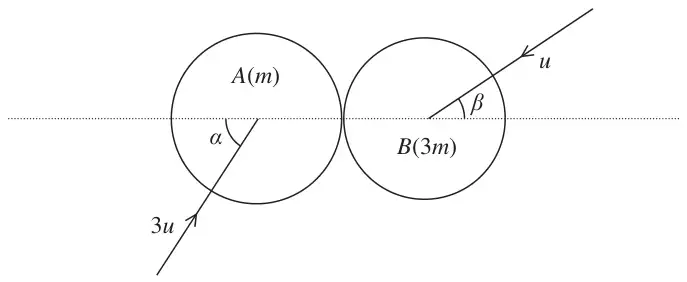
Two smooth uniform spheres \(A\) and \(B\) have equal radii. The mass of \(A\) is \(m\) and the mass of \(B\) is \(3m\). The spheres are moving on a smooth horizontal plane when they collide obliquely. Immediately before the collision, \(A\) is moving with speed \(3u\) at angle \(\alpha\) to the line of centres and \(B\) is moving with speed \(u\) at angle \(\beta\) to the line of centres, as shown in Figure 1. The coefficient of restitution between the two spheres is \(\dfrac{1}{5}\). It is given that \(\cos\alpha = \dfrac{1}{3}\) and \(\cos\beta = \dfrac{2}{3}\) and that \(\alpha\) and \(\beta\) are both acute angles.
(a) Find the magnitude of the impulse on \(A\) due to the collision in terms of \(m\) and \(u\). (8)
(b) Express the kinetic energy lost by \(A\) in the collision as a fraction of its initial kinetic energy. (4)
Mark scheme (a)
Scheme
Marks
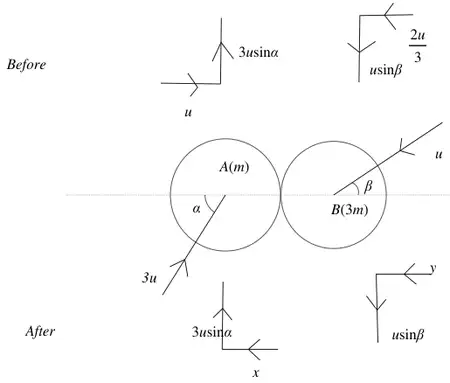
CLM: \(mx + 3my = 3m \times u\cos\beta - m \times 3u\cos\alpha = mu \quad (x + 3y = u)\)
Magnitude of the impulse on \(A\) \(= mu - \left(m \times -\dfrac{u}{2}\right) = \dfrac{3mu}{2}\)
M1 A1
(8)
Notes
M1 Terms of correct structure but condone sign errors
M1 equation of correct structure but condone sign errors
DM1 Dependent on the two previous M marks. Solve for \(x\) or \(y\)
M1 Correct for their \(x\) or \(y\)
A1 Must be positive
Mark scheme (b)
Scheme
Marks
Component of velocity perpendicular to the line of centres before = component after \(= 3u\sin\alpha = 3u \times \dfrac{\sqrt{8}}{3} = \sqrt{8}u\)
B1
KE lost \(= \dfrac{m}{2}\left(9u^2 - \left(8u^2 + \dfrac{1}{4}u^2\right)\right)\left[= \dfrac{3}{8}mu^2\right]\)
M1 A1
Fraction lost \(= \dfrac{3/8}{9/2} = \dfrac{3}{8} \times \dfrac{2}{9} = \dfrac{1}{12}\)
A1
(4)
(12 marks)
Notes
M1 Change in KE. Does not need to be a fraction at this stage. Does not need to include the (cancelling) component perpendicular to the line of centre.
5. A particle of mass \(m\) kg lies on a smooth horizontal surface. Initially the particle is at rest at a point \(O\) midway between a pair of fixed parallel vertical walls. The walls are 2 m apart. At time \(t = 0\) the particle is projected from \(O\) with speed \(u\) m s\(^{-1}\) in a direction perpendicular to the walls. The coefficient of restitution between the particle and each wall is \(\dfrac{2}{3}\). The magnitude of the impulse on the particle due to the first impact with a wall is \(\lambda mu\) N s.
(a) Find the value of \(\lambda\). (3)
The particle returns to \(O\), having bounced off each wall once, at time \(t = 3\) seconds.
4. A spacecraft is travelling in a straight line in deep space where all external forces can be assumed to be negligible. The spacecraft decelerates by ejecting fuel at a constant speed \(k\) relative to the spacecraft, in the direction of motion of the spacecraft. At time \(t\), the spacecraft has speed \(v\) and mass \(m\).
(a) Show, from first principles, that while the spacecraft is ejecting fuel,\[\frac{\mathrm{d}v}{\mathrm{d}m} - \frac{k}{m} = 0\] (5)
At time \(t = 0\), the spacecraft has speed \(U\) and mass \(M\).
(b) Find the mass of the spacecraft when it comes to rest. (6)
Given that \(m = M\mathrm{e}^{-\alpha t^2}\), where \(\alpha\) is a positive constant, and that the spacecraft comes to rest at time \(t = T\),
(c) find, in terms of \(U\) and \(T\) only, the distance travelled by the spacecraft in decelerating from speed \(U\) to rest. (6)
3. A spacecraft is moving in a straight line in deep space. The spacecraft moves by ejecting burnt fuel backwards at a constant speed of 2000 m s\(^{-1}\) relative to the spacecraft. The burnt fuel is ejected at a constant rate of \(c\) kg s\(^{-1}\). At time \(t\) seconds the total mass of the spacecraft, including fuel, is \(m\) kg and the speed of the spacecraft is \(v\) m s\(^{-1}\).
(a) Show that, while the spacecraft is ejecting burnt fuel,\[m\frac{\mathrm{d}v}{\mathrm{d}t} = 2000c\] (7)
At time \(t = 0\), the mass of the spacecraft is \(M_0\) kg and the speed of the spacecraft is 2000 m s\(^{-1}\). When \(t = 50\), the spacecraft is still ejecting burnt fuel and its speed is 6000 m s\(^{-1}\).
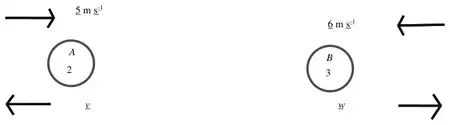
1. Two particles \(A\) and \(B\), of mass 2 kg and 3 kg respectively, are moving towards each other in opposite directions along the same straight line on a smooth horizontal surface. The particles collide directly. Immediately before the collision the speed of \(A\) is 5 m s\(^{-1}\) and the speed of \(B\) is 6 m s\(^{-1}\). The magnitude of the impulse exerted on \(B\) by \(A\) is 14 N s. Find
(a) the speed of \(A\) immediately after the collision, (3)
(b) the speed of \(B\) immediately after the collision. (3)
Mark scheme (a)
Scheme
Marks
\(2v + 10 = 14\)
M1A1
\(v = 2\) m s\(^{-1}\)
A1
(3)
Notes
M1 for attempt at Impulse = difference in momenta for particle \(A\), (must be considering one particle) (M0 if g is included or if mass omitted).
First A1 for \(-14 = 2(\pm v - 5)\)
Second A1 for 2 (Must be positive). Allow change of sign at end to obtain speed.
Mark scheme (b)
Scheme
Marks
\(3w + 18 = 14\)
M1A1
\(w = \dfrac{4}{3}\) m s\(^{-1}\)
A1
(3)
(6 marks)
Notes
EITHER
M1 for attempt at Impulse = difference in momenta for particle \(B\), (must be considering one particle) (M0 if g is included or if mass omitted).
First A1 \(14 = 3(\pm w - {-6})\)
Second A1 for 4/3, 1.3 or better (Must be positive). Allow change of sign at end to obtain speed.
OR
M1 for attempt at CLM equation, with correct no. of terms, dimensionally correct. Allow consistent extra g’s and sign errors.
First A1 (Not f.t.) for a correct equation e.g.
\(2 \times 5 - 3 \times 6 = -2 \times 2 + 3w\)
Second A1 for speed is 4/3; 1.3 or better
N.B. They may find the speed of \(B\) first and then use CLM to find the speed of \(A\).
It must be clear which speed is which, in order to gain the A marks for the answers
7. [In this question \(\mathbf{i}\) and \(\mathbf{j}\) are perpendicular unit vectors in a horizontal plane]
A small smooth ball of mass \(m\) kg is moving on a smooth horizontal plane and strikes a fixed smooth vertical wall. The plane and the wall intersect in a straight line which is parallel to the vector \(2\mathbf{i} + \mathbf{j}\). The velocity of the ball immediately before the impact is \(b\mathbf{i}\) m s\(^{-1}\), where \(b\) is positive. The velocity of the ball immediately after the impact is \(a(\mathbf{i} + \mathbf{j})\) m s\(^{-1}\), where \(a\) is positive.
(a) Show that the impulse received by the ball when it strikes the wall is parallel to \((-\mathbf{i} + 2\mathbf{j})\). (1)
Find
(b) the coefficient of restitution between the ball and the wall, (8)
(c) the fraction of the kinetic energy of the ball that is lost due to the impact. (3)
Mark scheme (a)
Scheme
Marks
State that impulse acts perpendicular to the wall and demonstrate that \((2\mathbf{i} + \mathbf{j}).(-\mathbf{i} + 2\mathbf{j}) = 0\)
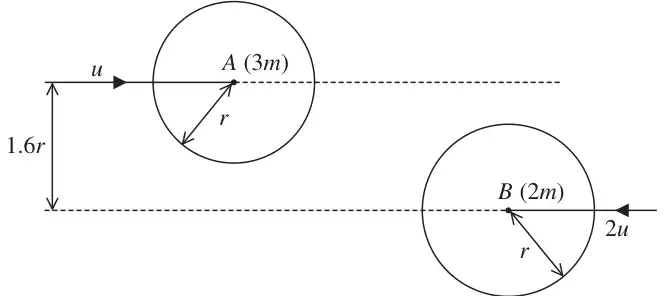
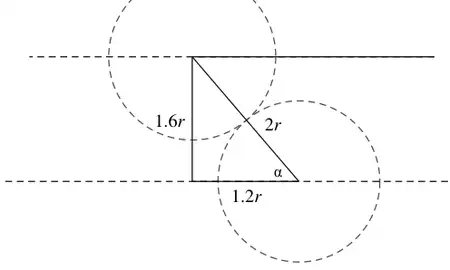
Two smooth uniform spheres \(A\) and \(B\), of equal radius \(r\), have masses \(3m\) and \(2m\) respectively. The spheres are moving on a smooth horizontal plane when they collide. Immediately before the collision they are moving with speeds \(u\) and \(2u\) respectively. The centres of the spheres are moving towards each other along parallel paths at a distance \(1.6r\) apart, as shown in Figure 2.
The coefficient of restitution between the two spheres is \(\dfrac{1}{6}\).
Find, in terms of \(m\) and \(u\), the magnitude of the impulse received by \(B\) in the collision. (10)
Mark scheme
Scheme
Marks
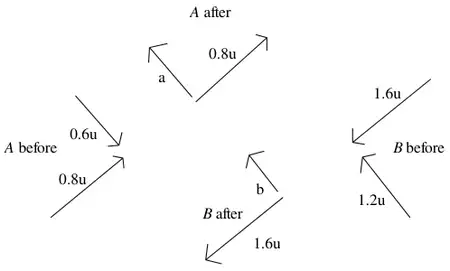
\(0.6u\) or \(u\cos\alpha\)
B1
\(1.2u\) or \(2u\cos\alpha\)
B1
\(2m \times 1.2u - 3m \times 0.6u = 3ma + 2mb\)
M1
\((3a + 2b = 0.6u)\)
A1ft
\(e(1.2u + 0.6u) = a - b\)
M1
\((a - b = 0.3u)\)
A1ft
DM1
\(a = 0.24u\) or \(b = -0.06u\)
A1
\((1.2u - (-0.06u)) \times 2m = 2.52mu\)
M1
or \((0.24u - (-0.6u)) \times 3m = 2.52mu\)
A1
(10 marks)
Notes
B1 component of the initial velocity of \(A\) parallel to the line of centres on impact
B1 component of the initial velocity of \(B\) parallel to the line of centres on impact
M1 CLM parallel to the line of centres. Requires all the terms.
A1ft Correct unsimplified for their \(0.6u\) and \(1.2u\)
M1 Restitution parallel to the line of centres. Must be used the right way round.
A1ft Correct unsimplified for their \(0.6u\) and \(1.2u\). If signs are inconsistent between the two equations, penalise here.
DM1 Solve a pair of simultaneous eqns in \(a\) & \(b\) for one of \(a\) & \(b\). Dependent on the two previous M marks.
A1 In terms of \(u\) only
M1 Find impulse on \(A\) or \(B\). Unsimplified. For their \(a\) or \(b\). Correct mass for the velocities used.
3. A raindrop falls vertically under gravity through a stationary cloud. At time \(t = 0\), the raindrop is at rest and has mass \(m_0\). As the raindrop falls, water condenses onto it from the cloud so that the mass of the raindrop increases at a constant rate \(c\). At time \(t\), the mass of the raindrop is \(m\) and the speed of the raindrop is \(v\). The resistance to the motion of the raindrop has magnitude \(mkv\), where \(k\) is a constant. Show that
1. Particle \(P\) has mass 3 kg and particle \(Q\) has mass \(m\) kg. The particles are moving in opposite directions along a smooth horizontal plane when they collide directly. Immediately before the collision, the speed of \(P\) is 4 m s\(^{-1}\) and the speed of \(Q\) is 3 m s\(^{-1}\). In the collision the direction of motion of \(P\) is unchanged and the direction of motion of \(Q\) is reversed. Immediately after the collision, the speed of \(P\) is 1 m s\(^{-1}\) and the speed of \(Q\) is 1.5 m s\(^{-1}\).
(a) Find the magnitude of the impulse exerted on \(P\) in the collision. (3)
(b) Find the value of \(m\). (3)
Mark scheme (a)
Scheme
Marks
For \(P\), \(-I = 3(1 - 4)\)
M1 A1
\(I = 9\) Ns
A1
(3)
Notes
M1 for attempt at Impulse = difference in momenta for particle \(P\), (must be considering one particle i.e. have same mass in both terms) (M0 if g is included or if mass omitted).
First A1 for \(\pm 3(1 - 4)\)
Second A1 for 9 (Must be positive). Allow change of sign at end to obtain magnitude.
N.B. For M1 they may use CLM to find a value for \(m\) first and then use it when considering the change in momentum of \(Q\) to find the impulse.
Mark scheme (b)
Scheme
Marks
For \(Q\), \(9 = m(1.5 - {-3})\)
M1 A1
\(m = 2\)
A1
(3)
(6 marks)
OR
\(12 - 3m = 3 + 1.5m\)
M1 A1
\(m = 2\)
A1
(3)
Notes
EITHER
M1 for attempt at:
their Impulse from (a) = difference in momenta for particle \(Q\), (must be considering one particle) (M0 if g is included or if mass omitted).
First A1 for \(9 = m(1.5 - {-3})\) oe.
Second A1 for \(m = 2\).
OR
M1 for attempt at CLM equation, with correct no. of terms, dimensionally correct. Allow consistent extra g’s and sign errors.
First A1 for a correct equation i.e. \(12 - 3m = 3 + 1.5m\) oe.
1. A particle \(P\) of mass 2 kg is moving with velocity \((\mathbf{i} - 4\mathbf{j})\) m s\(^{-1}\) when it receives an impulse of \((3\mathbf{i} + 6\mathbf{j})\) N s.
Find the speed of \(P\) immediately after the impulse is applied. (5)
1. Two particles \(P\) and \(Q\) have masses \(4m\) and \(m\) respectively. The particles are moving towards each other on a smooth horizontal plane and collide directly. The speeds of \(P\) and \(Q\) immediately before the collision are \(2u\) and \(5u\) respectively. Immediately after the collision, the speed of \(P\) is \(\dfrac{1}{2}u\) and its direction of motion is reversed.
(a) Find the speed and direction of motion of \(Q\) after the collision. (4)
(b) Find the magnitude of the impulse exerted on \(P\) by \(Q\) in the collision. (3)
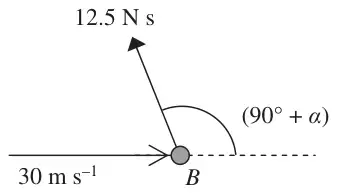
A small ball \(B\) of mass 0.25 kg is moving in a straight line with speed 30 m s\(^{-1}\) on a smooth horizontal plane when it is given an impulse. The impulse has magnitude 12.5 N s and is applied in a horizontal direction making an angle of \((90^\circ + \alpha)\), where \(\tan\alpha = \dfrac{3}{4}\), with the initial direction of motion of the ball, as shown in Figure 3.
(i) Find the speed of \(B\) immediately after the impulse is applied.
(ii) Find the direction of motion of \(B\) immediately after the impulse is applied. (6)
Mark scheme
NB In a Q with parts labelled (i) & (ii) marks are awarded when seen – they do not belong to a particular part of the Q.
2. A rocket, with initial mass 1500 kg, including 600 kg of fuel, is launched vertically upwards from rest. The rocket burns fuel at a rate of 15 kg s\(^{-1}\) and the burnt fuel is ejected vertically downwards with a speed of 1000 m s\(^{-1}\) relative to the rocket. At time \(t\) seconds after launch \((t \leqslant 40)\) the rocket has mass \(m\) kg and velocity \(v\) m s\(^{-1}\).
(a) Show that \[\frac{\mathrm{d}v}{\mathrm{d}t} + \frac{1000}{m}\frac{\mathrm{d}m}{\mathrm{d}t} = -9.8\] (5)
(b) Find \(v\) at time \(t\), \(0 \leqslant t \leqslant 40\) (5)
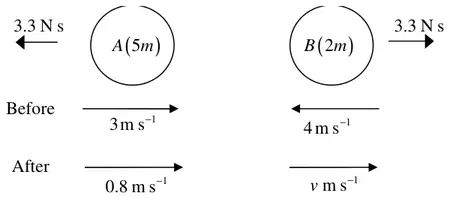
1. Two particles \(A\) and \(B\), of mass \(5m\) kg and \(2m\) kg respectively, are moving in opposite directions along the same straight horizontal line. The particles collide directly. Immediately before the collision, the speeds of \(A\) and \(B\) are 3 m s\(^{-1}\) and 4 m s\(^{-1}\) respectively. The direction of motion of \(A\) is unchanged by the collision. Immediately after the collision, the speed of \(A\) is 0.8 m s\(^{-1}\).
(a) Find the speed of \(B\) immediately after the collision. (3)
In the collision, the magnitude of the impulse exerted on \(A\) by \(B\) is 3.3 N s.
Leading to \(v = 1.5\) (Speed is 1.5 m s\(^{-1}\))
A1
(3)
Notes
M1 for attempt at CLM equation, with correct no.of terms, correct masses and dimensionally consistent. Allow consistent extra g’s, consistent missing \(m\)’s and sign errors. However, M0 if masses are not paired with the correct speeds.
First A1 for a correct equation.
Second A1 for \(v = 1.5\). (\(-1.5\) A0)
N.B. Allow M1 for an attempt to equate the impulses on the particles but must have \(5m(0.8 - 3)\) or \(5m(3 - 0.8)\) on one side of the equation and \(2m(\pm v \pm 4)\) on the other.
Mark scheme (b)
Scheme
Marks
Impulse for \(A\) \(5m(0.8 - 3) = -3.3\)
M1 A1
Leading to \(m = 0.3\)
A1
(3)
(6 marks)
Notes
M1 for attempt at impulse = difference in momenta, for either particle, (must be considering one particle) (M0 if g’s are included or if mass omitted or if just \(m\) used)
Allow Initial Momentum – Final Momentum.
A1 cao (i.e. no ft on their \(v\)) for a correct equation in \(m\) only.
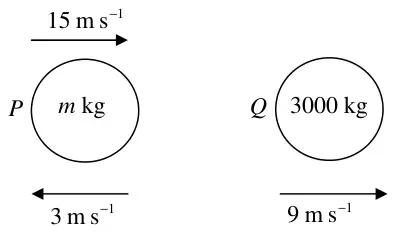
1. A railway truck \(P\), of mass \(m\) kg, is moving along a straight horizontal track with speed 15 m s\(^{-1}\). Truck \(P\) collides with a truck \(Q\) of mass 3000 kg, which is at rest on the same track. Immediately after the collision the speed of \(P\) is 3 m s\(^{-1}\) and the speed of \(Q\) is 9 m s\(^{-1}\). The direction of motion of \(P\) is reversed by the collision.
Modelling the trucks as particles, find
(a) the magnitude of the impulse exerted by \(P\) on \(Q\), (2)
1. A tennis ball of mass 0.1 kg is hit by a racquet. Immediately before being hit, the ball has velocity \(30\mathbf{i}\) m s\(^{-1}\). The racquet exerts an impulse of \((-2\mathbf{i} - 4\mathbf{j})\) N s on the ball. By modelling the ball as a particle, find the velocity of the ball immediately after being hit. (4)
Mark scheme
Scheme
Marks
Use of \(\ m(\boldsymbol{v} - \boldsymbol{u}) = \boldsymbol{I}\)
3. A rocket propels itself by its engine ejecting burnt fuel. Initially the rocket has total mass \(M\), of which a mass \(kM\), \(k < 1\), is fuel. The rocket is at rest when its engine is started. The burnt fuel is ejected with constant speed \(c\), relative to the rocket, in a direction opposite to that of the rocket’s motion. Assuming that there are no external forces, find the speed of the rocket when all its fuel has been burnt. (7)
Mark scheme
Scheme
Marks
\((m + \delta m)(v + \delta v) + (-\delta m)(v - c) = mv\) \(m\delta v + c\delta m = 0\)
3. A ball of mass 0.5 kg is moving with velocity \(12\mathbf{i}\) m s\(^{-1}\) when it is struck by a bat. The impulse received by the ball is \((-4\mathbf{i} + 7\mathbf{j})\) N s. By modelling the ball as a particle, find
(a) the speed of the ball immediately after the impact, (4)
(b) the angle, in degrees, between the velocity of the ball immediately after the impact and the vector \(\mathbf{i}\), (2)
(c) the kinetic energy gained by the ball as a result of the impact. (2)
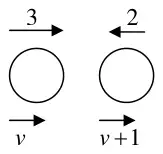
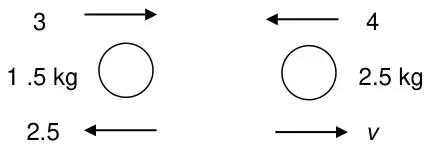
2. Particle \(P\) has mass 3 kg and particle \(Q\) has mass 2 kg. The particles are moving in opposite directions on a smooth horizontal plane when they collide directly. Immediately before the collision, \(P\) has speed 3 m s\(^{-1}\) and \(Q\) has speed 2 m s\(^{-1}\). Immediately after the collision, both particles move in the same direction and the difference in their speeds is 1 m s\(^{-1}\).
(a) Find the speed of each particle after the collision. (5)
(b) Find the magnitude of the impulse exerted on \(P\) by \(Q\). (3)
Mark scheme (a)
Scheme
Marks
CLM: \(3 \times 3 - 2 \times 2 = 3v + 2(v + 1)\)
M1 A1
\(v_P = 0.6\) m s\(^{-1}\); \(v_Q = 1.6\) m s\(^{-1}\)
2. A particle of mass 2 kg is moving with velocity \((5\mathbf{i} + \mathbf{j})\) m s\(^{-1}\) when it receives an impulse of \((-6\mathbf{i} + 8\mathbf{j})\) N s. Find the kinetic energy of the particle immediately after receiving the impulse. (5)
1. Two particles \(B\) and \(C\) have mass \(m\) kg and 3 kg respectively. They are moving towards each other in opposite directions on a smooth horizontal table. The two particles collide directly. Immediately before the collision, the speed of \(B\) is 4 m s\(^{-1}\) and the speed of \(C\) is 2 m s\(^{-1}\). In the collision the direction of motion of \(C\) is reversed and the direction of motion of \(B\) is unchanged. Immediately after the collision, the speed of \(B\) is 1 m s\(^{-1}\) and the speed of \(C\) is 3 m s\(^{-1}\).
Find
(a) the value of \(m\), (3)
(b) the magnitude of the impulse received by \(C\). (2)
5. A raindrop falls vertically under gravity through a cloud. In a model of the motion the raindrop is assumed to be spherical at all times and the cloud is assumed to consist of stationary water particles. At time \(t = 0\), the raindrop is at rest and has radius \(a\). As the raindrop falls, water particles from the cloud condense onto it and the radius of the raindrop is assumed to increase at a constant rate \(\lambda\). A time \(t\) the speed of the raindrop is \(v\).
(a) Show that \[\frac{\mathrm{d}v}{\mathrm{d}t} + \frac{3\lambda v}{(\lambda t + a)} = g.\] (8)
(b) Find the speed of the raindrop when its radius is \(3a\). (7)
Mark scheme (a)
Scheme
Marks
\(\dfrac{\mathrm{d}r}{\mathrm{d}t} = \lambda \Rightarrow r = \lambda t + a\)
5.[In this question \(\mathbf{i}\) and \(\mathbf{j}\) are perpendicular unit vectors in a horizontal plane.]
A ball of mass 0.5 kg is moving with velocity \((10\mathbf{i} + 24\mathbf{j})\) m s\(^{-1}\) when it is struck by a bat. Immediately after the impact the ball is moving with velocity \(20\mathbf{i}\) m s\(^{-1}\).
Find
(a) the magnitude of the impulse of the bat on the ball, (4)
(b) the size of the angle between the vector \(\mathbf{i}\) and the impulse exerted by the bat on the ball, (2)
(c) the kinetic energy lost by the ball in the impact. (3)
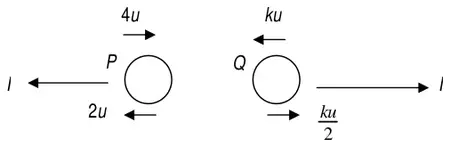
2. Particle \(P\) has mass \(m\) kg and particle \(Q\) has mass \(3m\) kg. The particles are moving in opposite directions along a smooth horizontal plane when they collide directly. Immediately before the collision \(P\) has speed \(4u\) m s\(^{-1}\) and \(Q\) has speed \(ku\) m s\(^{-1}\), where \(k\) is a constant. As a result of the collision the direction of motion of each particle is reversed and the speed of each particle is halved.
(a) Find the value of \(k\). (4)
(b) Find, in terms of \(m\) and \(u\), the magnitude of the impulse exerted on \(P\) by \(Q\). (3)
Mark scheme (a)
Scheme
Marks
\(4mu - 3mku = -2mu + 3mk\dfrac{u}{2}\)
M1 A1
\(k = \dfrac{4}{3}\)
M1 A1cso
(4)
Mark scheme (b)
Scheme
Marks
For \(P\), \(I = m(2u - -4u)\)
M1 A1
\(= 6mu\)
A1
OR For \(Q\), \(I = 3m\left(\dfrac{ku}{2} - -ku\right)\)
The points \(A\), \(B\) and \(C\) lie in a horizontal plane. A batsman strikes a ball of mass 0.25 kg. Immediately before being struck, the ball is moving along the horizontal line \(AB\) with speed 30 m s\(^{-1}\). Immediately after being struck, the ball moves along the horizontal line \(BC\) with speed 40 m s\(^{-1}\). The line \(BC\) makes an angle of 60\(^\circ\) with the original direction of motion \(AB\), as shown in Figure 1.
Find, to 3 significant figures,
(i) the magnitude of the impulse given to the ball,
(ii) the size of the angle that the direction of this impulse makes with the original direction of motion \(AB\). (8)
1. A particle \(A\) of mass 2 kg is moving along a straight horizontal line with speed 12 m s\(^{-1}\). Another particle \(B\) of mass \(m\) kg is moving along the same straight line, in the opposite direction to \(A\), with speed 8 m s\(^{-1}\). The particles collide. The direction of motion of \(A\) is unchanged by the collision. Immediately after the collision, \(A\) is moving with speed 3 m s\(^{-1}\) and \(B\) is moving with speed 4 m s\(^{-1}\). Find
(a) the magnitude of the impulse exerted by \(B\) on \(A\) in the collision, (2)
3. A spaceship is moving in a straight line in deep space and needs to increase its speed. This is done by ejecting fuel backwards from the spaceship at a constant speed \(c\) relative to the spaceship. When the speed of the spaceship is \(v\), its mass is \(m\).
(a) Show that, while the spaceship is ejecting fuel, \[\frac{\mathrm{d}v}{\mathrm{d}m} = -\frac{c}{m}.\] (5)
The initial mass of the spaceship is \(m_0\) and at time \(t\) the mass of the spaceship is given by \(m = m_0(1 - kt)\), where \(k\) is a positive constant.
(b) Find the acceleration of the spaceship at time \(t\). (4)
Mark scheme (a)
Scheme
Marks
\(mv = (m + \delta m)(v + \delta v) - (-\delta m)(c - v)\) \(mv = mv + m\delta v + v\delta m + c\delta m - v\delta m\)
M1 A2
\(-m\delta v = c\delta m\) \(\dfrac{\mathrm{d}v}{\mathrm{d}m} = -\dfrac{c}{m}\) *
3. Two particles \(A\) and \(B\) are moving on a smooth horizontal plane. The mass of \(A\) is \(2m\) and the mass of \(B\) is \(m\). The particles are moving along the same straight line but in opposite directions and they collide directly. Immediately before they collide the speed of \(A\) is \(2u\) and the speed of \(B\) is \(3u\). The magnitude of the impulse received by each particle in the collision is \(\dfrac{7mu}{2}\).
Find
(a) the speed of \(A\) immediately after the collision, (3)
(b) the speed of \(B\) immediately after the collision. (3)
1. A particle of mass 0.25 kg is moving with velocity \((3\mathbf{i} + 7\mathbf{j})\) m s\(^{-1}\) when it receives the impulse \((5\mathbf{i} - 3\mathbf{j})\) N s.
Find the speed of the particle immediately after the impulse. (5)
3. Two particles \(A\) and \(B\) are moving on a smooth horizontal plane. The mass of \(A\) is \(km\), where \(2 \lt k \lt 3\), and the mass of \(B\) is \(m\). The particles are moving along the same straight line, but in opposite directions, and they collide directly. Immediately before they collide the speed of \(A\) is \(2u\) and the speed of \(B\) is \(4u\). As a result of the collision the speed of \(A\) is halved and its direction of motion is reversed.
(a) Find, in terms of \(k\) and \(u\), the speed of \(B\) immediately after the collision. (3)
(b) State whether the direction of motion of \(B\) changes as a result of the collision, explaining your answer. (3)
Given that \(k = \tfrac{7}{3}\),
(c) find, in terms of \(m\) and \(u\), the magnitude of the impulse that \(A\) exerts on \(B\) in the collision. (3)
Mark scheme (a)
Scheme
Marks
\(km2u - 4mu = -kmu + mv\)
M1 A1
\(u(3k - 4) = v\)
A1
(3)
Mark scheme (b)
Scheme
Marks
\(k \gt 2\ \Rightarrow\ v \gt 0\ \Rightarrow\) dir\(^\text{n}\) of motion reversed
4. At time \(t = 0\) a rocket is launched from rest vertically upwards. The rocket propels itself upwards by expelling burnt fuel vertically downwards with constant speed \(U\) m s\(^{-1}\) relative to the rocket. The initial mass of the rocket is \(M_0\) kg. At time \(t\) seconds, where \(t \lt 2\), its mass is \(M_0\left(1 - \tfrac{1}{2}t\right)\) kg, and it is moving upwards with speed \(v\) m s\(^{-1}\).
(a) Show that \[\frac{\mathrm{d}v}{\mathrm{d}t} = \frac{U}{(2 - t)} - 9.8.\] (7)
(b) Hence show that \(U \gt 19.6\). (2)
(c) Find, in terms of \(U\), the speed of the rocket one second after its launch. (5)
1. Two particles \(P\) and \(Q\) have mass 0.4 kg and 0.6 kg respectively. The particles are initially at rest on a smooth horizontal table. Particle \(P\) is given an impulse of magnitude 3 N s in the direction \(PQ\).
(a) Find the speed of \(P\) immediately before it collides with \(Q\). (3)
Immediately after the collision between \(P\) and \(Q\), the speed of \(Q\) is 5 m s\(^{-1}\).
(b) Show that immediately after the collision \(P\) is at rest. (3)
1. Two particles \(A\) and \(B\) have masses 4 kg and \(m\) kg respectively. They are moving towards each other in opposite directions on a smooth horizontal table when they collide directly. Immediately before the collision, the speed of \(A\) is 5 m s\(^{-1}\) and the speed of \(B\) is 3 m s\(^{-1}\). Immediately after the collision, the direction of motion of \(A\) is unchanged and the speed of \(A\) is 1 m s\(^{-1}\).
(a) Find the magnitude of the impulse exerted on \(A\) in the collision. (2)
Immediately after the collision, the speed of \(B\) is 2 m s\(^{-1}\).
(b) Find the value of \(m\). (4)
Mark scheme (a)
Scheme
Marks
\(I = 4(5 - 1) = 16\) Ns
M1 A1
(2)
Mark scheme (b)
Scheme
Marks
CLM: \(4 \times 5 - m \times 3 = 4 \times 1 + m \times 2\)
7. A motor boat of mass \(M\) is moving in a straight line, with its engine switched off, across a stretch of still water. The boat is moving with speed \(U\) when, at time \(t = 0\), it develops a leak. The water comes in at a constant rate so that at time \(t\), the mass of water in the boat is \(\lambda t\). At time \(t\) the speed of the boat is \(v\) and it experiences a total resistance to motion of magnitude \(2\lambda v\).
(a) Show that \((M + \lambda t)\dfrac{\mathrm{d}v}{\mathrm{d}t} + 3\lambda v = 0\). (6)
(b) Show that the time taken for the speed of the boat to reduce to \(\tfrac{1}{2}U\) is \(\dfrac{M}{\lambda}\left(2^{\frac{1}{3}} - 1\right)\). (6)
The boat sinks when the mass of water inside the boat is \(M\).
(c) Show that the boat does not sink before the speed of the boat is \(\tfrac{1}{2}U\). (2)
5. A smooth uniform sphere \(A\) has mass \(2m\) kg and another smooth uniform sphere \(B\), with the same radius as \(A\), has mass \(m\) kg. The spheres are moving on a smooth horizontal plane when they collide. At the instant of collision the line joining the centres of the spheres is parallel to \(\mathbf{j}\). Immediately after the collision, the velocity of \(A\) is \((3\mathbf{i} - \mathbf{j})\) m s\(^{-1}\) and the velocity of \(B\) is \((2\mathbf{i} + \mathbf{j})\) m s\(^{-1}\). The coefficient of restitution between the spheres is \(\tfrac{1}{2}\).
(a) Find the velocities of the two spheres immediately before the collision. (7)
(b) Find the magnitude of the impulse in the collision. (2)
(c) Find, to the nearest degree, the angle through which the direction of motion of \(A\) is deflected by the collision. (4)
Mark scheme (a)
Scheme
Marks
CLM: \(\quad 2v_2 - v_1 = 1 - 2 = -1\)
M1A1
NIL: \(\quad 1 + 1 = \dfrac{1}{2}(v_1 + v_2)\)
M1A1
\(\therefore v_2 = 1,\ v_1 = 3\qquad\) Dependent on both M’s above
DM1
Horizontal components unchanged (i.e. 2 & 3)\(\qquad\) Independent of all other marks
2. Two particles \(A\) and \(B\), of mass 0.3 kg and \(m\) kg respectively, are moving in opposite directions along the same straight horizontal line so that the particles collide directly. Immediately before the collision, the speeds of \(A\) and \(B\) are 8 m s\(^{-1}\) and 4 m s\(^{-1}\) respectively. In the collision the direction of motion of each particle is reversed and, immediately after the collision, the speed of each particle is 2 m s\(^{-1}\). Find
(a) the magnitude of the impulse exerted by \(B\) on \(A\) in the collision, (3)
(b) the value of \(m\). (4)
Mark scheme (a)
Scheme
Marks
\(A\!:\ \ I = 0.3(8 + 2)\)
M1 A1
\(= 3\ \ (\text{N s})\)
A1
(3)
Mark scheme (b)
Scheme
Marks
LM \(0.3 \times 8 - 4m = 0.3 \times (-2) + 2m\)
M1 A1
\(m = 0.5\)
DM1 A1
(4)
(7 marks)
Alternative to (b)
\(B\!:\ \ m(4 + 2) = 3\)
M1 A1
\(m = 0.5\)
DM1 A1
The two parts of this question may be done in either order.
4. A particle \(P\) of mass 0.3 kg is moving with speed \(u\) m s\(^{-1}\) in a straight line on a smooth horizontal table. The particle \(P\) collides directly with a particle \(Q\) of mass 0.6 kg, which is at rest on the table. Immediately after the particles collide, \(P\) has speed 2 m s\(^{-1}\) and \(Q\) has speed 5 m s\(^{-1}\). The direction of motion of \(P\) is reversed by the collision. Find
(a) the value of \(u\), (4)
(b) the magnitude of the impulse exerted by \(P\) on \(Q\). (2)
Immediately after the collision, a constant force of magnitude \(R\) newtons is applied to \(Q\) in the direction directly opposite to the direction of motion of \(Q\). As a result \(Q\) is brought to rest in 1.5 s.
(c) Find the value of \(R\). (4)
Mark scheme (a)
Scheme
Marks
CLM \(0.3u = 0.3 \times (-2) + 0.6 \times 5\)
M1 A1
\(u = 8\)
M1 A1
(4)
Mark scheme (b)
Scheme
Marks
\(I = 0.6 \times 5 = 3\) (N s)
M1 A1
(2)
Mark scheme (c)
Scheme
Marks
\(v = u + at \;\Rightarrow\; 5 = a \times 1.5\) \(\left(a = \tfrac{10}{3}\right)\)
5. A space-ship is moving in a straight line in deep space and needs to reduce its speed from \(U\) to \(V\). This is done by ejecting fuel from the front of the space-ship at a constant speed \(k\) relative to the space-ship. When the speed of the space-ship is \(v\), its mass is \(m\).
(a) Show that, while the space-ship is ejecting fuel, \(\dfrac{\mathrm{d}m}{\mathrm{d}v} = \dfrac{m}{k}\). (6)
The initial mass of the space-ship is \(M\).
(b) Find, in terms of \(U\), \(V\), \(k\) and \(M\), the amount of fuel which needs to be used to reduce the speed of the space-ship from \(U\) to \(V\). (6)
3. A cricket ball of mass 0.5 kg is struck by a bat. Immediately before being struck, the velocity of the ball is \((-30\mathbf{i})\) m s\(^{-1}\). Immediately after being struck, the velocity of the ball is \((16\mathbf{i} + 20\mathbf{j})\) m s\(^{-1}\).
(a) Find the magnitude of the impulse exerted on the ball by the bat. (4)
In the subsequent motion, the position vector of the ball is \(\mathbf{r}\) metres at time \(t\) seconds. In a model of the situation, it is assumed that \(\mathbf{r} = [16t\mathbf{i} + (20t - 5t^2)\mathbf{j}]\). Using this model,
(b) find the speed of the ball when \(t = 3\). (4)
2. Two particles \(A\) and \(B\) have mass 0.4 kg and 0.3 kg respectively. They are moving in opposite directions on a smooth horizontal table and collide directly. Immediately before the collision, the speed of \(A\) is 6 m s\(^{-1}\) and the speed of \(B\) is 2 m s\(^{-1}\). As a result of the collision, the direction of motion of \(B\) is reversed and its speed immediately after the collision is 3 m s\(^{-1}\). Find
(a) the speed of \(A\) immediately after the collision, stating clearly whether the direction of motion of \(A\) is changed by the collision, (4)
(b) the magnitude of the impulse exerted on \(B\) in the collision, stating clearly the units in which your answer is given. (3)
(a) M1 for 4 term equation dimensionally correct (\(\pm g\)). A1 correct
A1 answer must be positive
A1 f.t. – accept correct answer from correct working without justification; if working is incorrect allow f.t. from a clear diagram with answer consistent with their statement; also allow A1 if their ans is +ve and they say direction unchanged.
Mark scheme (b)
Scheme
Marks
\(I = 0.3 \times (2 + 3) = 1.5\), Ns (o.e.)
M1 A1, B1
(3)
(7 marks)
Notes
(b) M1 – need (one mass) \(\times\) (sum or difference of the two speeds associated with the mass chosen)
7. At time \(t = 0\), a small body is projected vertically upwards. While ascending it picks up small drops of moisture from the atmosphere. The drops of moisture are at rest before they are picked up. At time \(t\), the combined body \(P\) has mass \(m\) and speed \(v\).
(a) Show that, while \(P\) is moving upwards, \(m\dfrac{\mathrm{d}v}{\mathrm{d}t} + v\dfrac{\mathrm{d}m}{\mathrm{d}t} = -mg\). (5)
The initial mass of \(P\) is \(M\), and \(m = M\mathrm{e}^{kt}\), where \(k\) is a positive constant.
(b) Show that, while \(P\) is moving upwards, \(\dfrac{\mathrm{d}}{\mathrm{d}t}(v\mathrm{e}^{kt}) = -g\mathrm{e}^{kt}\). (3)
Given that the initial projection speed of \(P\) is \(\dfrac{g}{2k}\),
(c) find, in terms of \(M\), the mass of \(P\) when it reaches its highest point. (7)
(a) Two particles \(A\) and \(B\), of mass 3 kg and 2 kg respectively, are moving in the same direction on a smooth horizontal table when they collide directly. Immediately before the collision, the speed of \(A\) is 4 m s\(^{-1}\) and the speed of \(B\) is 1.5 m s\(^{-1}\). In the collision, the particles join to form a single particle \(C\). Find the speed of \(C\) immediately after the collision. (3)
(b) Two particles \(P\) and \(Q\) have mass 3 kg and \(m\) kg respectively. They are moving towards each other in opposite directions on a smooth horizontal table. Each particle has speed 4 m s\(^{-1}\), when they collide directly. In this collision, the direction of motion of each particle is reversed. The speed of \(P\) immediately after the collision is 2 m s\(^{-1}\) and the speed of \(Q\) is 1 m s\(^{-1}\). Find
(i) the value of \(m\), (3)
(ii) the magnitude of the impulse exerted on \(Q\) in the collision. (2)
6. A rocket-driven car moves along a straight horizontal road. The car has total initial mass \(M\). It propels itself forwards by ejecting mass backwards at a constant rate \(\lambda\) per unit time at a constant speed \(U\) relative to the car. The car starts from rest at time \(t = 0\). At time \(t\) the speed of the car is \(v\). The total resistance to motion is modelled as having magnitude \(kv\), where \(k\) is a constant.
Given that \(t \lt \dfrac{M}{\lambda}\), show that
2. Two small steel balls \(A\) and \(B\) have mass 0.6 kg and 0.2 kg respectively. They are moving towards each other in opposite directions on a smooth horizontal table when they collide directly. Immediately before the collision, the speed of \(A\) is 8 m s\(^{-1}\) and the speed of \(B\) is 2 m s\(^{-1}\). Immediately after the collision, the direction of motion of \(A\) is unchanged and the speed of \(B\) is twice the speed of \(A\). Find
(a) the speed of \(A\) immediately after the collision, (5)
(b) the magnitude of the impulse exerted on \(B\) in the collision. (3)
6. A stone \(S\) is sliding on ice. The stone is moving along a straight horizontal line \(ABC\), where \(AB = 24\) m and \(AC = 30\) m. The stone is subject to a constant resistance to motion of magnitude 0.3 N. At \(A\) the speed of \(S\) is 20 m s\(^{-1}\), and at \(B\) the speed of \(S\) is 16 m s\(^{-1}\). Calculate
(a) the deceleration of \(S\), (2)
(b) the speed of \(S\) at \(C\). (3)
(c) Show that the mass of \(S\) is 0.1 kg. (2)
At \(C\), the stone \(S\) hits a vertical wall, rebounds from the wall and then slides back along the line \(CA\). The magnitude of the impulse of the wall on \(S\) is 2.4 Ns and the stone continues to move against a constant resistance of 0.3 N.
(d) Calculate the time between the instant that \(S\) rebounds from the wall and the instant that \(S\) comes to rest. (6)
Mark scheme (a)
Scheme
Marks
\(16^2 = 20^2 - 2 \times a \times 24 \;\Rightarrow\; a = 3\) m s\(^{-2}\)
M1 A1
(2)
Mark scheme (b)
Scheme
Marks
\(v^2 = 20^2 - 2 \times 3 \times 30\)
M1 A1ft
\(v = \sqrt{220}\) or 14.8 m s\(^{-1}\)
A1
(3)
Mark scheme (c)
Scheme
Marks
\(0.3 = m \times 3 \;\Rightarrow\; m = 0.1\) kg (*)
M1 A1
(2)
Mark scheme (d)
Scheme
Marks
\(0.1(w + \sqrt{220}) = 2.4\)
M1 A1ft
\(w = 9.17\)
A1
\(0 = 9.17 - 3 \times t\)
M1 A1ft
\(t \approx 3.06\) s
A1
(6)
(13 marks)
Notes
(Corrected from the printed mark scheme: the decimal point in 9.17 is printed as a comma, “9,17”.)
6. A particle \(P\) of mass \(3m\) is moving with speed \(2u\) in a straight line on a smooth horizontal table. The particle \(P\) collides with a particle \(Q\) of mass \(2m\) moving with speed \(u\) in the opposite direction to \(P\). The coefficient of restitution between \(P\) and \(Q\) is \(e\).
(a) Show that the speed of \(Q\) after the collision is \(\tfrac{1}{5}u(9e + 4)\). (5)
As a result of the collision, the direction of motion of \(P\) is reversed.
(b) Find the range of possible values of \(e\). (5)
Given that the magnitude of the impulse of \(P\) on \(Q\) is \(\tfrac{32}{5}mu\),
(c) find the value of \(e\). (4)
Mark scheme (a)
Scheme
Marks
LM \(6mu - 2mu = 3mx + 2my\)
M1 A1
NEL \(y - x = 3eu\)
B1
Solving to \(y = \tfrac{1}{5}u(9e + 4)\ \ *\) cso
M1 A1
(5)
Mark scheme (b)
Scheme
Marks
Solving to \(x = \tfrac{2}{5}u(2 - 3e)\) oe
M1 A1
\(x < 0\ \Rightarrow\ e > \tfrac{2}{3}\)
M1 A1
\(\tfrac{2}{3} < e \leqslant 1\) ft their \(e\) for glb
1. A particle \(P\) of mass 1.5 kg is moving along a straight horizontal line with speed 3 m s\(^{-1}\). Another particle \(Q\) of mass 2.5 kg is moving, in the opposite direction, along the same straight line with speed 4 m s\(^{-1}\). The particles collide. Immediately after the collision the direction of motion of \(P\) is reversed and its speed is 2.5 m s\(^{-1}\).
(a) Calculate the speed of \(Q\) immediately after the impact. (3)
(b) State whether or not the direction of motion of \(Q\) is changed by the collision. (1)
(c) Calculate the magnitude of the impulse exerted by \(Q\) on \(P\), giving the units of your answer. (3)