
A2 June 2019 Q6
6. [In this question \(\mathbf{i}\) and \(\mathbf{j}\) are perpendicular unit vectors in a horizontal plane.]
A smooth uniform sphere \(A\) has mass 0.2 kg and another smooth uniform sphere \(B\), with the same radius as \(A\), has mass 0.4 kg.
The spheres are moving on a smooth horizontal surface when they collide obliquely. Immediately before the collision, the velocity of \(A\) is \((3\mathbf{i} + 2\mathbf{j})\ \text{m s}^{-1}\) and the velocity of \(B\) is \((-4\mathbf{i} - \mathbf{j})\ \text{m s}^{-1}\)
At the instant of collision, the line joining the centres of the spheres is parallel to \(\mathbf{i}\)
The coefficient of restitution between the spheres is \(\dfrac{3}{7}\)
| Scheme | Marks | AO |
|---|---|---|
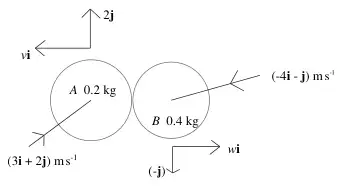 | ||
| Perpendicular to line of centres: \(2\mathbf{j}\) | B1 | 3.4 |
| CLM parallel to the line of centres | M1 | 3.1b |
| \(0.2 \times 3 - 0.4 \times 4 = 0.4w - 0.2v\) \((-5 = 2w - v)\) | A1 | 1.1b |
| Impact law parallel to the line of centres | M1 | 3.4 |
| \(7e = v + w\ \ \Rightarrow 3 = v + w\) | A1 | 1.1b |
| Complete strategy to find \(\mathbf{v}_A\) | M1 | 3.1b |
| \(\mathbf{v}_A = -\dfrac{11}{3}\mathbf{i} + 2\mathbf{j}\ (\text{m s}^{-1})\) follow their \(2\mathbf{j}\) | A1ft | 1.1b |
| (7) |
Notes
B1: Use the model to find the component perpendicular to the line of centres.
Correct value seen or implied
M1: Use of CLM parallel to line of centres. Need all terms and dimensionally correct. Condone sign errors
A1: Correct unsimplified equation.
M1: Correct use of impact law parallel to the line of centres. Condone sign errors
A1: Correct equation with \(\dfrac{3}{7}\) used.
M1: Complete strategy to find components parallel and perpendicular to line of centres, eg by using CLM and impact law
A1ft: \(\mathbf{v}_A\) correct, follow their \(a\mathbf{j}\) for \(2\mathbf{j}\ (a \ne 0)\)
| Scheme | Marks | AO |
|---|---|---|
| Magnitude of impulse on \(A\): \(0.2\left(\dfrac{11}{3} - (-3)\right)\) | M1 | 3.1b |
| \(= 0.2\left(\dfrac{11}{3} + 3\right) = \dfrac{4}{3}\) (N s) | A1 | 1.1b |
| (2) |
Notes
M1: Evidence of use of \(m(v - u)\) parallel to the line of centres
A1: 1.3 (N s) or better
| Scheme | Marks | AO |
|---|---|---|
| Use of scalar product to find the angle | M1 | 3.1a |
| \(\cos\theta = \dfrac{(3\mathbf{i} + 2\mathbf{j}).\left(-\frac{11}{3}\mathbf{i} + 2\mathbf{j}\right)}{\sqrt{13} \times \sqrt{\frac{157}{9}}}\) | A1ft | 1.1b |
| \(\theta = 118^\circ\) | A1 | 1.1b |
| Alternative method: \(180^\circ - \tan^{-1}\dfrac{2}{3} - \tan^{-1}\dfrac{6}{11}\) Or \(\tan^{-1}\dfrac{3}{2} + \tan^{-1}\dfrac{11}{6}\) | ||
| (3) | ||
| (12 marks) |
Notes
M1: Complete method for finding the required angle.
Allow for \(\tan^{-1}\dfrac{3}{2}\) or \(\tan^{-1}\dfrac{2}{3}\) and \(\tan^{-1}\dfrac{6}{11}\) or \(\tan^{-1}\dfrac{11}{6}\)
A1ft: A correct unsimplified expression Follow their \(\mathbf{v}_A\). Do not ISW
A1: Correct answer only. (Q asks for the nearest degree) Do not ISW
\(62^\circ\) probably scores M1A0A0