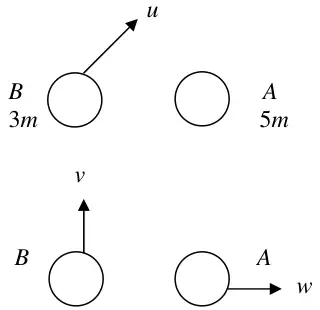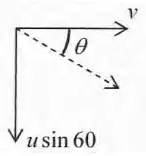
Collisions: 2 Spheres Oblique

Edexcel

Edexcel · Old spec

A2 June 2025 Q7

EdexcelCurrent spec13 marksCollisions: 2 Spheres Oblique

7.

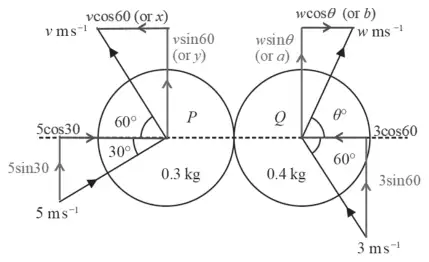
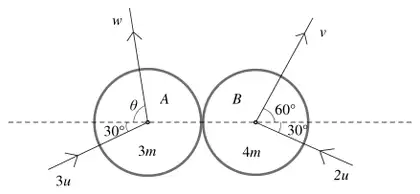
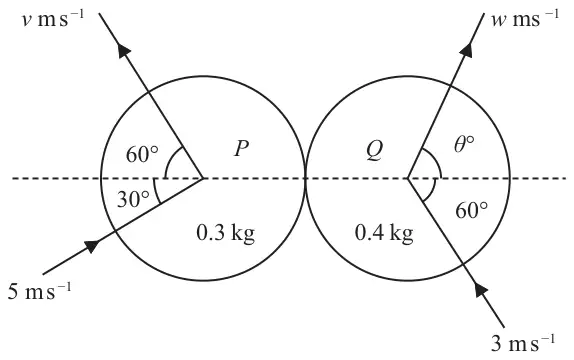
Figure 4: plan view of spheres P (0.3 kg) and Q (0.4 kg) touching, with the line of centres dashed; P approaches at 5 m s⁻¹ at 30° and leaves at v m s⁻¹ at 60°; Q approaches at 3 m s⁻¹ at 60° and leaves at w m s⁻¹ at θ°
Figure 4

Two uniform spheres \(P\) and \(Q\) have equal radii. The mass of \(P\) is 0.3 kg and the mass of \(Q\) is 0.4 kg. The spheres are moving on a smooth horizontal plane when they collide obliquely.

Immediately before the collision,

  • \(P\) is moving with speed \(5\ \text{m s}^{-1}\) at \(30^\circ\) to the line of centres of the spheres
  • \(Q\) is moving with speed \(3\ \text{m s}^{-1}\) at \(60^\circ\) to the line of centres of the spheres

Immediately after the collision,

  • \(P\) is moving with speed \(v\ \text{m s}^{-1}\) at \(60^\circ\) to the line of centres of the spheres
  • \(Q\) is moving with speed \(w\ \text{m s}^{-1}\) at \(\theta^\circ\) to the line of centres of the spheres

as in the plan view shown in Figure 4.

(a) Show that \(v = \dfrac{5\sqrt{3}}{3}\) (3)
(b) Find
(i) the value of \(w\)
(ii) the value of \(\theta\)
(7)
(c) Find the coefficient of restitution between \(P\) and \(Q\). (3)

A2 June 2024 Q7

EdexcelCurrent spec15 marksCollisions: 2 Spheres Oblique

7.

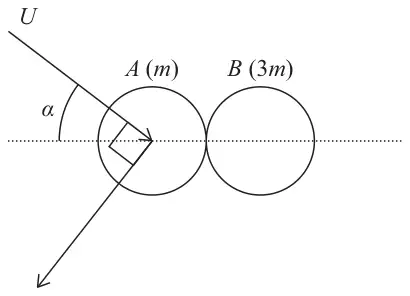
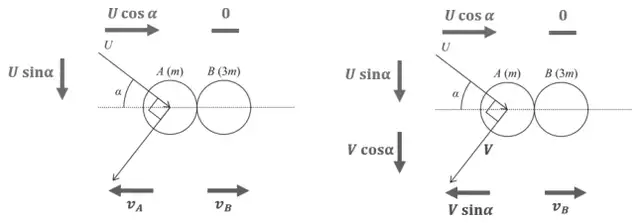
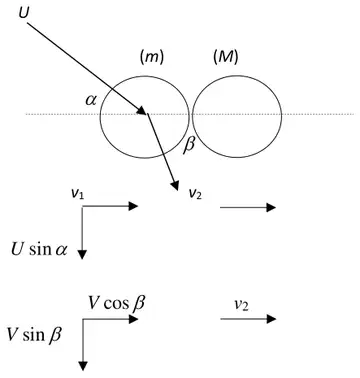
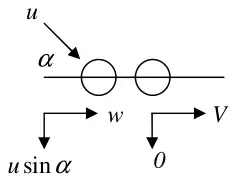
Figure 1: sphere A (m) approaching sphere B (3m) at speed U at angle α to the line of centres, then moving off at right angles to its original direction
Figure 1

A smooth uniform sphere \(A\) of mass \(m\) is moving with speed \(U\) on a smooth horizontal plane. The sphere \(A\) collides obliquely with a smooth uniform sphere \(B\) of mass \(3m\) which is at rest on the plane. The two spheres have the same radius.

Immediately before the collision, the direction of motion of \(A\) makes an angle \(\alpha\), where \(0^\circ \lt \alpha \lt 90^\circ\), with the line joining the centres of the spheres.

Immediately after the collision, the direction of motion of \(A\) is perpendicular to its original direction, as shown in Figure 1.

The coefficient of restitution between the spheres is \(e\).

(a) Show that the speed of \(B\) immediately after the collision is \[\frac{1}{4}(1 + e)U\cos\alpha\] (6)
(b) Show that \(e \gt \dfrac{1}{3}\) (4)
(c) Show that \(0 \lt \tan\alpha \leqslant \dfrac{1}{\sqrt{2}}\) (5)

A2 June 2023 Q5

EdexcelCurrent spec10 marksCollisions: 2 Spheres Oblique

5.

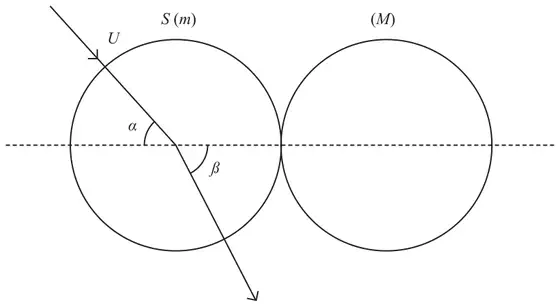
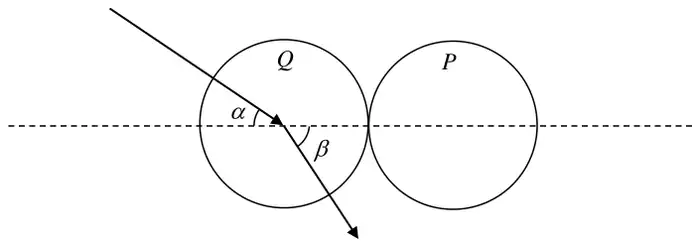
Figure 1: two equal spheres touching, S (m) on the left and a sphere of mass M on the right, with the line of centres dashed; S approaches with speed U at angle α to the line of centres and leaves at angle β to it
Figure 1

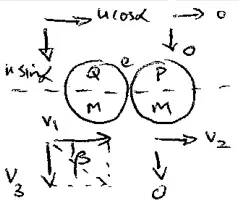
A smooth uniform sphere \(S\) of mass \(m\) is moving with speed \(U\) on a smooth horizontal plane. The sphere \(S\) collides obliquely with another uniform sphere of mass \(M\) which is at rest on the plane. The two spheres have the same radius.

Immediately before the collision the direction of motion of \(S\) makes an angle \(\alpha\), where \(0 < \alpha < 90^\circ\), with the line joining the centres of the spheres.

Immediately after the collision the direction of motion of \(S\) makes an angle \(\beta\) with the line joining the centres of the spheres, as shown in Figure 1.

The coefficient of restitution between the spheres is \(e\).

(a) Show that \(\tan\beta = \dfrac{(m + M)\tan\alpha}{(m - eM)}\) (8)

Given that \(m = eM\),

(b) show that the directions of motion of the two spheres immediately after the collision are perpendicular. (2)
A2 June 2022 Q4

EdexcelCurrent spec9 marksCollisions: 2 Spheres Oblique

4.

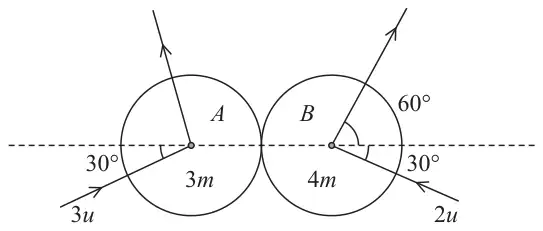
Figure 3: spheres A (3m) and B (4m) colliding; A approaches with speed 3u at 30° to the line of centres, B approaches with speed 2u at 30° to the line of centres, and B leaves at 60° to the line of centres
Figure 3

Two smooth uniform spheres, \(A\) and \(B\), have equal radii. The mass of \(A\) is \(3m\) and the mass of \(B\) is \(4m\). The spheres are moving on a smooth horizontal plane when they collide obliquely. Immediately before they collide, \(A\) is moving with speed \(3u\) at \(30^\circ\) to the line of centres of the spheres and \(B\) is moving with speed \(2u\) at \(30^\circ\) to the line of centres of the spheres. The direction of motion of \(B\) is turned through an angle of \(90^\circ\) by the collision, as shown in Figure 3.

(i) Find the size of the angle through which the direction of motion of \(A\) is turned as a result of the collision.
(ii) Find, in terms of \(m\) and \(u\), the magnitude of the impulse received by \(B\) in the collision. (9)

A2 October 2021 Q3

EdexcelCurrent spec14 marksCollisions: 2 Spheres Oblique

3. [In this question, \(\mathbf{i}\) and \(\mathbf{j}\) are perpendicular unit vectors in a horizontal plane.]

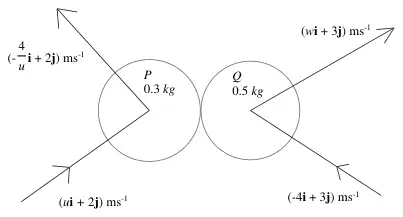
A smooth uniform sphere \(P\) has mass 0.3 kg. Another smooth uniform sphere \(Q\), with the same radius as \(P\), has mass 0.5 kg.

The spheres are moving on a smooth horizontal surface when they collide obliquely. Immediately before the collision the velocity of \(P\) is \((u\mathbf{i} + 2\mathbf{j})\ \text{m s}^{-1}\), where \(u\) is a positive constant, and the velocity of \(Q\) is \((-4\mathbf{i} + 3\mathbf{j})\ \text{m s}^{-1}\)

At the instant when the spheres collide, the line joining their centres is parallel to \(\mathbf{i}\).

The coefficient of restitution between \(P\) and \(Q\) is \(\dfrac{3}{5}\)

As a result of the collision, the direction of motion of \(P\) is deflected through an angle of \(90^\circ\) and the direction of motion of \(Q\) is deflected through an angle of \(\alpha^\circ\)

(a) Find the value of \(u\) (8)
(b) Find the value of \(\alpha\) (5)
(c) State how you have used the fact that \(P\) and \(Q\) have equal radii. (1)

A2 October 2020 Q5

EdexcelCurrent spec14 marksCollisions: 2 Spheres Oblique

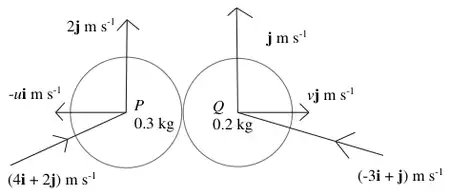
5. A smooth uniform sphere \(P\) has mass 0.3 kg. Another smooth uniform sphere \(Q\), with the same radius as \(P\), has mass 0.2 kg.

The spheres are moving on a smooth horizontal surface when they collide obliquely. Immediately before the collision the velocity of \(P\) is \((4\mathbf{i} + 2\mathbf{j})\ \text{m s}^{-1}\) and the velocity of \(Q\) is \((-3\mathbf{i} + \mathbf{j})\ \text{m s}^{-1}\).

At the instant of collision, the line joining the centres of the spheres is parallel to \(\mathbf{i}\).

The kinetic energy of \(Q\) immediately after the collision is half the kinetic energy of \(Q\) immediately before the collision.

(a) Find
(i) the velocity of \(P\) immediately after the collision,
(ii) the velocity of \(Q\) immediately after the collision,
(iii) the coefficient of restitution between \(P\) and \(Q\),

carefully justifying your answers.

(11)
(b) Find the size of the angle through which the direction of motion of \(P\) is deflected by the collision. (3)

A2 June 2019 Q6

6. [In this question \(\mathbf{i}\) and \(\mathbf{j}\) are perpendicular unit vectors in a horizontal plane.]

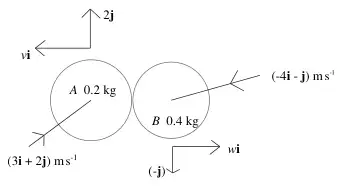
A smooth uniform sphere \(A\) has mass 0.2 kg and another smooth uniform sphere \(B\), with the same radius as \(A\), has mass 0.4 kg.

The spheres are moving on a smooth horizontal surface when they collide obliquely. Immediately before the collision, the velocity of \(A\) is \((3\mathbf{i} + 2\mathbf{j})\ \text{m s}^{-1}\) and the velocity of \(B\) is \((-4\mathbf{i} - \mathbf{j})\ \text{m s}^{-1}\)

At the instant of collision, the line joining the centres of the spheres is parallel to \(\mathbf{i}\)

The coefficient of restitution between the spheres is \(\dfrac{3}{7}\)

(a) Find the velocity of \(A\) immediately after the collision. (7)
(b) Find the magnitude of the impulse received by \(A\) in the collision. (2)
(c) Find, to the nearest degree, the size of the angle through which the direction of motion of \(A\) is deflected as a result of the collision. (3)

M4 June 2018 Q7

7. Two smooth uniform spheres \(A\) and \(B\), of mass 2 kg and 3 kg respectively, and of equal radius, are moving on a smooth horizontal plane when they collide.

Immediately before the collision the velocity of \(A\) is \((3\mathbf{i} + \mathbf{j})\) m s\(^{-1}\) and the velocity of \(B\) is \((-\mathbf{i} + 2\mathbf{j})\) m s\(^{-1}\). Immediately after the collision the velocity of \(A\) is \((\mathbf{i} + 3\mathbf{j})\) m s\(^{-1}\).

(a) Show that, at the instant when \(A\) and \(B\) collide, their line of centres is parallel to \(-\mathbf{i} + \mathbf{j}\). (4)
(b) Find the velocity of \(B\) immediately after the collision. (3)
(c) Find the coefficient of restitution between \(A\) and \(B\). (6)

M4 June 2017 Q2

EdexcelOld spec12 marksCollisions: 2 Spheres Oblique

2.

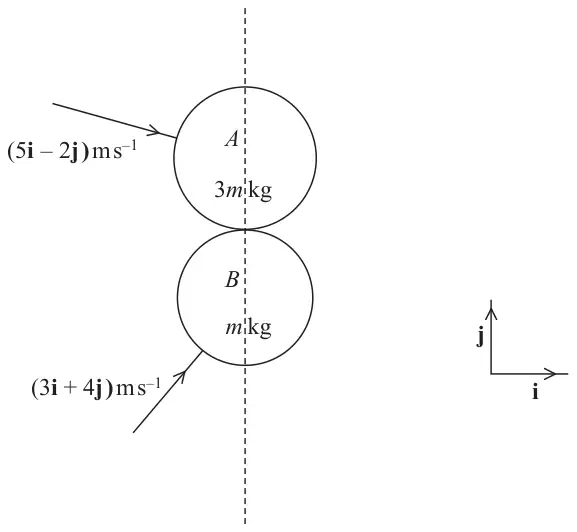
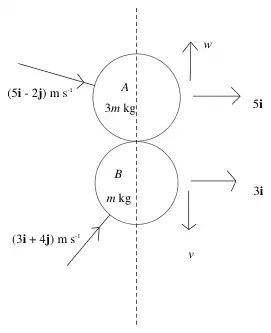
Figure 1: sphere A (3m kg) with velocity 5i minus 2j and sphere B (m kg) with velocity 3i plus 4j colliding with line of centres parallel to j
Figure 1

Two smooth uniform spheres \(A\) and \(B\) have masses \(3m\) kg and \(m\) kg respectively and equal radii. The spheres are moving on a smooth horizontal surface. Initially, sphere \(A\) has velocity \((5\mathbf{i} - 2\mathbf{j})\) m s\(^{-1}\) and sphere \(B\) has velocity \((3\mathbf{i} + 4\mathbf{j})\) m s\(^{-1}\). When the spheres collide, the line joining their centres is parallel to \(\mathbf{j}\), as shown in Figure 1.

The coefficient of restitution between the two spheres is \(e\).

The kinetic energy of sphere \(B\) immediately after the collision is 85% of its kinetic energy immediately before the collision.

Find

(a) the velocity of each sphere immediately after the collision, (9)
(b) the value of \(e\). (3)

M4 June 2016 Q1

EdexcelOld spec8 marksCollisions: 2 Spheres Oblique

1.

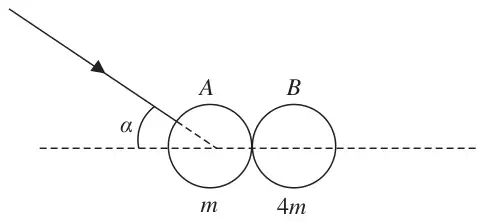
Figure 1: sphere A of mass m moving at angle alpha to the line of centres towards sphere B of mass 4m
Figure 1

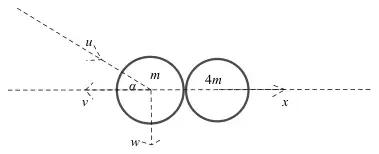
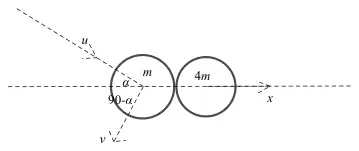
A smooth uniform sphere \(A\) of mass \(m\) is moving on a smooth horizontal plane when it collides with a second smooth uniform sphere \(B\), which is at rest on the plane. The sphere \(B\) has mass \(4m\) and the same radius as \(A\). Immediately before the collision the direction of motion of \(A\) makes an angle \(\alpha\) with the line of centres of the spheres, as shown in Figure 1. The direction of motion of \(A\) is turned through an angle of \(90^\circ\) by the collision and the coefficient of restitution between the spheres is \(\dfrac{1}{2}\)

Find the value of \(\tan\alpha\). (8)

M4 June 2015 Q3

EdexcelOld spec12 marksCollisions: 2 Spheres Oblique

3.

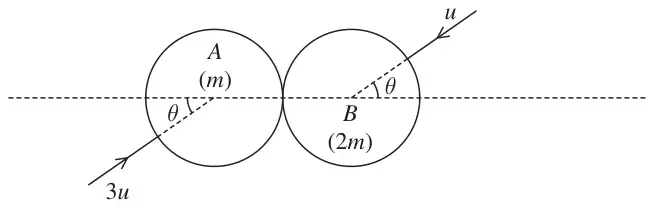
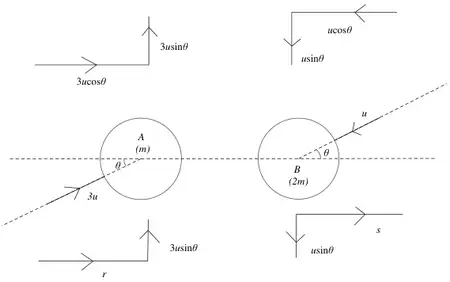
Figure 1: spheres A (m) and B (2m) in contact; A moving with speed 3u and B with speed u, each at angle theta to the line of centres, in opposite directions
Figure 1

Two smooth uniform spheres \(A\) and \(B\) with equal radii have masses \(m\) and \(2m\) respectively. The spheres are moving in opposite directions on a smooth horizontal surface and collide obliquely. Immediately before the collision, \(A\) has speed \(3u\) with its direction of motion at an angle \(\theta\) to the line of centres, and \(B\) has speed \(u\) with its direction of motion at an angle \(\theta\) to the line of centres, as shown in Figure 1. The coefficient of restitution between the spheres is \(\dfrac{1}{8}\)

Immediately after the collision, the speed of \(A\) is twice the speed of \(B\).

Find the size of the angle \(\theta\). (12)

M4 June 2014 (R) Q4

EdexcelOld spec15 marksCollisions: 2 Spheres Oblique

4. A smooth uniform sphere \(S\) is moving on a smooth horizontal plane when it collides obliquely with an identical sphere \(T\) which is at rest on the plane. Immediately before the collision \(S\) is moving with speed \(U\) in a direction which makes an angle of 60\(^\circ\) with the line joining the centres of the spheres. The coefficient of restitution between the spheres is \(e\).

(a) Find, in terms of \(e\) and \(U\) where necessary,
(i) the speed and direction of motion of \(S\) immediately after the collision,
(ii) the speed and direction of motion of \(T\) immediately after the collision. (12)

The angle through which the direction of motion of \(S\) is deflected is \(\delta^\circ\).

(b) Find
(i) the value of \(e\) for which \(\delta\) takes the largest possible value,
(ii) the value of \(\delta\) in this case. (3)

M4 June 2014 Q5

5.

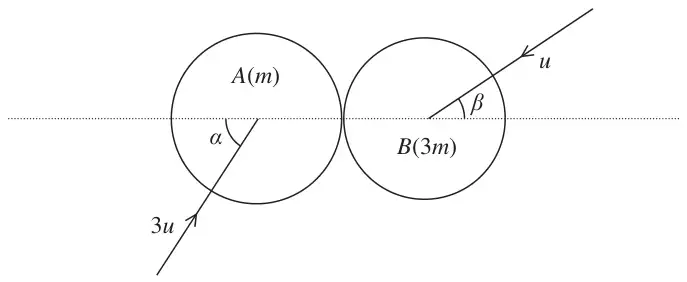
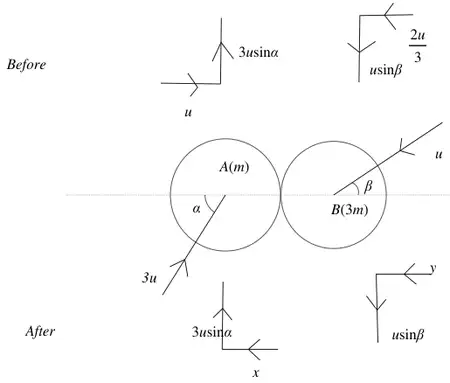
Figure 1: spheres A(m) and B(3m) in contact; A moving with speed 3u at angle alpha to the line of centres, B moving with speed u at angle beta to the line of centres
Figure 1

Two smooth uniform spheres \(A\) and \(B\) have equal radii. The mass of \(A\) is \(m\) and the mass of \(B\) is \(3m\). The spheres are moving on a smooth horizontal plane when they collide obliquely. Immediately before the collision, \(A\) is moving with speed \(3u\) at angle \(\alpha\) to the line of centres and \(B\) is moving with speed \(u\) at angle \(\beta\) to the line of centres, as shown in Figure 1. The coefficient of restitution between the two spheres is \(\dfrac{1}{5}\). It is given that \(\cos\alpha = \dfrac{1}{3}\) and \(\cos\beta = \dfrac{2}{3}\) and that \(\alpha\) and \(\beta\) are both acute angles.

(a) Find the magnitude of the impulse on \(A\) due to the collision in terms of \(m\) and \(u\). (8)
(b) Express the kinetic energy lost by \(A\) in the collision as a fraction of its initial kinetic energy. (4)

M4 June 2013 (R) Q3

EdexcelOld spec9 marksCollisions: 2 Spheres Oblique

3. A smooth uniform sphere \(A\), of mass \(5m\) and radius \(r\), is at rest on a smooth horizontal plane. A second smooth uniform sphere \(B\), of mass \(3m\) and radius \(r\), is moving in a straight line on the plane with speed \(u\) m s\(^{-1}\) and strikes \(A\). Immediately before the impact the direction of motion of \(B\) makes an angle of 60\(^\circ\) with the line of centres of the spheres. The direction of motion of \(B\) is turned through an angle of 30\(^\circ\) by the impact.

Find

(a) the speed of \(B\) immediately after the impact, (3)
(b) the coefficient of restitution between the spheres. (6)

M4 June 2013 Q3

3.

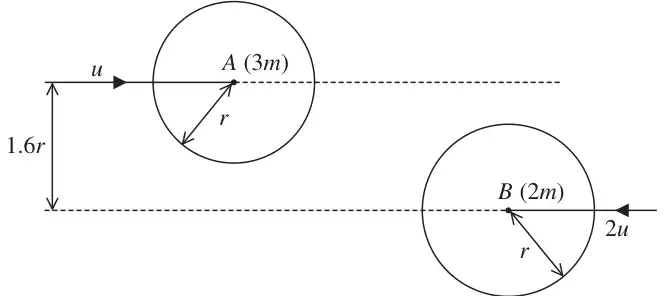
Figure 2: sphere A (3m) moving right with speed u, sphere B (2m) moving left with speed 2u, paths of centres 1.6r apart
Figure 2

Two smooth uniform spheres \(A\) and \(B\), of equal radius \(r\), have masses \(3m\) and \(2m\) respectively. The spheres are moving on a smooth horizontal plane when they collide. Immediately before the collision they are moving with speeds \(u\) and \(2u\) respectively. The centres of the spheres are moving towards each other along parallel paths at a distance \(1.6r\) apart, as shown in Figure 2.

The coefficient of restitution between the two spheres is \(\dfrac{1}{6}\).

Find, in terms of \(m\) and \(u\), the magnitude of the impulse received by \(B\) in the collision. (10)

M4 June 2012 Q1

EdexcelOld spec13 marksCollisions: 2 Spheres Oblique

1. A smooth uniform sphere \(S\), of mass \(m\), is moving on a smooth horizontal plane when it collides obliquely with another smooth uniform sphere \(T\), of the same radius as \(S\) but of mass \(2m\), which is at rest on the plane. Immediately before the collision the velocity of \(S\) makes an angle \(\alpha\), where \(\tan\alpha = \dfrac{3}{4}\), with the line joining the centres of the spheres. Immediately after the collision the speed of \(T\) is \(V\). The coefficient of restitution between the spheres is \(\dfrac{3}{4}\).

(a) Find, in terms of \(V\), the speed of \(S\)
(i) immediately before the collision,
(ii) immediately after the collision.
(9)
(b) Find the angle through which the direction of motion of \(S\) is deflected as a result of the collision. (4)

M4 June 2011 Q1

EdexcelOld spec10 marksCollisions: 2 Spheres Oblique

1.

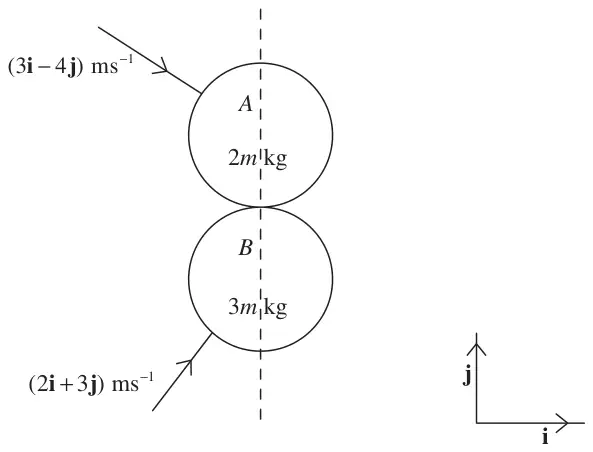
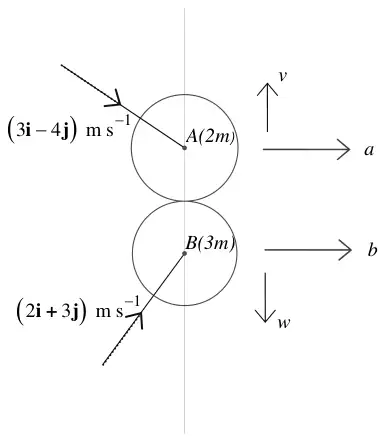
Figure 1: spheres A (2m kg) and B (3m kg) in contact with their line of centres parallel to j; A moving with velocity (3i - 4j) m/s and B with velocity (2i + 3j) m/s
Figure 1

Two smooth uniform spheres \(A\) and \(B\) have masses \(2m\) kg and \(3m\) kg respectively and equal radii. The spheres are moving on a smooth horizontal surface. Initially, sphere \(A\) has velocity \((3\mathbf{i} - 4\mathbf{j})\) m s\(^{-1}\) and sphere \(B\) has velocity \((2\mathbf{i} - 3\mathbf{j})\) m s\(^{-1}\). When the spheres collide, the line joining their centres is parallel to \(\mathbf{j}\), as shown in Figure 1. The coefficient of restitution between the spheres is \(\dfrac{3}{7}\). Find, in terms of \(m\), the total kinetic energy lost in the collision. (10)

M4 June 2010 Q2

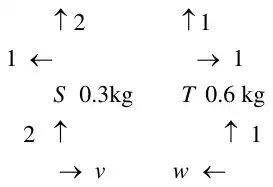
2. Two smooth uniform spheres \(S\) and \(T\) have equal radii. The mass of \(S\) is 0.3 kg and the mass of \(T\) is 0.6 kg. The spheres are moving on a smooth horizontal plane and collide obliquely. Immediately before the collision the velocity of \(S\) is \(\mathbf{u}_1\) m s\(^{-1}\) and the velocity of \(T\) is \(\mathbf{u}_2\) m s\(^{-1}\). The coefficient of restitution between the spheres is 0.5. Immediately after the collision the velocity of \(S\) is \((-\mathbf{i} + 2\mathbf{j})\) m s\(^{-1}\) and the velocity of \(T\) is \((\mathbf{i} + \mathbf{j})\) m s\(^{-1}\). Given that when the spheres collide the line joining their centres is parallel to \(\mathbf{i}\),

(a) find
(i) \(\mathbf{u}_1\),
(ii) \(\mathbf{u}_2\).
(6)

After the collision, \(T\) goes on to collide with a smooth vertical wall which is parallel to \(\mathbf{j}\). Given that the coefficient of restitution between \(T\) and the wall is also 0.5, find

(b) the angle through which the direction of motion of \(T\) is deflected as a result of the collision with the wall, (5)
(c) the loss in kinetic energy of \(T\) caused by the collision with the wall. (3)

M4 June 2009 Q5

EdexcelOld spec13 marksCollisions: 2 Spheres Oblique

5. Two small smooth spheres \(A\) and \(B\), of mass 2 kg and 1 kg respectively, are moving on a smooth horizontal plane when they collide. Immediately before the collision the velocity of \(A\) is \((\mathbf{i} + 2\mathbf{j})\) m s\(^{-1}\) and the velocity of \(B\) is \(-2\mathbf{i}\) m s\(^{-1}\). Immediately after the collision the velocity of \(A\) is \(\mathbf{j}\) m s\(^{-1}\).

(a) Show that the velocity of \(B\) immediately after the collision is \(2\mathbf{j}\) m s\(^{-1}\). (3)
(b) Find the impulse of \(B\) on \(A\) in the collision, giving your answer as a vector, and hence show that the line of centres is parallel to \(\mathbf{i} + \mathbf{j}\). (4)
(c) Find the coefficient of restitution between \(A\) and \(B\). (6)

M4 June 2008 Q2

EdexcelOld spec5 marksCollisions: 2 Spheres Oblique

2. Two small smooth spheres \(A\) and \(B\) have equal radii. The mass of \(A\) is \(2m\) kg and the mass of \(B\) is \(m\) kg. The spheres are moving on a smooth horizontal plane and they collide. Immediately before the collision the velocity of \(A\) is \((2\mathbf{i} - 2\mathbf{j})\) m s\(^{-1}\) and the velocity of \(B\) is \((-3\mathbf{i} - \mathbf{j})\) m s\(^{-1}\). Immediately after the collision the velocity of \(A\) is \((\mathbf{i} - 3\mathbf{j})\) m s\(^{-1}\).

Find the speed of \(B\) immediately after the collision. (5)

M4 June 2007 Q5

5. A smooth uniform sphere \(A\) has mass \(2m\) kg and another smooth uniform sphere \(B\), with the same radius as \(A\), has mass \(m\) kg. The spheres are moving on a smooth horizontal plane when they collide. At the instant of collision the line joining the centres of the spheres is parallel to \(\mathbf{j}\). Immediately after the collision, the velocity of \(A\) is \((3\mathbf{i} - \mathbf{j})\) m s\(^{-1}\) and the velocity of \(B\) is \((2\mathbf{i} + \mathbf{j})\) m s\(^{-1}\). The coefficient of restitution between the spheres is \(\tfrac{1}{2}\).

(a) Find the velocities of the two spheres immediately before the collision. (7)
(b) Find the magnitude of the impulse in the collision. (2)
(c) Find, to the nearest degree, the angle through which the direction of motion of \(A\) is deflected by the collision. (4)

M4 June 2006 Q6

EdexcelOld spec14 marksCollisions: 2 Spheres Oblique

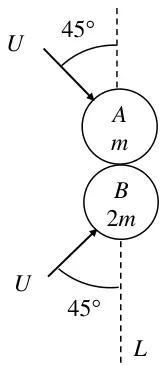
6.

Figure 2: spheres A (mass m) and B (mass 2m) in contact with centres on line L, each moving with speed U at 45 degrees to L towards the other
Figure 2

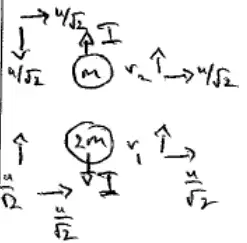
Two small smooth spheres \(A\) and \(B\), of equal size and of mass \(m\) and \(2m\) respectively, are moving initially with the same speed \(U\) on a smooth horizontal floor. The spheres collide when their centres are on a line \(L\). Before the collision the spheres are moving towards each other, with their directions of motion perpendicular to each other and each inclined at an angle of 45\(^\circ\) to the line \(L\), as shown in Figure 2. The coefficient of restitution between the spheres is \(\tfrac{1}{2}\).

(a) Find the magnitude of the impulse which acts on \(A\) in the collision. (9)
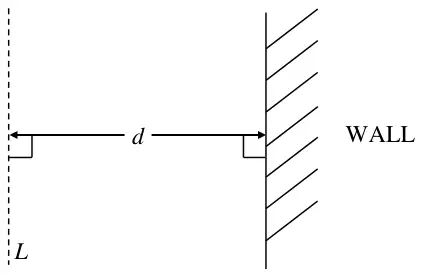
Figure 3: line L parallel to a vertical wall at distance d
Figure 3

The line \(L\) is parallel to and a distance \(d\) from a smooth vertical wall, as shown in Figure 3.

(b) Find, in terms of \(d\), the distance between the points at which the spheres first strike the wall. (5)

M4 January 2006 Q5

EdexcelOld spec16 marksCollisions: 2 Spheres Oblique

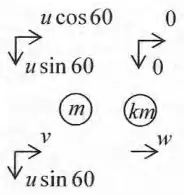
5. Two smooth uniform spheres \(A\) and \(B\) have equal radii. Sphere \(A\) has mass \(m\) and sphere \(B\) has mass \(km\). The spheres are at rest on a smooth horizontal table. Sphere \(A\) is then projected along the table with speed \(u\) and collides with \(B\). Immediately before the collision, the direction of motion of \(A\) makes an angle of 60\(^\circ\) with the line joining the centres of the two spheres. The coefficient of restitution between the spheres is \(\tfrac{1}{2}\).

(a) Show that the speed of \(B\) immediately after the collision is \(\dfrac{3u}{4(k + 1)}\). (6)

Immediately after the collision the direction of motion of \(A\) makes an angle \(\arctan\left(2\sqrt{3}\right)\) with the direction of motion of \(B\).

(b) Show that \(k = \tfrac{1}{2}\). (6)
(c) Find the loss of kinetic energy due to the collision. (4)

M4 June 2005 Q3

EdexcelOld spec11 marksCollisions: 2 Spheres Oblique

3.

Figure 1: sphere Q touching sphere P along the line of centres; Q approaches at angle alpha to the line of centres and leaves at angle beta to it
Figure 1

A smooth sphere \(P\) lies at rest on a smooth horizontal plane. A second identical sphere \(Q\), moving on the plane, collides with the sphere \(P\). Immediately before the collision the direction of motion of \(Q\) makes an angle \(\alpha\) with the line joining the centres of the spheres. Immediately after the collision the direction of motion of \(Q\) makes an angle \(\beta\) with the line joining the centres of spheres, as shown in Figure 1. The coefficient of restitution between the spheres is \(e\).

Show that \((1 - e)\tan\beta = 2\tan\alpha\). (11)

M4 January 2005 Q1

EdexcelOld spec7 marksCollisions: 2 Spheres Oblique

1. [In this question \(\mathbf{i}\) and \(\mathbf{j}\) are horizontal perpendicular unit vectors.]

Two smooth uniform spheres \(A\) and \(B\) have equal radius but masses \(m\) and \(5m\) respectively. The spheres are moving on a smooth horizontal plane when they collide. Immediately before the collision, the velocities of \(A\) and \(B\) are \((\mathbf{i} + 2\mathbf{j})\) m s\(^{-1}\) and \((-\mathbf{i} + 3\mathbf{j})\) m s\(^{-1}\) respectively. Immediately after the collision, the velocity of \(A\) is \((-2\mathbf{i} + 5\mathbf{j})\) m s\(^{-1}\).

(a) By considering the impulse on \(A\), find a unit vector parallel to the line joining the centres of the spheres when they collide. (4)
(b) Find the velocity of \(B\) immediately after the collision. (3)