A2 June 2025 Q8
8.
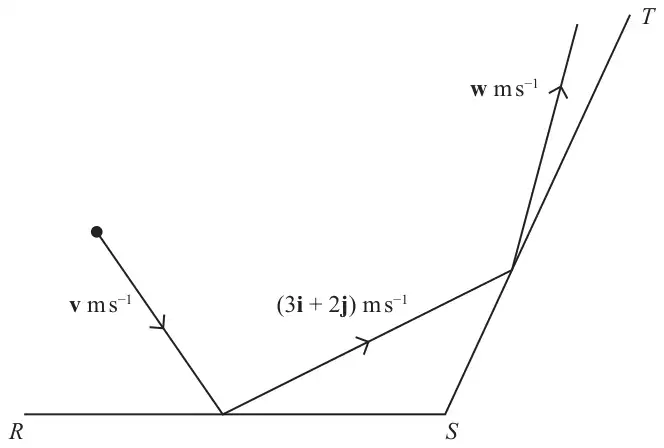
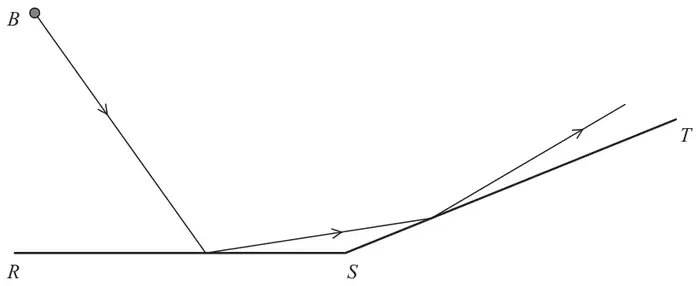
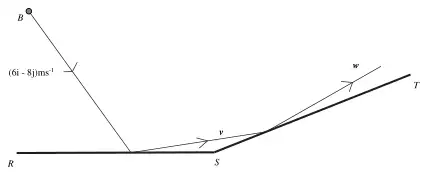
Figure 5 represents the plan view of part of a smooth horizontal floor, where \(RS\) and \(ST\) are smooth fixed vertical walls.
The vector \(\overrightarrow{RS}\) is in the direction of the vector \(\mathbf{i}\).
The vector \(\overrightarrow{ST}\) is in the direction of the vector \((3\mathbf{i} + 4\mathbf{j})\).
A small ball \(B\) of mass 0.25 kg is projected across the floor towards \(RS\).
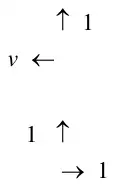
Immediately before the impact with \(RS\), the velocity of \(B\) is \(\mathbf{v}\ \text{m s}^{-1}\)
Immediately after the impact with \(RS\), the velocity of \(B\) is \((3\mathbf{i} + 2\mathbf{j})\ \text{m s}^{-1}\)
The coefficient of restitution between \(B\) and \(RS\) is \(\dfrac{1}{3}\)
The ball is modelled as a particle.
Immediately after the impact with \(ST\), the velocity of \(B\) is \(\mathbf{w}\ \text{m s}^{-1}\)
Given that the coefficient of restitution between \(B\) and \(ST\) is \(\dfrac{1}{3}\)
| Scheme | Marks | AO |
|---|---|---|
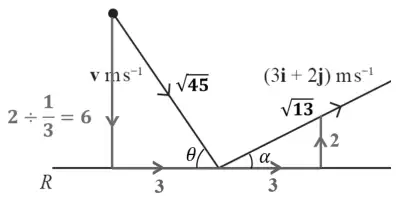 | ||
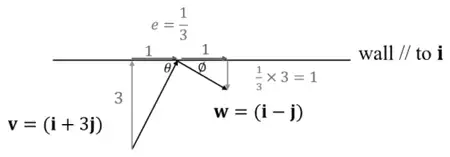
| Component of \(\mathbf{v}\) parallel to \(RS = 3\mathbf{i}\) | B1 | 3.4 |
| Use of NEL perpendicular to RS: \(2 = \dfrac{1}{3} \times\) perpendicular component | M1 | 3.4 |
| \((\mathbf{v} = 3\mathbf{i}) - 6\mathbf{j}\) | A1 | 1.1b |
| KE loss | M1 | 3.1b |
| \(= \dfrac{1}{2} \times 0.25(3^2 + 6^2) - \dfrac{1}{2} \times 0.25(3^2 + 2^2)\) | A1 | 1.1b |
| \(= 4\) (J) * | A1* | 2.2a |
| (6) |
Notes
B1: Correct only, \(3\mathbf{i}\). Accept a magnitude of 3, if seen with correct direction indicated. Accept trig components with 3 and direction indicated
E.g. \(v\cos\theta = \sqrt{13}\cos\alpha = \sqrt{13} \times \dfrac{3}{\sqrt{13}} = 3\)
M1: Correct use of the impact law perpendicular to \(RS\) with \(\dfrac{1}{3}\) and 2. Allow \(\pm\).
M0 if separation and approach are on the wrong side.
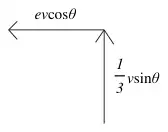
May also use scalar product eg \(\begin{pmatrix} 3 \\ 2 \end{pmatrix} \bullet \begin{pmatrix} 0 \\ 1 \end{pmatrix} = -\dfrac{1}{3}\begin{pmatrix} x \\ y \end{pmatrix} \bullet \begin{pmatrix} 0 \\ 1 \end{pmatrix}\) or magnitude and direction with trig components eg \(v\sin\theta = \dfrac{\sqrt{13}\sin\alpha}{\frac{1}{3}} = 3 \times \sqrt{13} \times \dfrac{2}{\sqrt{13}} = 6\)
A1: Correct perpendicular component of \(\mathbf{v}\), \(-6\mathbf{j}\).
Accept a magnitude of 6, if seen with correct direction indicated.
A0 for \(+6\mathbf{j}\)
M1: Correct method for change in KE. Allow \(\pm 6\)
A1: Correct unsimplified equation for change in KE (allow \(\pm 6\))
A1*: Obtain given answer from complete and correct working including consideration of parallel components.
NB
- If the given answer is obtained by only considering the KE of the perpendicular components ie \(\dfrac{1}{2} \times 0.25(6^2) - \dfrac{1}{2} \times 0.25(2^2)\), the method is incomplete.
Max score B1M1A1M1A1A0* - If the given answer is obtained by considering the KE of the perpendicular components, \(\dfrac{1}{2} \times 0.25(6^2) - \dfrac{1}{2} \times 0.25(2^2)\) and states that the KE parallel to \(RS\) is unchanged, all marks are available.
- If the solution only consists of the energy equation, this is insufficient working for a given answer \(\dfrac{1}{2} \times 0.25(3^2 + 6^2) - \dfrac{1}{2} \times 0.25(3^2 + 2^2)\). Max score B1M0A0M1A1A0*
| Scheme | Marks | AO |
|---|---|---|
| ALT 1 Method [1] using scalar product and components of \(\mathbf{w} = a\mathbf{i} + b\mathbf{j}\) and \((3\mathbf{i} + 2\mathbf{j})\) parallel to \(ST\) \((3\mathbf{i} + 4\mathbf{j})\). Allow without \(\dfrac{1}{5}\). | M1 | 3.1b |
| \(\dfrac{1}{5}(3\mathbf{i} + 4\mathbf{j}).(a\mathbf{i} + b\mathbf{j}) = \dfrac{1}{5}(3\mathbf{i} + 4\mathbf{j}).(3\mathbf{i} + 2\mathbf{j})\) \(\{3a + 4b = 17\}\) | A1 | 1.1b |
| Method [1] using scalar product and components of \(\mathbf{w} = a\mathbf{i} + b\mathbf{j}\) and \((3\mathbf{i} + 2\mathbf{j})\) perpendicular to \(ST\), \((-4\mathbf{i} + 3\mathbf{j})\). Any multiple of \((-4\mathbf{i} + 3\mathbf{j})\). Must have \(\pm\dfrac{1}{3}\). Allow without \(\dfrac{1}{5}\). | M1 | 3.1b |
| \(\dfrac{1}{5}(-4\mathbf{i} + 3\mathbf{j}).(a\mathbf{i} + b\mathbf{j}) = -\dfrac{1}{3}\left[\dfrac{1}{5}(-4\mathbf{i} + 3\mathbf{j}).(3\mathbf{i} + 2\mathbf{j})\right]\) \(\{-4a + 3b = 2\}\) | A1 | 1.1b |
| Complete method [1] to solve for \(a\) and \(b\) and form \(\mathbf{w}\) \(\begin{cases} 3a + 4b = 17 \\ -4a + 3b = 2 \end{cases} \;\Rightarrow\; \mathbf{w} = a\mathbf{i} + b\mathbf{j}\) | dM1 | 2.1 |
| \(= \dfrac{43}{25}\mathbf{i} + \dfrac{74}{25}\mathbf{j}\) (i-j notation required) | A1 | 2.2a |
| (6) | ||
| (12 marks) |
Notes
ALT 1: Method [1] Accept column vectors throughout working but must be in i-j form for final A mark.
M1: Method [1] using scalar product and components of \(\mathbf{w} = a\mathbf{i} + b\mathbf{j}\) and \((3\mathbf{i} + 2\mathbf{j})\) parallel to \(ST\) \((3\mathbf{i} + 4\mathbf{j})\) i.e. any multiple of \((3\mathbf{i} + 4\mathbf{j})\) to form an equation in \(a\) and \(b\).
Allow without \(\dfrac{1}{5}\).
A1: Correct equation in \(a\) and \(b\).
M1: Method [1] using scalar product and components of \(\mathbf{w} = a\mathbf{i} + b\mathbf{j}\) and \((3\mathbf{i} + 2\mathbf{j})\) perpendicular to \(ST\) \((-4\mathbf{i} + 3\mathbf{j})\) i.e. any multiple of \((-4\mathbf{i} + 3\mathbf{j})\) to form an equation in \(a\) and \(b\). Must have \(\pm\dfrac{1}{3}\). Allow without \(\dfrac{1}{5}\).
N.B. It is possible to form 2 simultaneous equations using 2 perpendicular equations instead of 1 parallel and 1 perpendicular
NEL: \(\dfrac{1}{5}(-4\mathbf{i} + 3\mathbf{j}).(a\mathbf{i} + b\mathbf{j}) = -\dfrac{1}{3}\left[\dfrac{1}{5}(-4\mathbf{i} + 3\mathbf{j}).(3\mathbf{i} + 2\mathbf{j})\right] \;\Rightarrow\; -4a + 3b = 2\)
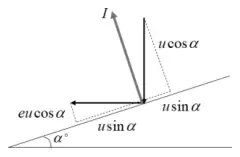
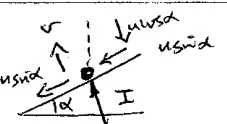
Perp.: \(\mathbf{I} = 0.25\begin{pmatrix} a - 3 \\ b - 2 \end{pmatrix}\) and \(\mathbf{I} \bullet \begin{pmatrix} 3 \\ 4 \end{pmatrix} = 0 \;\Rightarrow\; 3a + 4b = 17\)
A1: Correct equation in \(a\) and \(b\).
dM1: Dependent on previous 2 M’s. Complete method [1] to solve simultaneous equations and obtain \(\mathbf{w}\).
A1: Correct i-j form. Accept \(\dfrac{43}{25}\mathbf{i} + \dfrac{74}{25}\mathbf{j}\) or \((1.72\mathbf{i} + 2.96\mathbf{j})\)
ALT 2
| Scheme | Marks | AO |
|---|---|---|
| Method [2] using scalar product and component of \((3\mathbf{i} + 2\mathbf{j})\) with a unit vector parallel to \(ST\) \((3\mathbf{i} + 4\mathbf{j})\) | M1 | 3.1b |
| \(\dfrac{1}{5}(3\mathbf{i} + 4\mathbf{j}).(3\mathbf{i} + 2\mathbf{j}) \quad \left(= \dfrac{17}{5}\right)\) | A1 | 1.1b |
| Method [2] using scalar product and component of \((3\mathbf{i} + 2\mathbf{j})\) with a unit vector perpendicular to \(ST\), \((-4\mathbf{i} + 3\mathbf{j})\). | M1 | 3.1b |
| \(\dfrac{1}{5}(-4\mathbf{i} + 3\mathbf{j}).(3\mathbf{i} + 2\mathbf{j}) \quad \left(= -\dfrac{6}{5}\right)\) | A1 | 1.1b |
| Complete method [2] to combine correctly with \(\pm\dfrac{1}{3}\) and form \(\mathbf{w}\) \(\mathbf{w} = \dfrac{17}{5} \times \dfrac{1}{5}(3\mathbf{i} + 4\mathbf{j}) + -\dfrac{1}{3} \times -\dfrac{6}{5} \times \dfrac{1}{5}(-4\mathbf{i} + 3\mathbf{j})\) | dM1 | 2.1 |
| \(= \dfrac{43}{25}\mathbf{i} + \dfrac{74}{25}\mathbf{j}\) (i-j notation required) | A1 | 2.2a |
| (6) |
ALT 2: Method [2] Accept column vectors throughout working but must be in i-j form for final A mark.
M1: Method [2] using scalar product and component of \((3\mathbf{i} + 2\mathbf{j})\) and unit vector parallel to \(ST\)
A1: Correct expression
M1: Method [2] using scalar product and component of \((3\mathbf{i} + 2\mathbf{j})\) and unit vector perpendicular to \(ST\)
A1: Correct expression.
dM1: Dependent on previous 2 M’s. Complete method [2] to combine and form \(\mathbf{w}\). Must see \(\pm\dfrac{1}{3}\) with \((-4\mathbf{i} + 3\mathbf{j})\) component.
A1: Correct i-j form. Accept \(\dfrac{43}{25}\mathbf{i} + \dfrac{74}{25}\mathbf{j}\) or \((1.72\mathbf{i} + 2.96\mathbf{j})\)
ALT 3
| Scheme | Marks | AO |
|---|---|---|
| Method [3] finding coefficients to express \((3\mathbf{i} + 2\mathbf{j})\) as multiples of \((3\mathbf{i} + 4\mathbf{j})\) and \((-4\mathbf{i} + 3\mathbf{j})\). | M1 | 3.1b |
| \(3\mathbf{i} + 2\mathbf{j} = p(3\mathbf{i} + 4\mathbf{j}) + q(-4\mathbf{i} + 3\mathbf{j})\) | A1 | 1.1b |
| Equate components and solve for \(p\) and \(q\): eg \(\begin{cases} 3 = 3p - 4q \\ 2 = 4p + 3q \end{cases}\) | M1 | 3.1b |
| \(p = \dfrac{17}{25} \quad q = -\dfrac{6}{25}\) | A1 | 1.1b |
| Complete method [3] to combine correctly with \(\pm\dfrac{1}{3}\) and form \(\mathbf{w}\) \(\mathbf{w} = p(3\mathbf{i} + 4\mathbf{j}) + -\dfrac{1}{3} \times q(-4\mathbf{i} + 3\mathbf{j})\) | dM1 | 2.1 |
| \(= \dfrac{43}{25}\mathbf{i} + \dfrac{74}{25}\mathbf{j}\) (i-j notation required) | A1 | 2.2a |
| (6) |
ALT 3: Method [3] Accept column vectors throughout working but must be in i-j form for final A mark.
M1: Method [3] finding coefficients to express \((3\mathbf{i} + 2\mathbf{j})\) as multiples of \((3\mathbf{i} + 4\mathbf{j})\) and \((-4\mathbf{i} + 3\mathbf{j})\)
A1: Correct expression
M1: Solve to obtain the coefficients.
A1: Correct only.
dM1: Dependent on previous 2 M’s. Complete method [3] to \(\mathbf{w}\). Must see \(\pm\dfrac{1}{3}\) with \((-4\mathbf{i} + 3\mathbf{j})\).
A1: Correct i-j form. Accept \(\dfrac{43}{25}\mathbf{i} + \dfrac{74}{25}\mathbf{j}\) or \((1.72\mathbf{i} + 2.96\mathbf{j})\)
ALT 4
| Scheme | Marks | AO |
|---|---|---|
| Method [4] using rotation matrix on \(3\mathbf{i} + 2\mathbf{j}\) | M1 | |
| \(\begin{pmatrix} \frac{3}{5} & \frac{4}{5} \\ -\frac{4}{5} & \frac{3}{5} \end{pmatrix}\begin{pmatrix} 3 \\ 2 \end{pmatrix} \quad \left\{= \begin{pmatrix} \frac{17}{5} \\ -\frac{6}{5} \end{pmatrix}\right\}\) | A1 | |
| Method [4] using \(\pm\dfrac{1}{3}\) with the correct component to find velocity relative to \(ST\). | M1 | |
| \(\begin{pmatrix} \frac{17}{5} \\ \frac{2}{5} \end{pmatrix}\) | A1 | |
| Complete method [4] to reverse rotation and form \(\mathbf{w}\) \(\begin{pmatrix} \frac{3}{5} & -\frac{4}{5} \\ \frac{4}{5} & \frac{3}{5} \end{pmatrix}\begin{pmatrix} \frac{17}{5} \\ \frac{2}{5} \end{pmatrix} = \begin{pmatrix} \frac{43}{25} \\ \frac{74}{25} \end{pmatrix}\) | dM1 | |
| \(= \dfrac{43}{25}\mathbf{i} + \dfrac{74}{25}\mathbf{j}\) (i-j notation required) | A1 | |
| (6) |
ALT 4: Method [4] Accept column vectors throughout working but must be in i-j form for final A mark.
M1: Method [4] using rotation matrix on \(3\mathbf{i} + 2\mathbf{j}\)
A1: Correct matrix expression
M1: Method [4] using \(\pm\dfrac{1}{3}\) with the correct component to find velocity relative to \(ST\).
A1: Correct only.
dM1: Dependent on previous 2 M’s. Complete method [4] by reversing rotation to form \(\mathbf{w}\)
A1: Correct i-j form. Accept \(\dfrac{43}{25}\mathbf{i} + \dfrac{74}{25}\mathbf{j}\) or \((1.72\mathbf{i} + 2.96\mathbf{j})\)
ALT 5
| Scheme | Marks | AO |
|---|---|---|
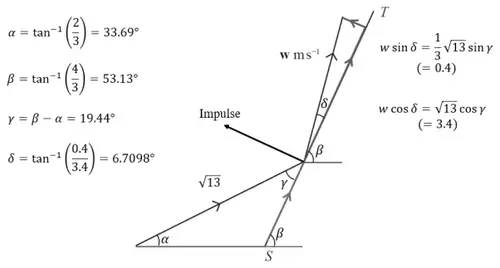 | ||
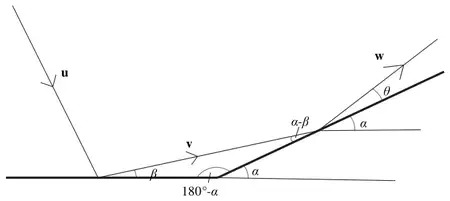
| Method [5] using speed and direction parallel to \(ST\) | M1 | 3.1b |
| \(w\cos\delta = \sqrt{13}\cos\gamma \quad (= 3.4)\) | A1 | 1.1b |
| Method [5] using speed and direction perpendicular to \(ST\) with \(\pm\dfrac{1}{3}\) | M1 | 3.1b |
| \(w\sin\delta = \dfrac{1}{3}\sqrt{13}\sin\gamma \quad (= 0.4)\) | A1 | 1.1b |
| Complete method [5] to combine modulus with angle \((\beta + \delta)\) and form \(\mathbf{w}\) \(\mathbf{w} = \dfrac{\sqrt{293}}{5}\cos(\beta + \delta)\mathbf{i} + \dfrac{\sqrt{293}}{5}\sin(\beta + \delta)\mathbf{j}\) | dM1 | 2.1 |
| \(= \dfrac{43}{25}\mathbf{i} + \dfrac{74}{25}\mathbf{j}\) (i-j notation required) | A1 | 2.2a |
| (6) |
ALT 5: Method [5] Answer must be in i-j form for final A mark.
M1: Method [5] using speed and direction parallel to \(ST\). Use \(\sqrt{3^2 + 2^2}\) with \(\gamma\) where \(\gamma = \tan^{-1}\left(\dfrac{4}{3}\right) - \tan^{-1}\left(\dfrac{2}{3}\right)\)
A1: \(w\cos\delta = \sqrt{3^2 + 2^2}\cos\gamma \quad (= 3.4)\)
M1: Method [5] using speed and direction perpendicular to \(ST\). Use \(\pm\dfrac{1}{3}\) and \(\sqrt{3^2 + 2^2}\) with \(\gamma\) where \(\gamma = \tan^{-1}\left(\dfrac{4}{3}\right) - \tan^{-1}\left(\dfrac{2}{3}\right)\)
A1: \(w\sin\delta = \dfrac{1}{3}\sqrt{3^2 + 2^2}\sin\gamma \quad (= 0.4)\)
dM1: Dependent on previous 2 M’s. Complete method [5] to combine the modulus with the relevant angle and form \(\mathbf{w}\)
\(\mathbf{w} = \dfrac{\sqrt{293}}{5}\cos(\beta + \delta)\mathbf{i} + \dfrac{\sqrt{293}}{5}\sin(\beta + \delta)\mathbf{j}\)
A1: Correct i-j form. Accept \(\dfrac{43}{25}\mathbf{i} + \dfrac{74}{25}\mathbf{j}\) or \((1.72\mathbf{i} + 2.96\mathbf{j})\)