
A2 June 2019 Q2
2.
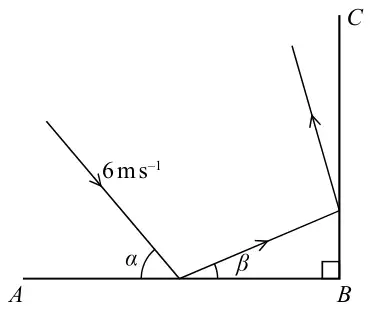
Figure 2 represents the plan view of part of a horizontal floor, where \(AB\) and \(BC\) are fixed vertical walls with \(AB\) perpendicular to \(BC\).
A small ball is projected along the floor towards \(AB\) with speed \(6\ \text{m s}^{-1}\) on a path that makes an angle \(\alpha\) with \(AB\), where \(\tan\alpha = \dfrac{4}{3}\). The ball hits \(AB\) and then hits \(BC\).
Immediately after hitting \(AB\), the ball is moving at an angle \(\beta\) to \(AB\), where \(\tan\beta = \dfrac{1}{3}\)
The coefficient of restitution between the ball and \(AB\) is \(e\).
The coefficient of restitution between the ball and \(BC\) is \(\dfrac{1}{2}\)
By modelling the ball as a particle and the floor and walls as being smooth,
| Scheme | Marks | AO |
|---|---|---|
| After hit \(AB\): \(\rightarrow 6\cos\alpha\ (= v\cos\beta)\ \ (= 3.6)\) | B1 | 3.1b |
| Use of impact law: | M1 | 3.4 |
| \(\uparrow 6e\sin\alpha\ \ (= v\sin\beta)\ \left(= \dfrac{24e}{5}\right)\ (= 4.8e)\) | A1 | 1.1b |
| \(\tan\beta = \dfrac{1}{3} = \dfrac{6e\sin\alpha}{6\cos\alpha}\ \left(= \dfrac{24e}{5} \div \dfrac{18}{5}\right)\) | M1 | 2.1 |
| \(e = \dfrac{18}{3 \times 24} = \dfrac{1}{4}\) * | A1* | 2.2a |
| (5) |
Notes
B1: Use model to find component parallel to the wall
M1: Use model and impact law perpendicular to the wall
A1: Correct perpendicular component
M1: Use \(\tfrac{1}{3}\) and their components to form equation in \(e\) \(\left(v = \dfrac{6\sqrt{10}}{5} = 3.79\right)\)
A1*: Correct answer from correct exact working
If only see \(e\tan\alpha = \tan\beta\) with no explanation of where it comes from then score 0/5
| Scheme | Marks | AO |
|---|---|---|
| After hit \(BC\): \(\uparrow \dfrac{6}{5}\) | B1 | 1.1b |
| \(\rightarrow \dfrac{1}{2} \times \dfrac{18}{5}\ \left(= \dfrac{9}{5}\right)\) | B1 | 3.4 |
| Speed \(= \dfrac{3}{5}\sqrt{2^2 + 3^2}\) | M1 | 1.1b |
| \(= \dfrac{3\sqrt{13}}{5}\ (\text{m s}^{-1})\) | A1 | 1.1b |
| (4) |
Notes
B1: First component correct
B1: Second component correct
Alternative: B1 for speed of impact with \(BC = 3.79\ldots\)
B1 for path on leaving \(BC\) at \(56.3\ldots^\circ\) to \(BC\)
M1: Use Pythagoras’ theorem or trigonometry to find the speed
A1: Any equivalent form. 2.2 or better \((2.1633\ldots)\)
| Scheme | Marks | AO |
|---|---|---|
| An appropriate refinement | B1 | 3.5c |
| A second independent appropriate refinement and no incorrect refinements | B1 | 3.5c |
| (2) | ||
| (11 marks) |
Notes
B1 B1: Two independent refinements relating to the modelling e.g.
- Include friction between the floor and the ball
- Include friction between the ball and the walls
- Give the ball dimensions.
- Consider air resistance
- Spin / rotation