
M4 January 2005 Q5
5. [In this question \(\mathbf{i}\) and \(\mathbf{j}\) are horizontal perpendicular unit vectors.]
The vector \(\mathbf{n} = \left(-\tfrac{3}{5}\mathbf{i} + \tfrac{4}{5}\mathbf{j}\right)\) and the vector \(\mathbf{p} = \left(\tfrac{4}{5}\mathbf{i} + \tfrac{3}{5}\mathbf{j}\right)\) are perpendicular unit vectors.
[Note: the printed paper gives \(\mathbf{p} = \left(-\tfrac{4}{5}\mathbf{i} + \tfrac{3}{5}\mathbf{j}\right)\), which is not perpendicular to \(\mathbf{n}\). The mark scheme notes this error and uses \(\mathbf{p} = \tfrac{4}{5}\mathbf{i} + \tfrac{3}{5}\mathbf{j}\).]
A smooth uniform sphere \(S\) of mass 0.5 kg is moving on a smooth horizontal plane when it collides with a fixed smooth vertical wall which is parallel to \(\mathbf{p}\). Immediately after the collision the velocity of \(S\) is \((\mathbf{i} + 3\mathbf{j})\) m s\(^{-1}\). The coefficient of restitution between \(S\) and the wall is \(\tfrac{9}{16}\).
| Scheme |
|---|
| (Note: error in question: \(\mathbf{p} = +\tfrac{4}{5}\mathbf{i} + \tfrac{3}{5}\mathbf{j}\).) |
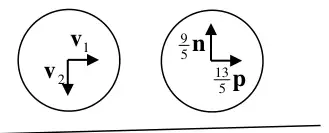
| \(\tfrac{9}{5}\mathbf{n} + \tfrac{13}{5}\mathbf{p} = \tfrac{9}{5}\left(-\tfrac{3}{5}\mathbf{i} + \tfrac{4}{5}\mathbf{j}\right) + \tfrac{13}{5}\left(\tfrac{4}{5}\mathbf{i} + \tfrac{3}{5}\mathbf{j}\right) = \tfrac{25}{25}\mathbf{i} + \tfrac{75}{25}\mathbf{j} = \mathbf{i} + 3\mathbf{j}\) |
Notes
The published mark scheme for this paper is a set of worked answers: no mark allocation is printed.
Before After
| Scheme |
|---|
| No impulse parallel to the wall so velocity parallel to wall unchanged: \(\ \mathbf{v}_1 = \tfrac{13}{5}\mathbf{p}\) |
| Newton’s law of Restitution perpendicular to the wall: \(\ e\mathbf{v}_2 = -\tfrac{9}{5}\mathbf{n}\) |
| Put in values: \(\ \tfrac{9}{16}\mathbf{v}_2 = -\tfrac{9}{5}\left(-\tfrac{3}{5}\mathbf{i} + \tfrac{4}{5}\mathbf{j}\right),\ \ \mathbf{v}_2 = -\tfrac{16}{5}\left(-\tfrac{3}{5}\mathbf{i} + \tfrac{4}{5}\mathbf{j}\right) = \tfrac{48}{25}\mathbf{i} - \tfrac{64}{25}\mathbf{j}\) |
| \(\mathbf{v}_1 + \mathbf{v}_2 = \tfrac{13}{5}\left(\tfrac{4}{5}\mathbf{i} + \tfrac{3}{5}\mathbf{j}\right) - \tfrac{16}{5}\left(-\tfrac{3}{5}\mathbf{i} + \tfrac{4}{5}\mathbf{j}\right) = 4\mathbf{i} - \mathbf{j}\) |
Notes
(Corrected from the printed mark scheme: \(\mathbf{v}_2\) is printed as \(\tfrac{39}{25}\mathbf{i} - \tfrac{64}{25}\mathbf{j}\) and the final velocity as \(4\mathbf{i} - \mathbf{i}\).)
| Scheme |
|---|
| Change in KE \(= \tfrac{1}{2} \times \tfrac{1}{2} \times \left(4^2 + 1^2\right) - \tfrac{1}{2} \times \tfrac{1}{2} \times \left(3^2 + 1^2\right) = 1.75\) J |