
A2 October 2021 Q7
7. [In this question, \(\mathbf{i}\) and \(\mathbf{j}\) are perpendicular unit vectors in a horizontal plane.]
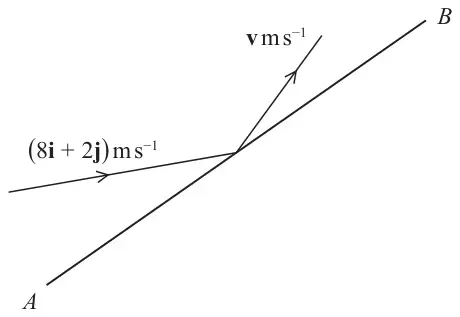
Figure 3 represents the plan view of part of a smooth horizontal floor, where \(AB\) is a fixed smooth vertical wall.
The direction of \(\overrightarrow{AB}\) is in the direction of the vector \((\mathbf{i} + \mathbf{j})\)
A small ball of mass 0.25 kg is moving on the floor when it strikes the wall \(AB\).
Immediately before its impact with the wall \(AB\), the velocity of the ball is \((8\mathbf{i} + 2\mathbf{j})\ \text{m s}^{-1}\)
Immediately after its impact with the wall \(AB\), the velocity of the ball is \(\mathbf{v}\ \text{m s}^{-1}\)
The coefficient of restitution between the ball and the wall is \(\dfrac{1}{3}\)
By modelling the ball as a particle,
| Scheme | Marks | AO |
|---|---|---|
| Component parallel to the wall: \(\left[\dfrac{1}{\sqrt{2}}(\mathbf{i} + \mathbf{j}).(8\mathbf{i} + 2\mathbf{j})\right]\) | M1 | 2.1 |
| \(= 5\sqrt{2}\) | A1 | 1.1b |
| Use of impact law perpendicular to wall: | M1 | 3.4 |
| Component perpendicular to wall after impact \(\dfrac{1}{3}\left[\dfrac{1}{\sqrt{2}}(-\mathbf{i} + \mathbf{j}).(8\mathbf{i} + 2\mathbf{j})\right] = -\sqrt{2}\) | A1 | 1.1b |
| For a complete method to find \(\mathbf{v}\) | M1 | 1.1b |
| \(\Rightarrow \mathbf{v} = (5\mathbf{i} + 5\mathbf{j}) + (-\mathbf{i} + \mathbf{j}) = (4\mathbf{i} + 6\mathbf{j})\) * | A1* | 2.2a |
| (6) |
Notes
M1: Use of scalar product or equivalent. Allow M1 if not using unit vector
A1: Correct unsimplified expression for component parallel to wall
M1: Correct use of impact law perpendicular to the wall. Condone sign error
A1: Correct unsimplified expression for component perpendicular to wall
M1: Complete method to solve for \(\mathbf{v}\)
A1*: Obtain given result from correct working
Alternative (a) alt
| Scheme | Marks | AO |
|---|---|---|
| If \(\mathbf{v} = a\mathbf{i} + b\mathbf{j}\) component parallel to the wall: | M1 | 2.1 |
| \((8\mathbf{i} + 2\mathbf{j}).(\mathbf{i} + \mathbf{j}) = (a\mathbf{i} + b\mathbf{j}).(\mathbf{i} + \mathbf{j})\) \((a + b = 10)\) | A1 | 1.1b |
| Use of impact law: | M1 | 3.4 |
| \(-\dfrac{1}{3}(8\mathbf{i} + 2\mathbf{j}).(-\mathbf{i} + \mathbf{j}) = (a\mathbf{i} + b\mathbf{j}).(-\mathbf{i} + \mathbf{j})\) \((2 = -a + b)\) | A1 | 1.1b |
| For a complete method to find \(\mathbf{v}\) | M1 | 1.1b |
| \(\Rightarrow \mathbf{v} = (4\mathbf{i} + 6\mathbf{j})\) * | A1* | 2.2a |
| (6) |
Alternative (a) alt 2
| Scheme | Marks | AO |
|---|---|---|
| Angle to wall \(= 31^\circ\), component parallel to the wall: | M1 | 2.1 |
| \(= \sqrt{68}\cos 31^\circ = 7.07\) | A1 | 1.1b |
| Component perpendicular to the wall | M1 | 3.4 |
| \(= \dfrac{1}{3}\sqrt{68}\sin 31^\circ = 1.42\) | A1 | 1.1b |
| For a complete method to find \(\mathbf{v}\) | M1 | 1.1b |
| \(\Rightarrow \mathbf{v} = \left(\sqrt{52}\cos 56.3^\circ\mathbf{i} + \sqrt{52}\sin 56.3^\circ\mathbf{j}\right) = (4\mathbf{i} + 6\mathbf{j})\) | A1* | 2.2a |
| (6) |
| Scheme | Marks | AO |
|---|---|---|
| \(\mathbf{I} = 0.25(4\mathbf{i} + 6\mathbf{j}) - 0.25(8\mathbf{i} + 2\mathbf{j})\) \(\big(\mathbf{I} = 0.25(-\mathbf{i} + \mathbf{j}) - 0.25(3\mathbf{i} - 3\mathbf{j})\big)\) \(\big(\mathbf{I} = (-\mathbf{i} + \mathbf{j})\big)\) | M1 | 3.1b |
| Use of Pythagoras | M1 | 1.1b |
| \(|\mathbf{I}| = \sqrt{2}\ (\text{N s})\) | A1 | 1.1b |
| (3) | ||
| (9 marks) |
Notes
M1: Use of \(\mathbf{I} = m\mathbf{v} - m\mathbf{u}\) with velocities or perpendicular components of velocities. Must be subtracting but allow subtraction in either order.
M1: Correct use of Pythagoras to find modulus
A1: Accept 1.4 Ns or better