
A2 June 2022 Q8
8.
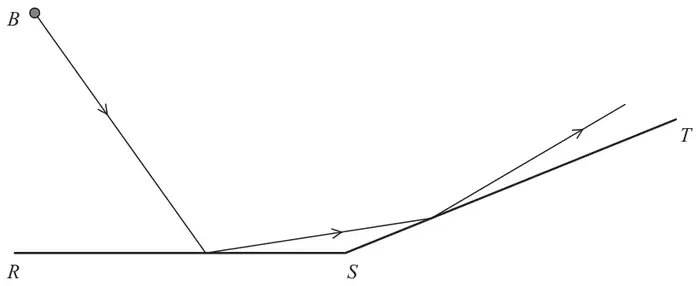
Figure 5 represents the plan view of part of a smooth horizontal floor, where \(RS\) and \(ST\) are smooth fixed vertical walls. The vector \(\overrightarrow{RS}\) is in the direction of \(\mathbf{i}\) and the vector \(\overrightarrow{ST}\) is in the direction of \((2\mathbf{i} + \mathbf{j})\).
A small ball \(B\) is projected across the floor towards \(RS\). Immediately before the impact with \(RS\), the velocity of \(B\) is \((6\mathbf{i} - 8\mathbf{j})\ \text{m s}^{-1}\). The ball bounces off \(RS\) and then hits \(ST\).
The ball is modelled as a particle.
Given that the coefficient of restitution between \(B\) and \(RS\) is \(e\),
It is now given that \(e = \dfrac{1}{4}\) and that the coefficient of restitution between \(B\) and \(ST\) is \(\dfrac{1}{2}\)
| Scheme | Marks | AO |
|---|---|---|
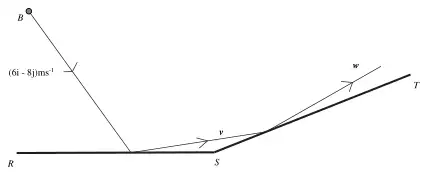 | ||
| \(\mathbf{v} = 6\mathbf{i} + \ldots\) | B1 | 3.4 |
| \(\ldots 8e\mathbf{j}\) | B1 | 3.4 |
| impact with \(ST \Rightarrow \dfrac{8e}{6} \lt \dfrac{1}{2},\quad 0 \lt e \lt \dfrac{3}{8}\) | B1 | 3.1b |
| (3) |
Notes
B1: Component parallel to the wall unchanged. Could be on a diagram or implied if they use \(e\tan\alpha = \tan\beta\)
B1: Use of impact law perpendicular to the wall. Could be on a diagram or implied if they use \(e\tan\alpha = \tan\beta\)
B1: Use the direction to determine the range for \(e\). (could come via \(e\tan\alpha = \tan\beta \lt 1/2\))
| Scheme | Marks | AO |
|---|---|---|
| Perpendicular to \(ST\): direction \(\pm\mu(-\mathbf{i} + 2\mathbf{j})\) | B1 | 1.2 |
| Component parallel to \(ST\): \((6\mathbf{i} + 2\mathbf{j}) \cdot \lambda(2\mathbf{i} + \mathbf{j})\) | M1 | 3.1b |
| \(= \left((6\mathbf{i} + 2\mathbf{j}) \cdot \dfrac{1}{\sqrt{5}}(2\mathbf{i} + \mathbf{j}) =\right) \dfrac{1}{\sqrt{5}}(12 + 2)\) | A1 | 1.1b |
| Component perpendicular to \(ST\): \(\pm\left(\dfrac{1}{2}(6\mathbf{i} + 2\mathbf{j}) \cdot \gamma(-\mathbf{i} + 2\mathbf{j})\right)\) | M1 | 3.4 |
| \(= \dfrac{1}{2\sqrt{5}}(-6 + 4)\) | A1 | 1.1b |
| \(\mathbf{w} = \dfrac{14}{\sqrt{5}}\dfrac{1}{\sqrt{5}}(2\mathbf{i} + \mathbf{j}) + \dfrac{1}{\sqrt{5}}\dfrac{1}{\sqrt{5}}(-\mathbf{i} + 2\mathbf{j})\) | M1 | 3.1b |
| \(\mathbf{w} = \left(\dfrac{28}{5} - \dfrac{1}{5}\right)\mathbf{i} + \left(\dfrac{14}{5} + \dfrac{2}{5}\right)\mathbf{j} = \left(\dfrac{27}{5}\mathbf{i} + \dfrac{16}{5}\mathbf{j}\right)\) or \((5.4\mathbf{i} + 3.2\mathbf{j})\) \((\text{m s}^{-1})\) | A1 | 2.2a |
| (7) | ||
| (10 marks) |
Notes
B1: Correct vector perpendicular to \(ST\) seen or implied
\(\mu\) can have any scalar value
M1: Use scalar product to find component of \(\mathbf{v}\) parallel to \(ST\). \(\lambda\) can have any scalar value
A1: Correct unsimplified expression for the magnitude
M1: Use scalar product and impact law perpendicular to \(ST\) to find magnitude of component perpendicular to the wall. For their perpendicular vector. Must clearly be using \(e = \tfrac{1}{2}\). \(\gamma\) can have any scalar value.
A1: Correct unsimplified expression for the perpendicular component. Allow \(\pm\)
M1: Combine the magnitudes and directions to obtain the velocity. The perpendicular should now be in the correct direction.
A1: Correct simplified velocity.
Alternative 1 (8b alt 1)
| Scheme | Marks | AO |
|---|---|---|
| Perpendicular to \(ST\): direction \(\pm\mu(-\mathbf{i} + 2\mathbf{j})\) | B1 | 1.2 |
| \(\mathbf{w} = a\mathbf{i} + b\mathbf{j} \Rightarrow (6\mathbf{i} + 2\mathbf{j}).(2\mathbf{i} + \mathbf{j}) = (a\mathbf{i} + b\mathbf{j}).(2\mathbf{i} + \mathbf{j})\) | M1 | |
| \(14 = 2a + b\) | A1 | |
| \(\pm\dfrac{1}{2}(6\mathbf{i} + 2\mathbf{j}).(-\mathbf{i} + 2\mathbf{j}) = (a\mathbf{i} + b\mathbf{j}).(-\mathbf{i} + 2\mathbf{j})\) | M1 | |
| \(2b - a = \pm 1\) | A1 | |
| Solve simultaneous equations for \(a\) and \(b\) | M1 | |
| \(\mathbf{w} = \left(\dfrac{27}{5}\mathbf{i} + \dfrac{16}{5}\mathbf{j}\right)\) or \((5.4\mathbf{i} + 3.2\mathbf{j})\) \((\text{m s}^{-1})\) | A1 | |
| (7) |
B1: Correct vector perpendicular to \(ST\) seen or implied.
\(\mu\) can have any scalar value
M1: Correct method for component parallel to \(ST\)
A1: Correct equation in \(a\) and \(b\)
M1: Correct method for component perpendicular to \(ST\)
Allow \(\pm\) For their perpendicular vector
A1: Correct equation in \(a\) and \(b\)
M1: Solve for \(a\) and \(b\) to obtain velocity. Using the correct direction for the perpendicular component
A1: Correct simplified answer.
Alternative 2 (8b alt 2)
| Scheme | Marks | AO |
|---|---|---|
| Perpendicular to \(ST\): direction \(\pm\mu(-\mathbf{i} + 2\mathbf{j})\) | B1 | 1.2 |
| \(\mathbf{v} = 6\mathbf{i} + 2\mathbf{j} = p(2\mathbf{i} + \mathbf{j}) + q(-\mathbf{i} + 2\mathbf{j})\) | M1 | 3.1b |
| \(6 = 2p - q,\ \ 2 = p + 2q\) \(\left(p = \dfrac{14}{5},\ \ q = \dfrac{-2}{5}\right)\) | A1 | 1.1b |
| Component perpendicular to \(ST\) \(\pm\dfrac{1}{2} \times q(-\mathbf{i} + 2\mathbf{j})\) | M1 | 3.4 |
| \(\pm\dfrac{1}{2} \times q(-\mathbf{i} + 2\mathbf{j})\) | A1 | 1.1b |
| Solve for \(p\) and \(q\) to obtain velocity \(\mathbf{w} = \dfrac{14}{5}(2\mathbf{i} + \mathbf{j}) + \dfrac{1}{2} \times \dfrac{2}{5}(-\mathbf{i} + 2\mathbf{j})\) | M1 | 3.1b |
| \(\mathbf{w} = \left(\dfrac{27}{5}\mathbf{i} + \dfrac{16}{5}\mathbf{j}\right)\) or \((5.4\mathbf{i} + 3.2\mathbf{j})\) \((\text{m s}^{-1})\) | A1 | 2.2a |
| (7) |
B1: Correct vector perpendicular to \(ST\) seen or implied.
\(\mu\) can have any scalar value
M1: Split \(\mathbf{v}\) into components parallel and perpendicular to \(ST\)
A1: Two equations in \(p\) and \(q\)
M1: Use the impact law perpendicular to \(ST\) For their perpendicular vector
A1: Correct unsimpified perpendicular component.
With \(q\) or their \(q\)
M1: Solve for \(p\) and \(q\) to obtain velocity Using the correct direction for the perpendicular component
A1: Correct simplified total.
Alternative 3 (8b alt 3)
| Scheme | Marks | AO |
|---|---|---|
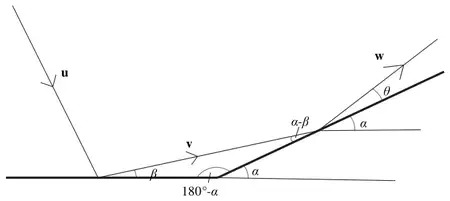 | ||
| \(\alpha - \beta = 8.1\ldots^\circ\) | B1 | |
| Component of \(\mathbf{w}\) parallel to \(ST\) is \(|\mathbf{v}|\cos(\alpha - \beta)\) | M1 | |
| \(= \sqrt{40}\cos(\alpha - \beta)\left(= \sqrt{40} \times \dfrac{7}{\sqrt{50}} = 6.26..\right)\) | A1 | |
| Component of \(\mathbf{w}\) perpendicular to \(ST\) is \(\dfrac{1}{2}|\mathbf{v}|\sin(\alpha - \beta)\) | M1 | |
| \(\pm\dfrac{1}{2} \times \sqrt{40}\sin(\alpha - \beta)\left(= \dfrac{\sqrt{40}}{2} \times \dfrac{1}{\sqrt{50}} = 0.447\ldots\right)\) | A1 | |
| \(\mathbf{w} = |\mathbf{w}|\cos(\alpha + \theta)\mathbf{i} + |\mathbf{w}|\sin(\alpha + \theta)\mathbf{j}\) | M1 | |
| \(\mathbf{w} = \left(\dfrac{27}{5}\mathbf{i} + \dfrac{16}{5}\mathbf{j}\right)\) or \((5.4\mathbf{i} + 3.2\mathbf{j})\) \((\text{m s}^{-1})\) | A1 | |
| (7) |
B1: Seen or implied. \(\sin(\alpha - \beta) = \dfrac{1}{\sqrt{50}},\ \cos(\alpha - \beta) = \dfrac{7}{\sqrt{50}},\ \tan(\alpha - \beta) = \dfrac{1}{7}\)
M1: Correct use of their \(|\mathbf{v}|\) and their \(\alpha - \beta\)
A1: Correct unsimplified
M1: Correct use of \(\dfrac{1}{2}\), their \(|\mathbf{v}|\) and their \(\alpha - \beta\)
A1: Correct unsimplified
M1: Use of Pythagoras and correct method for \(\theta + \alpha\).
\(\cos(\alpha + \theta) = \dfrac{27}{\sqrt{5}\sqrt{197}},\ \sin(\alpha + \theta) = \dfrac{16}{\sqrt{5}\sqrt{197}}\)
\(\alpha + \theta = 30.65^\circ\)
A1: Correct simplified total.