6.[In this question, \(\mathbf{i}\) and \(\mathbf{j}\) are horizontal perpendicular unit vectors.]
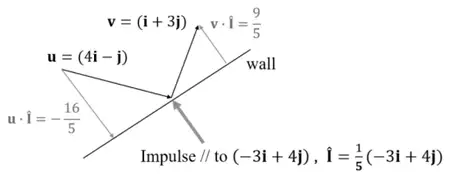
A particle \(P\) is moving with velocity \((4\mathbf{i} - \mathbf{j})\ \text{m s}^{-1}\) on a smooth horizontal plane. The particle collides with a smooth vertical wall and rebounds with velocity \((\mathbf{i} + 3\mathbf{j})\ \text{m s}^{-1}\)
The coefficient of restitution between \(P\) and the wall is \(e\).
(a) Find the value of \(e\). (6)
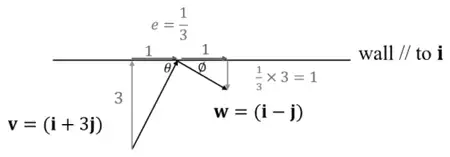
After the collision, \(P\) goes on to hit a second smooth vertical wall, which is parallel to \(\mathbf{i}\).
The coefficient of restitution between \(P\) and this second wall is \(\dfrac{1}{3}\)
The angle through which the direction of motion of \(P\) has been deflected by its collision with this second wall is \(\alpha^\circ\).
(b) Find the value of \(\alpha\), giving your answer to the nearest whole number. (4)
Mark scheme (a)
Scheme
Marks
AO
Complete method to find direction of normal (perpendicular to wall) \((\pm m)\ \big((\mathbf{i} + 3\mathbf{j}) - (4\mathbf{i} - \mathbf{j})\big)\)
M1
2.1
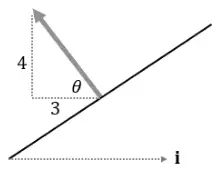
\((-3\mathbf{i} + 4\mathbf{j})\) or any parallel vector
A1
1.1b
Resolve both velocities parallel to impulse
M1
3.1a
Approach: \((4\mathbf{i} - \mathbf{j}).\left(\dfrac{1}{5}\right)(-3\mathbf{i} + 4\mathbf{j}) = -\dfrac{16}{5}\) N.B. \(\dfrac{1}{5}\) is not required Separation: \((\mathbf{i} + 3\mathbf{j}).\left(\dfrac{1}{5}\right)(-3\mathbf{i} + 4\mathbf{j}) = \dfrac{9}{5}\) N.B. \(\dfrac{1}{5}\) is not required
A1
1.1b
\(e =\) separation speed / approach speed
DM1
3.3
\(e = \dfrac{9}{16}\) (0.56 or better)
A1
1.1b
(6)
Notes
Allow column vectors throughout the question
M1: Complete method to find the direction of the normal (perpendicular to the wall). Eg
Main scheme: use of impulse equation with difference in momenta, \(m\) is not required so may see only the difference in velocities.
Find the direction of the wall first by equating parallel components then find a perpendicular direction using the scalar product or otherwise. Eg \((4\mathbf{i} - \mathbf{j}) \cdot (x\mathbf{i} + y\mathbf{j}) = (\mathbf{i} + 3\mathbf{j}) \cdot (x\mathbf{i} + y\mathbf{j}) \;\Rightarrow\; 3x = 4y\) Wall direction // \((4\mathbf{i} + 3\mathbf{j}) \Rightarrow\) Impulse direction // \((-3\mathbf{i} + 4\mathbf{j})\)
A1: Any correct vector parallel to impulse \((-3\mathbf{i} + 4\mathbf{j})\)
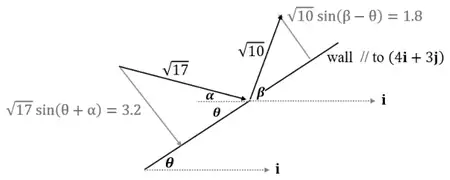
M1: Complete method to resolve both velocities parallel to impulse
Using the scalar product (main scheme)
Using trig: velocity components from shown on diagramwhere \(\tan\theta = \tfrac{3}{4}\) \(\tan\alpha = \tfrac{1}{4}\) \(\tan\beta = \tfrac{3}{1}\)
Note: \(\tan\emptyset = \tfrac{1}{3}\tan\theta\) may be used in working
DM1
3.1a
\(\alpha = 117\) (nearest whole number)
A1
1.1b
(4)
(10 marks)
Notes
Allow column vectors throughout the question
M1: Method to find velocity after impact with second wall: \(\mathbf{i}\) component unchanged, \(\mathbf{j}\) component: \(\tfrac{1}{3}(3)\). Condone sign errors.
A1: Correct velocity components after impact, may be given if seen on a diagram.
DM1: Complete method to find the angle of deflection for their velocity after second impact. Dependent on previous M.
A1: Correct answer, must be rounded to nearest degree.