
A2 June 2023 Q7
7.
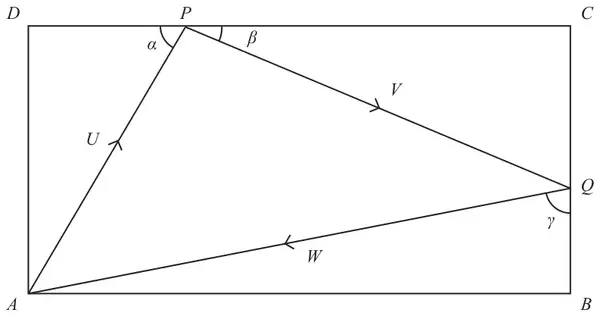
A small smooth snooker ball is projected from the corner \(A\) of a horizontal rectangular snooker table \(ABCD\).
The ball is projected so it first hits the side \(DC\) at the point \(P\), then hits the side \(CB\) at the point \(Q\) and then returns to \(A\).
Angle \(APD = \alpha\), Angle \(QPC = \beta\), Angle \(AQB = \gamma\)
The ball moves along \(AP\) with speed \(U\), along \(PQ\) with speed \(V\) and along \(QA\) with speed \(W\), as shown in Figure 2.
The coefficient of restitution between the ball and side \(DC\) is \(e_1\)
The coefficient of restitution between the ball and side \(CB\) is \(e_2\)
The ball is modelled as a particle.
Use the model to answer all parts of this question.
If instead \(e_1 = e_2\), the ball would not return to \(A\).
Given that \(e_1 = e_2\)
| Scheme | Marks | AO |
|---|---|---|
Note: The diagram below is an aide for marking. In reality, the velocity components cannot be represented by the side lengths of the snooker table. The magnitude of \(PC\) is not the magnitude of \(U\cos\alpha\)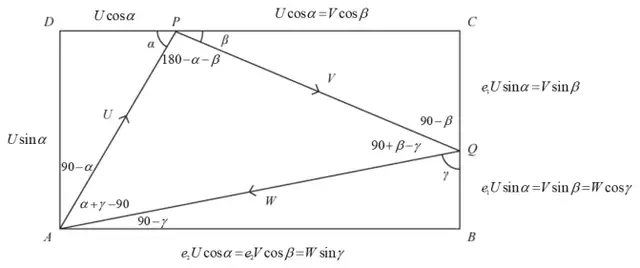 | ||
| \((V\sin\beta =)\, e_1U\sin\alpha\) | B1 | 3.4 |
| \((V\cos\beta =)\, U\cos\alpha\) | B1 | 3.4 |
| Eliminate \(U\) and \(V\) from two equations | M1 | 1.1b |
| \(\tan\beta = e_1\tan\alpha\) * | A1* | 2.2a |
| (4) |
Notes
B1: \(e_1U\sin\alpha\) seen from a relevant equation or on a diagram.
B1: \(U\cos\alpha\) seen in a relevant equation or on a diagram.
M1: A clear method using two equations to eliminate \(U\) and \(V\).
A1*: GIVEN answer correctly obtained. Must include two equations showing how to reach both \(\tan\beta\) and \(e_1\tan\alpha\). It is not sufficient to use the side lengths of the snooker eg using \(\tan\beta = \dfrac{CQ}{PC}\) oe is not sufficient.
Accept \(\tan\beta = e_1\tan\alpha\) or \(e_1\tan\alpha = \tan\beta\)
| Scheme | Marks | AO |
|---|---|---|
| Note: The diagram below is an aide for marking. In reality, the velocity components cannot be represented by the side lengths of the snooker table. The magnitude of \(PC\) is not the magnitude of \(U\cos\alpha\) | ||
| Form a correct equation for \(\gamma\), \(\beta\) and \(e_2\) \(\tan\gamma = e_2\tan(90^\circ - \beta)\) \(\tan\gamma = e_2\cot\beta\) \(\cot\gamma = \dfrac{\tan\beta}{e_2}\) | B1 | 1.1b |
| \(\tan\gamma = e_2 \times \dfrac{1}{\tan\beta} = e_2 \times \dfrac{1}{e_1\tan\alpha}\) | M1 | 3.1b |
| \(e_1\tan\alpha = e_2\cot\gamma\) * | A1* | 2.2a |
| (3) |
Notes
This part states ‘hence’ so \(\beta\) must be used.
B1: Form a correct expression for \(\tan\gamma\) or \(\cot\gamma\) in terms of \(e_2\) and \(\beta\) or \((90 - \beta)\). May quote result from (a) or obtain again.
M1: Use result from (a) to eliminate \(\tan\beta\) and form an equation in \(\alpha\), \(\gamma\), \(e_1\), \(e_2\)
A1*: Given answer correctly obtained. The solution must include the replacement of \(\tan\beta\) and rearrangement to the correct form.
Accept \(e_1\tan\alpha = e_2\cot\gamma\) or \(e_2\cot\gamma = e_1\tan\alpha\)
| Scheme | Marks | AO |
|---|---|---|
| Note: The diagram below is an aide for marking. In reality, the velocity components cannot be represented by the side lengths of the snooker table. The magnitude of \(PC\) is not the magnitude of \(U\cos\alpha\) | ||
| (angle \(APQ\) + angle \(AQP\)) = \((180^\circ - \alpha - \beta) + \{180^\circ - (90^\circ - \beta) - \gamma\}\) = \(270 - \alpha - \gamma\) Otherwise:
| M1 | 1.1b |
| To return to \(A\), (angle \(APQ\) + angle \(AQP\)) < \(180^\circ\), since \(APQ\) is a triangle Otherwise:
| M1 | 3.1b |
| \(270^\circ - \alpha - \gamma < 180^\circ \;\Rightarrow\; \alpha > 90^\circ - \gamma\) oe | A1 | 1.1b |
| \(\tan\alpha > \tan(90^\circ - \gamma)\) oe See notes for completion using addition formulae. | M1 | 1.1b |
| \(\dfrac{e_2\cot\gamma}{e_1} > \cot\gamma\) | M1 | 1.1b |
| \(e_2 > e_1\) * | A1* | 2.2a |
| (6) |
Notes
M1: Clear attempt to find angle sum (condone slips) or another relevant starting point eg an expression for angle \(PAQ\)
M1: Clear statement to form an inequality eg
- the correct angle sum < 180 is acceptable
- angle \(PAQ > 0\)
A1: Correct simplified inequality in correct form
M1: Correct method to form an inequality in tan or cot
M1: Using part (b) to eliminate the angles
A1*: Given answer correctly obtained
7(c) alt: Use of trig identity
M1: (angle \(APQ\) + angle \(AQP\)) = \((180^\circ - \alpha - \beta) + \{180^\circ - (90^\circ - \beta) - \gamma\}\) = \(270 - \alpha - \gamma\)
M1: To return to \(A\), (angle \(APQ\) + angle \(AQP\)) < \(180^\circ\), since \(APQ\) is a triangle
A1: \(\tan(\alpha + \gamma) = \dfrac{\tan\alpha + \tan\gamma}{1 - \tan\alpha\tan\gamma}\) and \(\tan\alpha = \dfrac{e_2\cot\gamma}{e_1}\) or \(\tan\alpha = \dfrac{e_2}{e_1\tan\gamma}\)
Leads to
\(\tan(\alpha + \gamma) = \dfrac{e_2 + e_1\tan^2\gamma}{e_1\tan\gamma - e_2\tan\gamma}\) oe
M1: \(180 > (\alpha + \gamma) > 90 \;\Rightarrow\; \tan(\alpha + \gamma) < 0 \;\Rightarrow\; \dfrac{e_2 + e_1\tan^2\gamma}{e_1\tan\gamma - e_2\tan\gamma} < 0\)
Condone if ‘180 >’ is not stated again.
M1: Since numerator > 0
\(e_1\tan\gamma - e_2\tan\gamma < 0\)
A1: \(e_2 > e_1\) *
| Scheme | Marks | AO |
|---|---|---|
| Note: The diagram below is an aide for marking. In reality, the velocity components cannot be represented by the side lengths of the snooker table. The magnitude of \(PC\) is not the magnitude of \(U\cos\alpha\) | ||
| From (b), \(\alpha = 90^\circ - \gamma\), so it moves parallel to \(AP\) oe Eg parallel to the initial velocity | B1 | 2.4 |
| (1) | ||
| (14 marks) |
Notes
B1: Use the given information in (b) to make any equivalent statement with a correct reason and no incorrect statements.
- \(\alpha = 90^\circ - \gamma\), so it moves parallel to \(AP\)
- \(\alpha = 90^\circ - \gamma\), so it moves parallel to the initial velocity