
A2 June 2023 Q5
5.
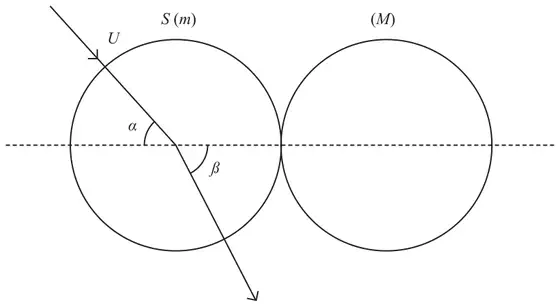
A smooth uniform sphere \(S\) of mass \(m\) is moving with speed \(U\) on a smooth horizontal plane. The sphere \(S\) collides obliquely with another uniform sphere of mass \(M\) which is at rest on the plane. The two spheres have the same radius.
Immediately before the collision the direction of motion of \(S\) makes an angle \(\alpha\), where \(0 < \alpha < 90^\circ\), with the line joining the centres of the spheres.
Immediately after the collision the direction of motion of \(S\) makes an angle \(\beta\) with the line joining the centres of the spheres, as shown in Figure 1.
The coefficient of restitution between the spheres is \(e\).
Given that \(m = eM\),
| Scheme | Marks | AO |
|---|---|---|
If it helps the candidate, ignore their diagram.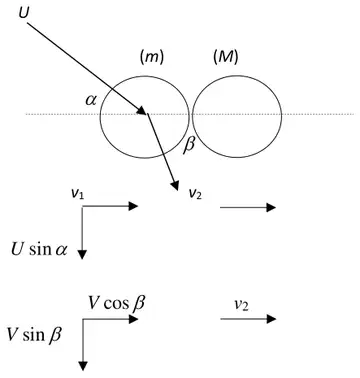 | ||
| \(U\sin\alpha\) seen as velocity component of \(S\), perpendicular to line of centres after impact. | B1 | 3.4 |
| CLM along line of centres | M1 | 3.1b |
| \(mU\cos\alpha = mv_1 + Mv_2\) | A1 | 1.1b |
| NEL used along line of centres | M1 | 3.3 |
| \(eU\cos\alpha = -v_1 + v_2\) | A1 | 1.1b |
| \(\tan\beta = \dfrac{U\sin\alpha}{v_1}\) | dM1 | 2.1 |
| Solve to produce an equation for \(\tan\beta\) in \(m\), \(M\), \(e\) and \(\alpha\) | dM1 | 1.1b |
| \(\tan\beta = \dfrac{(m + M)\tan\alpha}{(m - eM)}\) * | A1* | 1.1b |
| (8) |
Notes
B1: \(U\sin\alpha\) or \(U\cos(90 - \alpha)\) used as the perpendicular velocity component of \(S\) after impact. Must be seen in working for (a) or on a velocity diagram.
M1: CLM along the line of centres. Dimensionally correct, correct no. of terms, condone sin/cos confusion and sign errors.
A1: Correct equation.
M1: NEL used correctly along the line of centres with \(e\) appearing on the correct side of the equation. Condone sin/cos confusion as long as it is consistent with their CLM. Condone sign errors but must have the correct number of terms.
A1: Correct equation (the signs of \(v_1\) and \(v_2\) must be consistent with their CLM)
dM1: Use of the fact that \(S\) moves at \(\beta\) to the line of centres after the collision. Use of their components after the collision to form an equation in \(\beta\). Dependent on both previous M’s.
dM1: Eliminate \(v_1\) to produce an equation for \(\tan\beta\) in \(m\), \(M\), \(e\) and \(\alpha\). Dependent on first two M’s in (a) Note: \(v_1 = U\cos\alpha\left(\dfrac{m - eM}{m + M}\right)\)
(Corrected from the printed mark scheme: printed as “Dependent on first two M’s in (b)” with \(u\cos\alpha\); these marks are in part (a) and the speed is \(U\).)
A1*: Given answer correctly obtained. Must match printed answer EXACTLY.
5(a) alt1
| Scheme | Marks | AO |
|---|---|---|
| \(U\sin\alpha\) seen as velocity cpt of \(S\), perpendicular to line of centres after impact. | B1 | 3.4 |
| CLM along line of centres | M1 | 3.1b |
| \(mU\cos\alpha = mV\cos\beta + Mv_2\) | A1 | 1.1b |
| NEL used along line of centres | M1 | 3.3 |
| \(eU\cos\alpha = -V\cos\beta + v_2\) | A1 | 1.1b |
| \(\tan\beta = \dfrac{U\sin\alpha}{V\cos\beta}\) or \(V\sin\beta = U\sin\alpha\) | dM1 | 2.1 |
| Solve to produce an equation for \(\tan\beta\) in \(m\), \(M\), \(e\) and \(\alpha\) | dM1 | 1.1b |
| \(\tan\beta = \dfrac{(m + M)\tan\alpha}{(m - eM)}\) * | A1* | 1.1b |
| (8) |
B1: \(U\sin\alpha\) or \(U\cos(90 - \alpha)\) used as the perpendicular velocity component of \(S\) after impact. Must be seen in (a) or on a velocity diagram.
M1: CLM along the line of centres. Dimensionally correct, correct no. of terms, condone sin/cos confusion and sign errors.
A1: Correct equation
M1: NEL used correctly along the line of centres with \(e\) appearing on the correct side of the equation. Condone sin/cos confusion as long as it is consistent with their CLM. Condone sign errors but must have the correct number of terms.
A1: Correct equation (signs and sin/cos must be consistent with their CLM)
dM1: Use of the fact that \(S\) moves at \(\beta\) to the line of centres after the collision. Use of their components after the collision to form an equation \(\beta\). Dependent on both previous M’s.
dM1: Eliminate \(V\cos\beta\) to produce an equation for \(\tan\beta\) in \(m\), \(M\), \(e\) and \(\alpha\). Dependent on first two M’s in (a)
Note: \(V\cos\beta = U\cos\alpha\left(\dfrac{m - eM}{m + M}\right)\)
(Corrected from the printed mark scheme: printed as “Dependent on first two M’s in (b)” with \(u\cos\alpha\); these marks are in part (a) and the speed is \(U\).)
A1*: Given answer correctly obtained. Must match printed answer EXACTLY.
| Scheme | Marks | AO |
|---|---|---|
| Use the given condition to find the direction of \(S\) after impact. Eg
| M1 | 3.1b |
| Conclusion: After the collision, \(S\) moves perpendicular to the line of centres and the other sphere moves parallel to the line of centres i.e. they move at right angles oe * | A1* | 2.4 |
| (2) | ||
| (10 marks) |
Notes
M1: Use of given condition to deduce that \(\beta = 90^\circ\) or that velocity component parallel to line of centres is zero.
A1*: Correct explanation using given information. Must refer correctly to the direction of both particles, eg perpendicular, at right angles, parallel and perpendicular to the line of centres,
Do not accept horizontally and vertically since the surface is defined as horizontal.