
A2 June 2024 Q7
7.
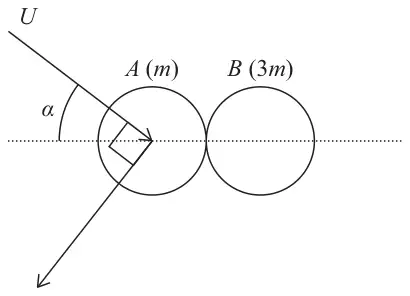
A smooth uniform sphere \(A\) of mass \(m\) is moving with speed \(U\) on a smooth horizontal plane. The sphere \(A\) collides obliquely with a smooth uniform sphere \(B\) of mass \(3m\) which is at rest on the plane. The two spheres have the same radius.
Immediately before the collision, the direction of motion of \(A\) makes an angle \(\alpha\), where \(0^\circ \lt \alpha \lt 90^\circ\), with the line joining the centres of the spheres.
Immediately after the collision, the direction of motion of \(A\) is perpendicular to its original direction, as shown in Figure 1.
The coefficient of restitution between the spheres is \(e\).
| Scheme | Marks | AO |
|---|---|---|
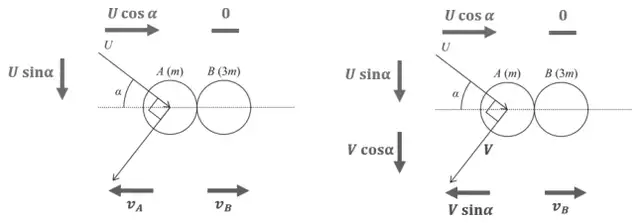 | ||
| CLM along line of centres | M1 | 3.1b |
| \(mU\cos\alpha = -mv_A + 3mv_B\) OR \(mU\cos\alpha = -mV\sin\alpha + 3mv_B\) | A1 | 1.1b |
| Impact Law used along line of centres | M1 | 3.3 |
| \(eU\cos\alpha = v_A + v_B\) OR \(eU\cos\alpha = V\sin\alpha + v_B\) | A1 | 1.1b |
| Solve for \(v_B\) | DM1 | 2.1 |
| \(\dfrac{1}{4}(1 + e)U\cos\alpha\) * | A1* | 2.2a |
| (6) |
Notes
M1: Use of CLM along the line of centres with mass and velocities paired correctly.
Correct no. of terms, condone sin/cos confusion and sign errors on velocities. Allow consistent missing \(m\)’s and/or consistent extra \(g\)’s (every term).
A1: Correct unsimplified equation
M1: Use of Impact Law along the line of centres. Correct no. of terms, condone sin/cos confusion and sign errors but \(e\) must be on the correct side of the equation
A1: Correct unsimplified equation (signs consistent with CLM equation)
DM1: Dependent on both previous M’s. Solve for their \(v_B\)
A1*: Given answer correctly obtained and EXACTLY as printed.
Working should include an equation in \(v_B\) only before reaching given answer.
| Scheme | Marks | AO |
|---|---|---|
| ||
| Unsimplified expression for \(v_A\) seen OR Unsimplified expression for \(V\sin\alpha\) seen | M1 | 2.1 |
| \(= \dfrac{1}{4}(3e - 1)U\cos\alpha\) oe seen | A1 | 1.1b |
| Solve \(v_A \gt 0\) to find an inequality for \(e\) OR Solve \(V\sin\alpha \gt 0\) to find an inequality for \(e\) | M1 | 3.1b |
| Correct and complete reasoning leading to \(e \gt \dfrac{1}{3}\) * Must include: correct inequality for \(v_A\), \(0^\circ \lt \alpha \lt 90^\circ\) or \(\alpha\) is acute, \(\cos\alpha \gt 0\). | A1* | 2.2a |
| (4) |
Notes
M1: Use the given expression for \(v_B\) to find an unsimplified expression for \(v_A\) or \(V\sin\alpha\)
Note: If seen in (a) it must be used in (b) to achieve the mark.
A1: Correct unsimplified expression for \(v_A\) or \(V\sin\alpha\) seen
M1: Solve \(v_A \gt 0\) or \(V\sin\alpha \gt 0\) to find an inequality for \(e\)
A1*: Given answer complete and correctly obtained with no incorrect statements.
Complete explanation must include:
- correct inequality for \(v_A\)
- \(0^\circ \lt \alpha \lt 90^\circ\) or \(\alpha\) is acute
- \(\cos\alpha \gt 0\)
| Scheme | Marks | AO |
|---|---|---|
| ||
| Velocity component of \(A\), perpendicular to the line of centres, after collision \(= U\sin\alpha\) | B1 | 3.3 |
| Use of \(90^\circ\) deflection: \(\tan\alpha = \dfrac{\frac{1}{4}(3e - 1)U\cos\alpha}{U\sin\alpha}\) | M1 | 2.1 |
| Correct equation in \(e\) and \(\tan\alpha\) \(\tan^2\alpha = \dfrac{1}{4}(3e - 1)\) oe | A1 | 1.1b |
| \(e \leqslant 1 \;\Rightarrow\; \tan^2\alpha \leqslant \dfrac{1}{2}\) | DM1 | 3.1b |
| \(0 \lt \tan\alpha \leqslant \dfrac{1}{\sqrt{2}}\) since \(0^\circ \lt \alpha \leqslant 90^\circ\) * | A1* | 2.2a |
| (5) | ||
| (15 marks) |
Notes
B1: Velocity component of \(A\), perpendicular to the line of centres, after collision is \(U\sin\alpha\)
May be seen labelled on the diagram or written as an expression early on in their working. Does not need to be used here.
M1: Use of perpendicular deflection to form an equation in \(\boldsymbol{\alpha}\) and \(\boldsymbol{e}\) (and \(U\)). Allow reciprocal.
Alternative methods include:
- scalar product of vectors, eg \(\begin{pmatrix} U\cos\alpha \\ U\sin\alpha \end{pmatrix} \cdot \begin{pmatrix} -v_A \\ U\sin\alpha \end{pmatrix} = 0\) with \(v_A\) substituted
- \(\tan(\alpha + \beta) = \dfrac{\tan\alpha + \tan\beta}{1 - \tan\alpha\tan\beta}\) with \(\alpha + \beta = 90 \;\Rightarrow\; 1 - \tan\alpha\tan\beta = 0 \Rightarrow \cdots\)
A1: A correct equation in \(\tan\alpha\) and \(e\) only
eg \(\tan^2\alpha = \dfrac{1}{4}(3e - 1)\) or \(e = \dfrac{4\tan^2\alpha + 1}{3}\) oe
DM1: Dependent on previous M. Clear explanation using \(e \leqslant 1\) to form an inequality in \(\tan\alpha\).
Condone, use of max \(e = 1 \Rightarrow\) max \(\tan^2\alpha = \ldots\)
A1*: Given answer obtained from correct and complete working with no incorrect statements. Complete explanation must justify both sides of inequality using both \(e \leqslant 1\) and \(0^\circ \lt \alpha \lt 90^\circ\) (allow \(\alpha\) is acute)