
A2 October 2020 Q5
5. A smooth uniform sphere \(P\) has mass 0.3 kg. Another smooth uniform sphere \(Q\), with the same radius as \(P\), has mass 0.2 kg.
The spheres are moving on a smooth horizontal surface when they collide obliquely. Immediately before the collision the velocity of \(P\) is \((4\mathbf{i} + 2\mathbf{j})\ \text{m s}^{-1}\) and the velocity of \(Q\) is \((-3\mathbf{i} + \mathbf{j})\ \text{m s}^{-1}\).
At the instant of collision, the line joining the centres of the spheres is parallel to \(\mathbf{i}\).
The kinetic energy of \(Q\) immediately after the collision is half the kinetic energy of \(Q\) immediately before the collision.
carefully justifying your answers.
(11)| Scheme | Marks | AO |
|---|---|---|
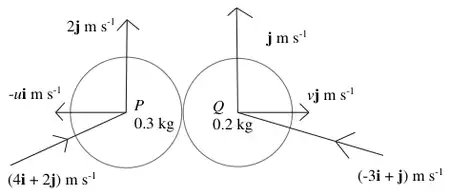 | ||
| Components perpendicular to the line of centres after the collision: \(\mathbf{v}_{P\mathbf{j}} = 2\mathbf{j}\ (\text{m s}^{-1})\), \(\mathbf{v}_{Q\mathbf{j}} = \mathbf{j}\ (\text{m s}^{-1})\) | B1 | 3.4 |
| Kinetic energy: | M1 | 3.1a |
| \(\dfrac{1}{2} \times 0.2 \times (v^2 + 1) = \dfrac{1}{2} \times \dfrac{1}{2} \times 0.2 \times (9 + 1)\) | A1 | 1.1b |
| CLM parallel to line of centres: | M1 | 3.1a |
| \(0.3 \times 4 - 0.2 \times 3 = 0.2v - 0.3u\) \((6 = 2v - 3u)\) | A1 | 1.1b |
| Impact law parallel to line of centres | M1 | 3.1a |
| \(v + u = e(4 + 3)\) | A1 | 1.1b |
| Solve for \(\mathbf{v}_P\), \(\mathbf{v}_Q\) or \(e\) | M1 | 1.1b |
| \(\mathbf{v}_P = \dfrac{2}{3}\mathbf{i} + 2\mathbf{j}\ (\text{m s}^{-1})\) and \(\mathbf{v}_Q = 2\mathbf{i} + \mathbf{j}\ (\text{m s}^{-1})\) | A1 | 1.1b |
| \(e = \dfrac{4}{21}\) | A1 | 1.1b |
| \(v = -2\ \Rightarrow\ u = -\dfrac{10}{3}\ \Rightarrow\) \(P\) and \(Q\) have passed through each other: impossible, so solution is unique * | A1* | 2.4 |
| (11) |
Notes
B1: Seen or implied. Correct only
M1: Equation for KE of \(Q\). Dimensionally correct. Condone \(\dfrac{1}{2}\) on the wrong side.
A1: Correct unsimplified equation in \(v^2\)
M1: Equation for CLM. Correct terms required. Condone sign errors. Dimensionally correct.
A1: Correct unsimplified equation
M1: Correct use of impact law. Condone sign errors
A1: Correct unsimplified equation.
M1: Complete method to solve for \(\mathbf{v}_P\), \(\mathbf{v}_Q\) or \(e\)
(Working in \(e\) gives \(v = \dfrac{1}{5}(6 + 21e)\) and \(441e^2 + 252e - 64 = 0\))
A1: Both velocities correct. Need to see answers in the form \(a\mathbf{i} + b\mathbf{j}\) or equivalent
A1: Correct only. 0.19 or better (0.19047….)
A1*: Or equivalent justification of given result. e.g. a negative value for \(e\) is not possible
| Scheme | Marks | AO |
|---|---|---|
| Use trig to find angle between velocities | M1 | 3.1a |
| \(\cos\theta = \left(\dfrac{\frac{8}{3} + 4}{\sqrt{20}\sqrt{4\frac{4}{9}}}\right)\) or \(\theta = \tan^{-1}\dfrac{2}{2/3} - \tan^{-1}\dfrac{1}{2}\) | A1ft | 1.1b |
| \(\theta = 45^\circ\ \ \left(\dfrac{\pi}{4}\ \text{rads}\right)\) | A1 | 1.1b |
| (3) | ||
| (14 marks) |
Notes
M1: Use of trig or equivalent to find a relevant angle between two velocities
e.g by scalar product or difference between angles.
A1ft: Correct unsimplified equation in \(\theta\). Follow their \(\mathbf{v}_P\)
A1: Correct only. (0.785… radians) Do not ISW