
A2 June 2022 Q1
1. A particle \(A\) of mass \(3m\) and a particle \(B\) of mass \(m\) are moving along the same straight line on a smooth horizontal surface. The particles are moving in opposite directions towards each other when they collide directly.
Immediately before the collision, the speed of \(A\) is \(ku\) and the speed of \(B\) is \(u\).
Immediately after the collision, the speed of \(A\) is \(v\) and the speed of \(B\) is \(2v\).
The magnitude of the impulse received by \(B\) in the collision is \(\dfrac{3}{2}mu\).
| Scheme | Marks | AO |
|---|---|---|
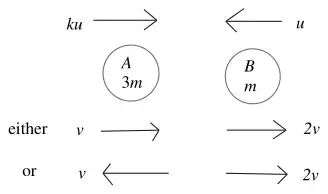 | ||
| Note that if they start with their 2v to the left this creates an impossible situation (the particles need to pass through each other). The maximum score is M1M1M1. | ||
| Impulse received by \(B\): | M1 | 3.4 |
| \(\dfrac{3}{2}mu = m\big(2v - (-u)\big)\) | A1 | 1.1b |
| \(v = \dfrac{u}{4}\) | A1 | 1.1b |
| (3) |
Notes
M1: Form impulse-momentum equation for \(B\) (or \(A\)).
May be expressed as either \(\mathbf{I} = m\mathbf{v} - m\mathbf{u}\) or \(\mathbf{I} + m\mathbf{u} = m\mathbf{v}\). Dimensionally correct.
Must be considering difference in velocities
Must have a correct combination of mass and velocity: pairing velocity of one with the mass of the other scores M0
Allow for subtraction the wrong way round or impulse in the wrong direction.
Assuming that you have not seen an incorrect formula stated, allow for \(2v + u\) without overt evidence of subtraction.
Allow if the common factor of \(m\) is not seen
A1: Correct unsimplified equation for \(B\) (or \(A\)).
Allow without \(m\)
A1: Correct answer only
| Scheme | Marks | AO |
|---|---|---|
| Use of CLM or Impulse-momentum for one option for \(A\): | M1 | 3.4 |
| \(3kmu - mu = 2mv + 3mv\left(= \dfrac{5mu}{4}\right)\) or \(3m(v - ku) = -\dfrac{3mu}{2}\) \(\left(3mu\left(\dfrac{1}{4} + \dfrac{1}{2}\right) = 3mku\right)\) | A1ft | 1.1b |
| \(k = \dfrac{3}{4}\) | A1 | 1.1b |
| Form a second equation in \(k\) \(\left(3mku - mu = 2mv - 3mv\left(= -\dfrac{mu}{4}\right)\ \text{or}\ 3m(v + ku) = \dfrac{3mu}{2}\right)\) | M1 | 3.1a |
| \(k = \dfrac{1}{4}\) | A1 | 1.1b |
| (5) | ||
| (8 marks) |
Notes
M1: Correct method to form an equation in \(k\). Must be dimensionally correct
Condone sign errors in CLM.
Allows marks for CLM equation here if seen in (a) and used correctly to find \(k\) here.
Rules for impulse-momentum as above. M1 is available if they have not reversed the direction of the impulse. An equation which allows for the change in direction by using \(\mathbf{u} - \mathbf{v}\) can score full marks.
Could be working with either option for the direction of motion of \(A\)
A1ft: Correct unsimplified equation in \(u\), \(v\) or their \(v\)
A1: One correct solution
Be aware that a sign error in the impulse-momentum equation for \(A\) can lead to a fortuitous answer. A fortuitous answer scores A0
(FYI the incorrect answers are \(\tfrac{-7}{4}\) and \(\tfrac{1}{4}\))
M1: Correct method to form a second equation in \(k\) (reversing the direction of motion of \(A\))
A1: Second correct solution