
M2 June 2012 Q5
5.
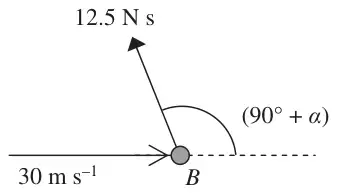
A small ball \(B\) of mass 0.25 kg is moving in a straight line with speed 30 m s\(^{-1}\) on a smooth horizontal plane when it is given an impulse. The impulse has magnitude 12.5 N s and is applied in a horizontal direction making an angle of \((90^\circ + \alpha)\), where \(\tan\alpha = \dfrac{3}{4}\), with the initial direction of motion of the ball, as shown in Figure 3.
NB In a Q with parts labelled (i) & (ii) marks are awarded when seen – they do not belong to a particular part of the Q.
| Scheme | Marks |
|---|---|
| \(12.5\sin\alpha = \tfrac{1}{4}(v_1 - -30)\) or \(-12.5\sin\alpha = \dfrac{1}{4}(v_1 - 30)\ \ \ (v_1 = 0)\) | M1 A1 |
| \(12.5\cos\alpha = \tfrac{1}{4}(v_2 - 0)\ \ \ \ (v_2 = 40)\) | M1 A1 |
| speed is 40 m s\(^{-1}\); | A1 |
| perpendicular to original direction | A1 |
| (6 marks) |
Notes
M1 Impulse = change in momentum parallel to the initial direction.
A1 Correct equation
M1 Impulse = change in momentum perpendicular to the initial direction. Condone sin/cos confusion
A1 Correct equation
A1 cwo. Correct magnitude of speed after impulse. NB Must be speed, not velocity.
A1 cwo. Correct direction (relative to the line given on the diagram – e.g. accept “vertically”, “North”, \(\mathbf{j}\) direction, “up”).
NB could be in the form: \(\begin{pmatrix}-12.5\sin\alpha\\12.5\cos\alpha\end{pmatrix} = 0.25\mathbf{v} - 0.25\begin{pmatrix}30\\0\end{pmatrix}\)
OR
| Using a vector triangle: \((\tfrac{1}{4}v)^2 = 7.5^2 + 12.5^2 - 2 \times 7.5 \times 12.5\cos(90^\circ - \alpha)\) | M1 A1 |
| \(v = 40\) m s\(^{-1}\) | A1 |
| \(\dfrac{12.5}{\sin\theta} = \dfrac{7.5}{\sin\alpha}\) | M1 A1 |
| \(\theta = 90^\circ\) | A1 |
M1 Use cosine rule to find \(\dfrac{1}{4}v\). Terms must be of correct form, but accept unsimplified or slips e.g. their \(\dfrac{1}{4} \times 30\)
A1 Correct equation
A1 cao (penultimate mark on epen)
M1 Use sine rule to find angle between initial and final directions.
A1 Correct equation in \(\alpha\) and \(\theta\)
A1 cao. (final mark on epen)