
M2 June 2016 Q3
3. A particle of mass 0.6 kg is moving with constant velocity \((c\mathbf{i} + 2c\mathbf{j})\) m s\(^{-1}\), where \(c\) is a positive constant. The particle receives an impulse of magnitude \(2\sqrt{10}\) N s.
Immediately after receiving the impulse the particle has velocity \((2c\mathbf{i} - c\mathbf{j})\) m s\(^{-1}\).
Find the value of \(c\). (6)
| Scheme | Marks |
|---|---|
| \(m\mathbf{v} - m\mathbf{u} = 0.6(2c\mathbf{i} - c\mathbf{j} - c\mathbf{i} - 2c\mathbf{j})\) | M1 |
| \(= 0.6(c\mathbf{i} - 3c\mathbf{j})\) | A1 |
| Magnitude \(\ = 0.6\sqrt{c^2 + 9c^2}\) | DM1 |
| \(= 0.6\sqrt{10}c\ \ \ \left(= 0.6\sqrt{10c^2}\right)\) | A1 |
| The next two marks are not available to a candidate who has equated a scalar to a vector. | |
| \(2\sqrt{10} = 0.6\sqrt{10}c\) | DM1 |
| \(c = \dfrac{10}{3}\) | A1 |
| (6) | |
| (6 marks) |
Notes
M1 Impulse = change in momentum. Marking the RHS only
DM1 Correct use of Pythagoras’ theorem on \(m\mathbf{v} - m\mathbf{u}\) or \(\mathbf{v} - \mathbf{u}\). Marking the RHS only. Dependent on the previous M1
A1 Accept \(\sqrt{10}c\) for change in velocity
DM1 Equate & solve for \(c\). Dependent on the previous M1
A1 Accept 3.3 or better
Since this question is about the magnitude of the impulse, condone subtraction in the "wrong order" throughout.
alt
| \(m\mathbf{v} - m\mathbf{u} = 0.6(2c\mathbf{i} - c\mathbf{j} - c\mathbf{i} - 2c\mathbf{j})\) | M1 |
| \(= 0.6(c\mathbf{i} - 3c\mathbf{j})\) | A1 |
| Square of magnitude | DM1 |
| \(= 0.36\left(10c^2\right)\) | A1 |
| The next two marks are not available to a candidate who has equated a scalar to a vector. | |
| \(40 = 0.36\left(c^2 + 9c^2\right)\), | DM1 |
| \(c = \dfrac{10}{3}\) | A1 |
M1 change in momentum
DM1 Equate & solve for \(c\)
alt
| \(\begin{pmatrix}2\sqrt{10}\cos\theta\\2\sqrt{10}\sin\theta\end{pmatrix} = 0.6\begin{pmatrix}2c - c\\-c - 2c\end{pmatrix}\) | M1 |
| \(= 0.6c\begin{pmatrix}1\\-3\end{pmatrix}\) | A1 |
| \(2\sqrt{10}\cos\theta = 0.6c\) \(2\sqrt{10}\sin\theta = -3 \times 0.6c\) | DM1 |
| \(\tan\theta = -3\ \Rightarrow \cos\theta = (\pm)\dfrac{1}{\sqrt{10}}\) | A1 |
| \(2\sqrt{10}\cos\theta = 0.6c\) | DM1 |
| \(\Rightarrow c = \dfrac{10}{3}\) | A1 |
M1 Impulse momentum equation
A1 Correct equation
DM1 Compare coefficients and form equation for \(\theta\)
A1 \(\cos\theta\) or \(\sin\theta\) correct
alt
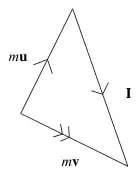 | M1 |
| Sides of magnitude \(\sqrt{5}c, \sqrt{5}c, \dfrac{10\sqrt{10}}{3}\) or \(\dfrac{3\sqrt{5}c}{5}, \dfrac{3\sqrt{5}c}{5}, 2\sqrt{10}\) | A1 |
| \(\mathbf{u} \cdot \mathbf{v} = \begin{pmatrix}c\\2c\end{pmatrix} \cdot \begin{pmatrix}2c\\-c\end{pmatrix}\) | DM1 |
| \(= 2c^2 - 2c^2 = 0\ \therefore\ \) at 90\(^\circ\) | A1 |
| \(\left(0.6 \times \sqrt{5}c\right)^2 + \left(0.6 \times \sqrt{5}c\right)^2 = \left(2\sqrt{10}\right)^2\) | DM1 |
| \(\dfrac{18c^2}{5} = 40,\ \ \ c = \dfrac{10}{3}\) | A1 |
M1 Impulse momentum triangle. Units used for the vectors must be dimensionally correct
DM1 Use of scalar product
A1 ...to show velocities perpendicular
DM1 Use of Pythagoras’ theorem in a right angled triangle