
A2 June 2019 Q3
3. A particle \(P\), of mass 0.5 kg, is moving with velocity \((4\mathbf{i} + 4\mathbf{j})\ \text{m s}^{-1}\) when it receives an impulse \(\mathbf{I}\) of magnitude 2.5 N s.
As a result of the impulse, the direction of motion of \(P\) is deflected through an angle of \(45^\circ\)
Given that \(\mathbf{I} = (\lambda\mathbf{i} + \mu\mathbf{j})\) N s, find all the possible pairs of values of \(\lambda\) and \(\mu\). (9)
| Scheme | Marks | AO |
|---|---|---|
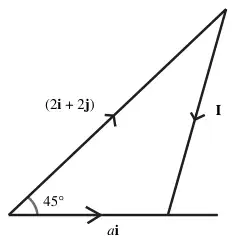 | ||
| Momentum of \(P\) after impulse \(= a\mathbf{i}\) (or \(a\mathbf{j}\)) | B1 | 2.2a |
| Either Use of \(\mathbf{I} = m(\mathbf{v} - \mathbf{u})\): \((\mathbf{I} =)\ 0.5\big(2a\mathbf{i} - (4\mathbf{i} + 4\mathbf{j})\big)\ \big(= (a - 2)\mathbf{i} - 2\mathbf{j}\big)\) | M1 | 3.3 |
| Use of Pythagoras to form equation in \(a\) | M1 | 3.4 |
| \(6.25 = 0.25\big((2a - 4)^2 + 16\big)\) \((4a^2 - 16a + 7 = 0)\) | A1ft A1 | 1.1b 1.1b |
| \(a = \dfrac{7}{2},\ \dfrac{1}{2}\ \Rightarrow \mathbf{I} = \dfrac{3}{2}\mathbf{i} - 2\mathbf{j}\) (N s) | M1 | 1.1b |
| or \(\mathbf{I} = -\dfrac{3}{2}\mathbf{i} - 2\mathbf{j}\) (N s) | A1 | 1.1b |
| or \(\mathbf{I} = -2\mathbf{i} - \dfrac{3}{2}\mathbf{j}\) (N s) | M1 | 2.2a |
| or \(\mathbf{I} = -2\mathbf{i} + \dfrac{3}{2}\mathbf{j}\) (N s) | A1 | 1.1b |
| (9) | ||
| (9 marks) |
Notes
B1: Correct interpretation of angle of deflection (velocity or momentum a multiple of \(\mathbf{i}\) or \(\mathbf{j}\))
M1: Form vector triangle or equation for \(\mathbf{v}\) or their \(a\mathbf{i}\)
M1: Use trigonometry or Pythagoras’ theorem to form equation in \(a\)
A1ft: Unsimplified equation with at most one error. Follow their \(a\mathbf{i}\)
A1: Correct unsimplified equation
M1: Complete correct method to solve to find a pair of values for \(\lambda\) and \(\mu\)
A1: Two correct pairs of values for \(\lambda\) and \(\mu\)
M1: Use symmetry in complete correct method to find one of the other pairs of values for \(\lambda\) and \(\mu\)
A1: All four correct pairs
(They do not need to write out the impulse in full)
Or (in place of the Either rows)
| Scheme | Marks | AO |
|---|---|---|
| \(\lambda^2 + \mu^2 = \dfrac{25}{4}\) | M1 | |
| \(\mathbf{I} = \lambda\mathbf{i} + \mu\mathbf{j} = \dfrac{1}{2}\big((x - 4)\mathbf{i} - 4\mathbf{j}\big)\) | M1 | |
| \(\mu = -2\) Dependent on 2nd M (for impulse) | A1 | |
| \(\lambda^2 = \dfrac{9}{4}\) | A1 |
Or (in place of the Either rows)
| Scheme | Marks | AO |
|---|---|---|
| Use of \(\mathbf{I} = m(\mathbf{v} - \mathbf{u})\) to form vector triangle | M1 | 3.3 |
| Form equation in their \(a\) | M1 | 3.4 |
| \(6.25 = a^2 + 8 - 2a\sqrt{8} \times \dfrac{1}{\sqrt{2}}\) \(\left(4 \times 6.25 = b^2 + 32 - 2b\sqrt{32} \times \dfrac{1}{\sqrt{2}}\ \text{for velocity } b\mathbf{i}\right)\) \((4a^2 - 16a + 7 = 0)\) | A1ft A1 | 1.1b 1.1b |