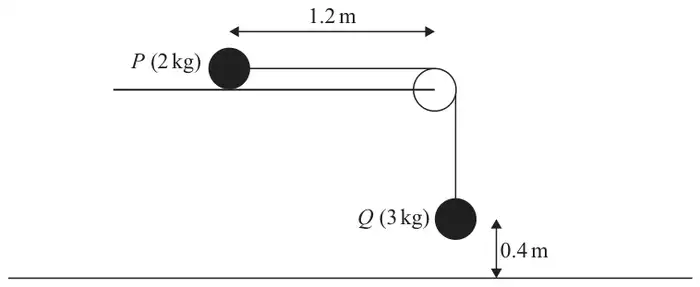
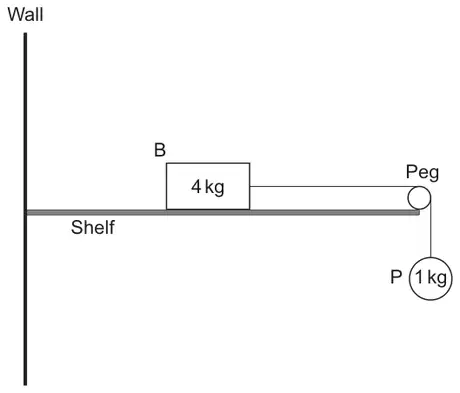
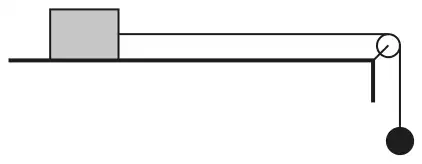
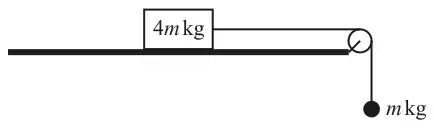
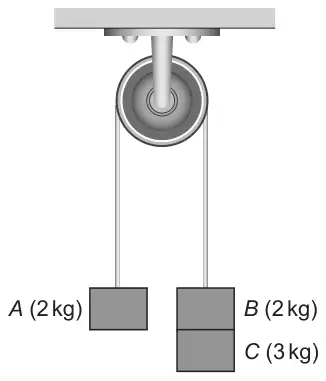
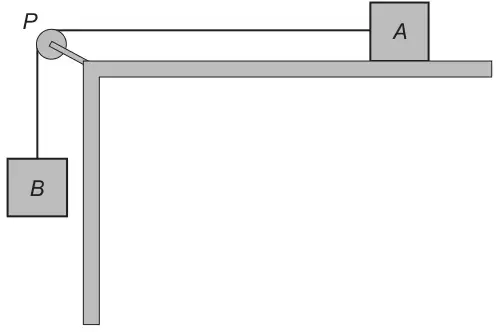
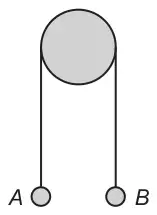
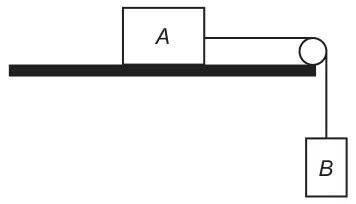
3. A package \(P\) of mass 2 kg is held at rest on a horizontal table.
One end of a thin rope is attached to \(P\).
The rope passes over a pulley that is fixed at the edge of the table.
The other end of the rope is attached to a package \(Q\) of mass 3 kg that hangs freely below the pulley.
Package \(P\) is 1.2 m from the pulley.
Package \(Q\) is 0.4 m above a horizontal floor and the rope is taut, as shown in Figure 2 below.
Figure 2
Package \(P\) is released from rest and \(Q\) moves downwards.
In an initial model of the motion of \(P\) and \(Q\)
the table is modelled as being smooth
the packages are modelled as particles
air resistance is modelled as being negligible
the pulley is modelled as being small and smooth
the rope is modelled as being light and inextensible
Using this model,
(a) write down an equation of motion for \(Q\) as it moves downwards, (2)
(b) find the acceleration of \(Q\) as it moves downwards, (3)
(c) find the speed of \(Q\) at the instant when \(Q\) hits the floor. (2)
Given that \(K\) seconds after \(Q\) hits the floor, \(P\) hits the pulley
(d) use the model to find the value of \(K\). (2)
In a refinement of the model, there is a resistance which acts against the motion of \(P\).
This refined model is now used to find the acceleration of \(Q\) as it moves downwards.
(e) State, with a reason, whether this new acceleration will be greater than, equal to, or less than, the acceleration found in part (b). (1)
(f) Suggest one further refinement that could be made to the model, apart from including air resistance, that would make the model more realistic. (1)
Mark scheme (a)
Scheme
Marks
AO
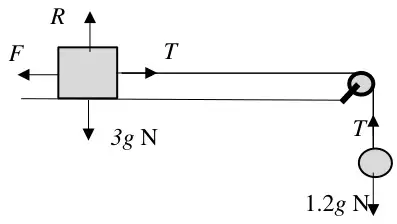
Equation of motion for \(Q\)
M1
3.3
\(3g - T = 3a\) or \(T - 3g = 3a\)
A1
1.1b
(2)
Notes
M1: Equation of motion for \(Q\). Dimensionally correct. All relevant terms and no extras. Condone sign errors. Must appear in (a) Consistent inclusion of \(m\): \(3mg - T = 3ma\), can score M1A0
A1: Correct equation, must appear in (a).
Mark scheme (b)
Scheme
Marks
AO
For \(P\): \(T = 2a\) or \(-T = 2a\) For system: \(3g = 5a\) or \(-3g = 5a\)
B1
1.1b
Solve for \(a\)
M1
3.4
Acceleration \(= \dfrac{3}{5}g = 5.9\ (\mathrm{m\,s^{-2}})\) or \(5.88\ (\mathrm{m\,s^{-2}})\)
A1
1.1b
(3)
Notes
B1: Equation of motion for \(P\), consistent with their equation for \(Q\), or for whole system. Inclusion of \(m\) here is B0.
M1: Obtain equation in \(a\) and solve N.B. If not using a valid attempt at a system equation with mass 5, they must be solving two equations in \(T\) and \(a\) which are dimensionally correct i.e. force \(=\) mass \(\times\ a\)
A1: Answer to 2 sf or 3 sf only. Must be positive.
Mark scheme (c)
Scheme
Marks
AO
Form an equation in \(v\) only e.g. \(v^2 = 2 \times (\text{their } a) \times 0.4\)
M1
3.1b
Speed \(= 2.2\ (\mathrm{m\,s^{-1}})\) or \(2.17\ (\mathrm{m\,s^{-1}})\)
A1
1.1b
(2)
Notes
M1: Complete method using suvat to form an equation in \(v\) or \(v^2\) using their \(a\), even if negative. N.B. Must have found a value for \(a\).
A1: Answer to 2 sf or 3 sf
Mark scheme (d)
Scheme
Marks
AO
Form an equation in \(K\) only e.g. \(K = \dfrac{1.2 - 0.4}{\textit{their } 2.2}\)
M1
3.1b
\(K = 0.37\) or \(K = 0.369\)
A1
1.1b
(2)
Notes
M1: Complete method to form an equation in \(K\) only
A1: Answer to 2 sf or 3 sf
Mark scheme (e)
Scheme
Marks
AO
Acceleration will be less, with a reason.
B1
3.5c
(1)
Notes
B1: Correct conclusion with a reason. B0 if no reason given.
Mark scheme (f)
Scheme
Marks
AO
e.g. Consider the dimensions or shape of the packages or not modelling the packages as particles Consider resistance in the pulley Consider the weight or mass of the pulley Consider the weight or mass or dimensions of the rope Consider elasticity of the rope
B0 use a more accurate value for \(g\) make the model 3D
N.B. Ignore mention of resistance or friction from the table and/or air resistance.
B1
3.5c
(1)
(11 marks)
Notes
B1: Must relate to an aspect of the model. B0 if any incorrect extras included.
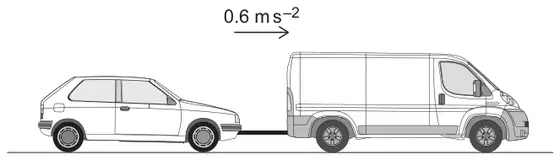
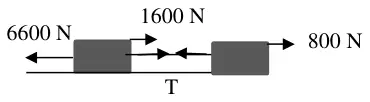
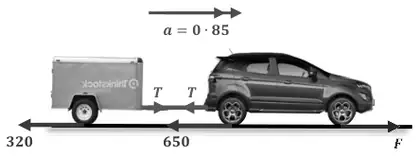
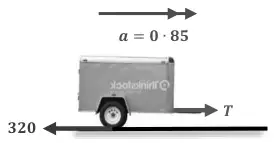
Figure 2 shows a car towing a trailer along a straight horizontal road.
The mass of the car is 800 kg and the mass of the trailer is 600 kg.
The trailer is attached to the car by a towbar which is parallel to the road and parallel to the direction of motion of the car and the trailer.
The towbar is modelled as a light rod.
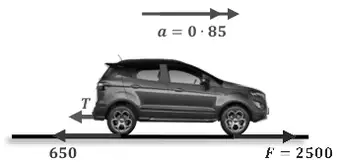
The resistance to the motion of the car is modelled as a constant force of magnitude 400 N.
The resistance to the motion of the trailer is modelled as a constant force of magnitude \(R\) newtons.
The engine of the car is producing a constant driving force that is horizontal and of magnitude 1740 N.
The acceleration of the car is \(0.6\ \mathrm{m\,s^{-2}}\) and the tension in the towbar is \(T\) newtons.
Using the model,
(a) show that \(R = 500\) (3)
(b) find the value of \(T\). (3)
At the instant when the speed of the car and the trailer is \(12.5\ \mathrm{m\,s^{-1}}\), the towbar breaks.
The trailer moves a further distance \(d\) metres before coming to rest.
The resistance to the motion of the trailer is modelled as a constant force of magnitude 500 N.
Using the model,
(c) show that, after the towbar breaks, the deceleration of the trailer is \(\dfrac{5}{6}\ \mathrm{m\,s^{-2}}\) (1)
(d) find the value of \(d\). (3)
In reality, the distance \(d\) metres is likely to be different from the answer found in part (d).
(e) Give two different reasons why this is the case. (2)
Mark scheme (a)
Scheme
Marks
AO
N.B. Use the mass in the \(ma\) term to determine which part of the system the equation refers to.
Equation of motion:
M1
3.3
\(1740 - 400 - R = (600 + 800) \times 0.6\) Or \(\left\{\begin{aligned} 1740 - T - 400 &= 800 \times 0.6 \\ T - R &= 600 \times 0.6 \end{aligned}\right.\) with \(T\) eliminated or found (860) from the first equation, and then used in the second to find \(R\).
A1
1.1b
\(R = 1740 - 840 - 400 = 500\ *\)
A1*
2.2a
(3)
Notes
N.B. Mark (a) and (b) together if no labelling.
M1 Use one or two equations of motion to form an equation in \(R\) only but allow a different letter, with \(a = 0.6\) substituted. For each equation used, need all terms and dimensionally correct but condone sign errors.
A1 Correct unsimplified equation in \(R\) or their \(R\)
A1* Obtain given answer from correct working but condone missing brackets around 600+800 if they are implied by subsequent working. N.B. Need to see \(R = 500\) N.B. Allow verification with \(R = 500\) used to show that \(a = 0.6\), but must state that \(R = 500\) at the end to earn this mark.
Mark scheme (b)
Scheme
Marks
AO
Equation of motion for car or trailer
M1
3.4
\(1740 - T - 400 = 800 \times 0.6\) or \(T - 500 = 600 \times 0.6\)
A1
1.1b
\(T = 860\)
A1
1.1b
(3)
Notes
N.B. The working for this part may appear in (a).
M1 Use the equation of motion for the car or trailer to form an equation in \(T\) need all terms and dimensionally correct but condone sign errors, with \(a = 0.6\) substituted.
A1 Correct unsimplified equation in \(T\) only
A1 Correct only
Mark scheme (c)
Scheme
Marks
AO
Use of \(500 = \pm 600a\) to obtain * N.B. Need to see explicitly deceleration \(= \dfrac{5}{6}\)
B1*
1.1b
(1)
Notes
B1* Correct justification of given answer
Mark scheme (d)
Scheme
Marks
AO
Complete method to find distance with \(a = \pm\dfrac{5}{6}\)
M1
3.4
\(0 = 12.5^2 - 2 \times \dfrac{5}{6} \times d\) OR e.g. \(t = \dfrac{12.5}{\frac{5}{6}} = 15\) then \(d = \dfrac{1}{2} \times \tfrac{5}{6} \times 15^2\) or \(d = \dfrac{1}{2} \times (0 + 12.5) \times 15\) or \(d = 12.5 \times 15 + \dfrac{1}{2} \times \left(-\tfrac{5}{6}\right) \times 15^2\)
A1
1.1b
93.75 oe
A1
1.1b
(3)
Notes
M1 Use a complete suvat method to find an equation in \(d\) only N.B. Allow the use of another letter other than \(d\), e.g. \(s\), for this mark.
A1 Correct unsimplified equation in \(d\) or \(s\) N.B. if they use \(s\), allow \(0 = 12.5^2 \pm 2 \times \dfrac{5}{6} \times s\)
A1 94 or better N.B. if they use \(s\) in their equation, they must then state \(d =\) or have said that \(s = d\) to earn this mark.
Mark scheme (e)
Scheme
Marks
AO
N.B. If more than two answers given, subtract 1 from any marks earned for each incorrect extra answer which are in group 7 below but do not penalise answers which are in group 8 and then, on ePEN, award as appropriate either: B1B1, B1B0 or B0B0 but NOT B0B1.
B1 B1
3.5b 3.5b
(2)
(12 marks)
Notes
N.B. On Epen, these are the only possible marks: B1B1, B1B0 or B0B0
B1 B1 Any two different appropriate reasons. Do not accept more than one from each of the 6 groups below. Award B1 for any one reason which is in any of the 6 groups.
Correct answers (not verbatim but equivalent to)
1. Resistance to motion of the trailer will be different (when not in the slipstream of the car). or there will be more air or wind resistance. Resistance to motion of the trailer will not be constant/ be exactly 500 N. Wind or air resistance would not be constant. The deceleration won’t be constant/ be exactly 5/6 m s-2 .
2. The model takes no account of forces acting side to side. The trailer may not continue to move in a straight line.
3. The trailer could be affected by any unevenness of the road e.g. potholes, bumps etc Does not take account of the type of ground.
4. Not considered the mass of the towbar.
5. Trailer emergency brake may engage.
6. After the towbar breaks the trailer will tip and drag on the road. The trailer will be unstable.
Incorrect answers which incur a penalty (not verbatim but equivalent to).
7. Any answer which mentions the car. The acceleration wouldn’t be equal. Not considered the length of the trailer. Road might not be straight and/or horizontal. Mass of the trailer. Does not take friction (between the tyres and the ground) into account. Does not take air resistance into account. Does not take wind resistance into account.
Incorrect answers which do NOT incur a penalty (not verbatim but equivalent to).
8. Obstacles in the road or cars which the trailer could hit. Does not take account of weather conditions e.g. wind, rain, snow etc The dimensions/shape of the trailer would slow it down. It won’t be travelling at a constant speed oe.
A car of mass 1200 kg is towing a trailer of mass 400 kg along a straight horizontal road using a tow rope, as shown in Figure 2. The rope is horizontal and parallel to the direction of motion of the car.
The resistance to motion of the car is modelled as a constant force of magnitude \(2R\) newtons
The resistance to motion of the trailer is modelled as a constant force of magnitude \(R\) newtons
The rope is modelled as being light and inextensible
The acceleration of the car is modelled as \(a\ \mathrm{m\,s^{-2}}\)
The driving force of the engine of the car is 7400 N and the tension in the tow rope is 2400 N.
Using the model,
(a) find the value of \(a\) (5)
In a refined model, the rope is modelled as having mass and the acceleration of the car is found to be \(a_1\ \mathrm{m\,s^{-2}}\)
(b) State how the value of \(a_1\) compares with the value of \(a\) (1)
(c) State one limitation of the model used for the resistance to motion of the car. (1)
Mark scheme (a)
Scheme
Marks
AO
Equation of motion for the car
M1
3.3
\(7400 - 2R - 2400 = 1200a\)
A1
1.1b
Equation of motion for the trailer
M1
3.4
\(2400 - R = 400a\)
A1
1.1b
\(a = 0.5\)
A1
1.1b
(5)
Notes
N.B. Either equation could be replaced by: Equation of motion for the whole system \(7400 - 3R = 1600a\)
N.B. When entering marks on ePEN for the two equations of motion, enter them in the order in which they appear on the script. For any equation of motion, use the mass in the ‘ma’ term to determine to which part of the system it relates.
M1 Correct no.of terms and condone sign errors, with the driving force as 7400 (when appropriate) and the tension as 2400.
A1 Correct equation
M1 Correct no.of terms and condone sign errors, with the driving force as 7400 (when appropriate) and the tension as 2400.
A1 Correct equation
A1 cao
Mark scheme (b)
Scheme
Marks
AO
The value of \(a_1\) would be less than the value of \(a\). Allow ‘\(a_1\) would be slower than \(a\)’, N.B. Allow ‘it would be less than \(a\)’
B1
3.5a
(1)
Notes
B1 cao
Mark scheme (c)
Scheme
Marks
AO
The resistance won’t be constant or just ‘it won’t be constant.’ Allow the negative also: The resistance is constant or just ‘it is constant’ B0 for ‘it doesn’t take account of air resistance’
B1
3.5b
(1)
(7 marks)
Notes
B1 B0 if any incorrect extras are given or for an incorrect statement
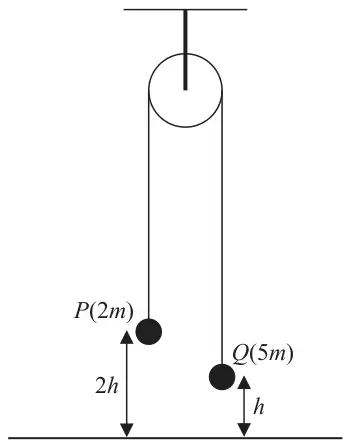
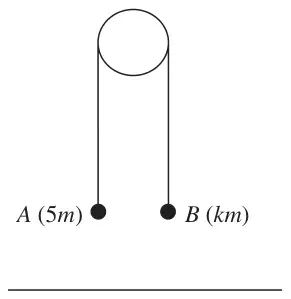
A ball \(P\) of mass \(2m\) is attached to one end of a string.
The other end of the string is attached to a ball \(Q\) of mass \(5m\).
The string passes over a fixed pulley.
The system is held at rest with the balls hanging freely and the string taut.
The hanging parts of the string are vertical with \(P\) at a height \(2h\) above horizontal ground and with \(Q\) at a height \(h\) above the ground, as shown in Figure 1.
The system is released from rest.
In the subsequent motion, \(Q\) does not rebound when it hits the ground and \(P\) does not hit the pulley.
The balls are modelled as particles.
The string is modelled as being light and inextensible.
The pulley is modelled as being small and smooth.
Air resistance is modelled as being negligible.
Using this model,
(a)
(i) write down an equation of motion for \(P\),
(ii) write down an equation of motion for \(Q\), (4)
(b) find, in terms of \(h\) only, the height above the ground at which \(P\) first comes to instantaneous rest. (7)
(c) State one limitation of modelling the balls as particles that could affect your answer to part (b). (1)
In reality, the string will not be inextensible.
(d) State how this would affect the accelerations of the particles. (1)
Mark scheme (a)
Scheme
Marks
AO
(i) Equation of motion for \(P\)
M1
3.3
\(T - 2mg = 2ma\)
A1
1.1b
(ii) Equation of motion for \(Q\)
M1
3.3
\(5mg - T = 5ma\)
A1
1.1b
N.B. (allow (\(-a\)) in both equations)
(4)
Notes
M1: Translate situation into the model and set up the equation of motion for \(P\) (must contain \(T\) and \(a\))
A1: Correct equation
M1: Translate situation into the model and set up the equation of motion for \(Q\) (must contain \(T\) and \(a\))
A1: Correct equation
N.B. Allow the above 4 marks if the equations appear in (b). If \(m\)’s are omitted consistently, max (a) M1A0M1A0 (b) M1A0M1M1A1M1A0
Mark scheme (b)
Scheme
Marks
AO
Solve equations for \(a\) or use whole system equation and solve for \(a\)
A1: Allow 4.2 (\(\text{m s}^{-2}\)) or must be in terms of \(g\) only.
N.B. Allow the above 2 marks if they appear in (a).
M1: Complete method to produce an expression for \(v\) or \(v^2\) in terms \(h\), using their \(a\)
M1: Complete method to produce an expression for \(H\) in terms of \(h\), using \(a = -g\) and \(v = 0\)
A1: Correct expression for \(H\)
M1: Complete method to find the total distance
A1: cao but allow \(3.4h\) or better
Mark scheme (c)
Scheme
Marks
AO
e.g. The distance that \(Q\) falls to the ground would not be exactly \(h\) oe
B1
3.5b
(1)
Notes
B1: B0 if any incorrect extras are given
Mark scheme (d)
Scheme
Marks
AO
e.g. The accelerations of the balls would not have equal magnitude (allow ‘wouldn’t be the same’ oe) B0 if they say ‘inextensible \(\Rightarrow\) acceleration same’
B1
3.5a
(1)
(13 marks)
Notes
B1: B0 if any incorrect extras are given or for an incorrect statement e.g. tension is not constant so accelerations will be different
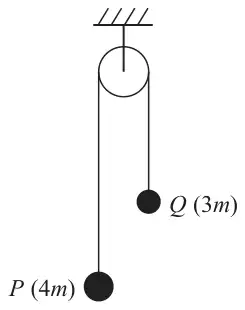
One end of a string is attached to a small ball \(P\) of mass \(4m\).
The other end of the string is attached to another small ball \(Q\) of mass \(3m\).
The string passes over a fixed pulley.
Ball \(P\) is held at rest with the string taut and the hanging parts of the string vertical, as shown in Figure 1.
Ball \(P\) is released.
The string is modelled as being light and inextensible, the balls are modelled as particles, the pulley is modelled as being smooth and air resistance is ignored.
(a) Using the model, find, in terms of \(m\) and \(g\), the magnitude of the force exerted on the pulley by the string while \(P\) is falling and before \(Q\) hits the pulley. (8)
(b) State one limitation of the model, apart from ignoring air resistance, that will affect the accuracy of your answer to part (a). (1)
Mark scheme (a)
Scheme
Marks
AO
Equation of motion for \(P\) with usual rules
M1
3.3
\(4mg - T = 4ma\)
A1
1.1b
Equation of motion for \(Q\) with usual rules
M1
3.3
\(T - 3mg = 3ma\)
A1
1.1b
Solve these equations for \(T\) (does not need to be in terms of \(mg\))
M1
1.1b
\(T = \dfrac{24mg}{7}\) in any form (does not need to be a single term)
A1
1.1b
Force on pulley = \(2T\)
M1
3.4
\(\dfrac{48mg}{7}\) Accept \(6.9mg\) or better
A1
1.1b
(8)
Notes
M1 Translate situation into the model and set up the equation of motion for \(P\) M0 if they omit \(m\)’s i.e. \(4g - T = 4a\)
A1 Correct equation
M1 Translate situation into the model and set up the equation of motion for \(Q\) M0 if they omit \(m\)’s i.e. \(T - 3g = 3a\)
A1 Correct equation
N.B. Condone either of the above equations being replaced by the ‘whole system equation’: \(4mg - 3mg = 7ma\) (N.B. \(a = g/7\)) N.B. \(a\) replaced by \(-a\) consistently can score all the marks
M1 Solve equations for \(T\)
A1 \(T = \dfrac{24mg}{7}\) oe
M1 \(T\) does not need to be substituted.
A1 \(\dfrac{48mg}{7}\) oe Must be in terms of \(m\) and \(g\) and be a single term
Mark scheme (b)
Scheme
Marks
AO
Weight of the rope or extensibility of rope Or: pulley may not be smooth
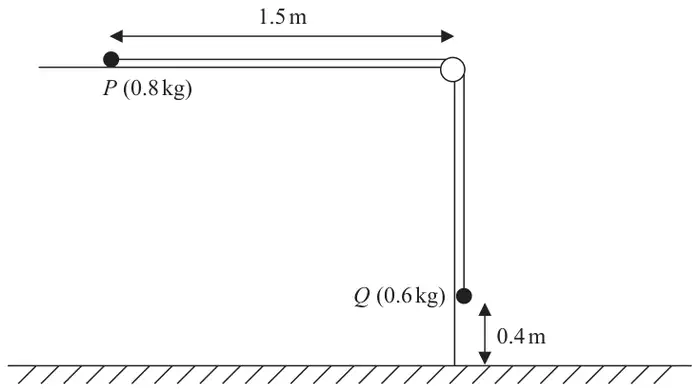
A small ball, \(P\), of mass 0.8 kg, is held at rest on a smooth horizontal table and is attached to one end of a thin rope.
The rope passes over a pulley that is fixed at the edge of the table.
The other end of the rope is attached to another small ball, \(Q\), of mass 0.6 kg, that hangs freely below the pulley.
Ball \(P\) is released from rest, with the rope taut, with \(P\) at a distance of 1.5 m from the pulley and with \(Q\) at a height of 0.4 m above the horizontal floor, as shown in Figure 1.
Ball \(Q\) descends, hits the floor and does not rebound.
The balls are modelled as particles, the rope as a light and inextensible string and the pulley as small and smooth.
Using this model,
(a) show that the acceleration of \(Q\), as it falls, is \(4.2\ \mathrm{m\,s^{-2}}\) (5)
(b) find the time taken by \(P\) to hit the pulley from the instant when \(P\) is released. (6)
(c) State one limitation of the model that will affect the accuracy of your answer to part (a). (1)
Mark scheme (a)
Scheme
Marks
AO
Equation of motion for \(Q\)
M1
3.3
\(0.6g - T = 0.6a\)
A1
1.1b
Equation of motion for \(P\)
M1
3.3
\(T = 0.8a\)
A1
1.1b
\(a = 4.2\ (\mathrm{m\,s^{-2}})\) *
A1*
2.2a
(5)
Notes
N.B. Omission or extra \(g\) in a resolution is an accuracy error not a method error In 2(a), use the mass which appears in the ‘ma’ term of an equation of motion, to identify which particle that equation of motion applies to.
M1 Equation of motion for \(Q\) with correct no. of terms, condone sign errors.
A1 A correct equation
M1 Equation of motion for \(P\) with correct no. of terms, condone sign errors. (corrected from the printed mark scheme: the note for this mark says “Equation of motion for \(Q\)”; it is the equation of motion for \(P\))
A1 A correct equation
A1*Given acceleration obtained correctly. You must see an equation in \(a\) only before reaching \(a = 4.2\)
N.B. if they just use the whole system equation: \(0.6g = 1.4a\), can only score max M1A1M0A0A0
N.B. Use of \(g = 9.81\) or 10 loses final A mark only.
N.B. Complete verification, using both equations, can score full marks.
Mark scheme (b)
Scheme
Marks
AO
\(0.4 = \dfrac{1}{2} \times 4.2 \times t_1^{\,2}\) or e.g. they may find \(v\) first and then use \(v = 4.2t_1\)
M1
2.1
\(t_1 = 0.436(4357\ldots)\) Allow 0.43, 0.44, 0.436, or better, or any surd form e.g. \(\dfrac{2}{\sqrt{21}}\)
Complete strategy to solve the problem by finding the sum of the two times \(t_1 + t_2\)
DM1
3.1b
1.0 (s) or 1.04 (s)
A1
1.1b
(6)
Notes
M1 Complete method (they may use more than one suvat equation) to find time for \(Q\) to hit the floor (M0 if 0.4 not used as distance moved and/or if 4.2 is not used as acceleration and this applies to finding \(v\) as well if they use \(v\) to find \(t_1\))
A1 See alternatives
M1 Complete method to find speed of \(Q\) as it hits the floor (M0 if 0.4 not used as distance moved and/or if 4.2 is not used as acceleration and this applies to finding \(t_1\) as well if they use \(t_1\) to find \(v\))
M1 Uses distance/speed to find time for \(P\) to hit the pulley after \(Q\) has hit the floor. N.B. This is independent of previous M mark.
DM1 Complete method to solve the problem by finding and adding the two required times, dependent on previous three M marks
Mark scheme (c)
Scheme
Marks
AO
e.g. rope being light; rope being inextensible; pulley being smooth; pulley being small; balls being particles
B1
3.5b
(1)
(12 marks)
Notes
B1 Clear statement. Allow negatives of these i.e. the rope may not be light, the rope may not be inextensible etc Must be a limitation of the model stated in the question Penalise incorrect or irrelevant extras B0 for: Air resistance, table being smooth
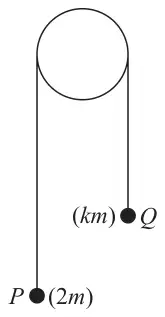
Two small balls, \(P\) and \(Q\), have masses \(2m\) and \(km\) respectively, where \(k \lt 2\). The balls are attached to the ends of a string that passes over a fixed pulley. The system is held at rest with the string taut and the hanging parts of the string vertical, as shown in Figure 1.
The system is released from rest and, in the subsequent motion, \(P\) moves downwards with an acceleration of magnitude \(\dfrac{5g}{7}\)
The balls are modelled as particles moving freely. The string is modelled as being light and inextensible. The pulley is modelled as being small and smooth.
Using the model,
(a) find, in terms of \(m\) and \(g\), the tension in the string, (3)
(b) explain why the acceleration of \(Q\) also has magnitude \(\dfrac{5g}{7}\) (1)
(c) find the value of \(k\). (4)
(d) Identify one limitation of the model that will affect the accuracy of your answer to part (c). (1)
Mark scheme (a)
Scheme
Marks
AO
Equation of motion for \(P\)
M1
3.3
\(2mg - T = 2m \times \dfrac{5g}{7}\)
A1
1.1b
\(T = \dfrac{4mg}{7}\)
A1
1.1b
(3)
Notes
Condone both equations of motion appearing in (a) if used in (c)
M1: Resolving vertically for \(P\) with usual rules, correct no. of terms but condone sign errors and \(a\) does not need to be substituted (N.B. inconsistent omission of \(m\) is M0). Allow \(ma\) on RHS for M1
A1: A correct equation (allow if they use 7 instead of \(\dfrac{5g}{7}\))
A1: A correct answer of form \(cmg\), where \(c = \dfrac{4}{7}\) oe or 0.57 or better
Mark scheme (b)
Scheme
Marks
AO
Since the string is modelled as being inextensible
B1
3.4
(1)
Notes
B1: String is inextensible. N.B. B0 if any extras (wrong or irrelevant) given
Mark scheme (c)
Scheme
Marks
AO
Equation of motion for \(Q\) OR for whole system
M1
3.3
\(T - kmg = km \times \dfrac{5g}{7}\) OR \(2mg - kmg = (km + 2m)\dfrac{5g}{7}\)
A1
1.1b
\(\dfrac{4mg}{7} - kmg = km \times \dfrac{5g}{7}\) oe and solve for \(k\)
DM1
1.1b
\(k = \dfrac{1}{3}\) or 0.333 or better
A1
1.1b
(4)
Notes
Condone both equations of motion appearing in (a) if used in (c)
M1: Resolving vertically for \(Q\) or for a whole system equation, with usual rules, correct no. of terms but condone sign errors and neither \(T\) nor \(a\) does need to be substituted (N.B. inconsistent omission of \(m\) is M0 and M0 if \(k\) is omitted from LHS or RHS or both.)
A1: A correct equation (allow if they use 7 instead of \(\dfrac{5g}{7}\))
DM1: Sub for \(T\) using their answer from (a), if necessary, and solve to give a numerical value of \(k\) (i.e. \(m\)’s must cancel)
A1: \(k = \dfrac{1}{3}\) or 0.333 or better.
Mark scheme (d)
Scheme
Marks
AO
e.g The model does not take account of the mass of the string (SEE BELOW for alternatives)
B1
3.5b
(1)
(9 marks)
Notes
B1: e.g. Pulley may not be smooth Pulley may not be light Particles may not be moving freely e.g. air resistance Balls may not be particles String may not be light String may not be inextensible (but allow converses in all cases e.g. ‘pulley smooth’)
N.B. B0 if any extra incorrect answer is given BUT ignore incorrect consequence of a correct answer.
Also note: B0 : Use of a more accurate value of \(g\)
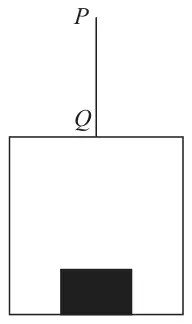
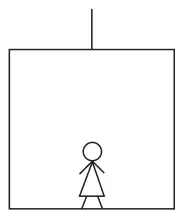
A lift of mass 250 kg is being raised by a vertical cable attached to the top of the lift. A woman of mass 60 kg stands on the horizontal floor inside the lift, as shown in Figure 3. The lift ascends vertically with constant acceleration 2 m s\(^{-2}\). There is a constant downwards resistance of magnitude 100 N on the lift. By modelling the woman as a particle,
(a) find the magnitude of the normal reaction exerted by the floor of the lift on the woman. (3)
The tension in the cable must not exceed 10 000 N for safety reasons, and the maximum upward acceleration of the lift is 3 m s\(^{-2}\). A typical occupant of the lift is modelled as a particle of mass 75 kg and the cable is modelled as a light inextensible string. There is still a constant downwards resistance of magnitude 100 N on the lift.
(b) Find the maximum number of typical occupants that can be safely carried in the lift when it is ascending with an acceleration of 3 m s\(^{-2}\). (7)
Mark scheme (a)
Scheme
Marks
\(R - 60g = 60 \times 2\)
M1A1
\(R = 708\) N or 710 N (must be positive)
A1
(3)
Notes
M1 for equation in \(R\) only, with usual rules
First A1 for a correct equation
Second A1 for 710 or 708 (N not needed)
Mark scheme (b)
Scheme
Marks
\(75n\)
B1
\(10000 - Mg - 100 = M \times 3\)
M1A2
using \(M = 250 + 75n \Rightarrow n = 6.9..\)
DM1A1
so 6 people
A1ft
(7)
(10 marks)
Notes
B1 for \(75n\) oe seen or implied
First M1 for an equation in one unknown in the form \(10000 - Mg - 100 = M \times a\) with usual rules (must be using 10000) where \(M\) can be any (relevant) number e.g. 250, 75, etc
First A1 and second A1 for a correct equation with \(a = 3\), A1A0 if one error (e.g. Use of \(a = 2\) loses 1 A mark)
Second DM1, dependent on first M1, for using \(M = 250 + 75n\) and solving for \(n\)
Third A1 for 6.9… (A0 for 7)
Fourth A1ft for no. of people, ft on their \(n\) value (A0 for < 7)
N.B. If no incorrect work seen, the third A mark can be implied by a correct answer (\(n = 6\))
SC: They may use Trial and Error to find the critical value of \(n\), by writing down equations for the tension when \(n = 1, 2, 3, \ldots\) until the tension exceeds 10000 oe
This method can score the final DM1 A1 A1 if done fully correctly up to and including \(n = 7\), with a correct answer given.
It could also score some or all of the first 4 marks.
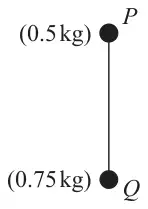
A vertical light rod \(PQ\) has a particle of mass 0.5 kg attached to it at \(P\) and a particle of mass 0.75 kg attached to it at \(Q\), to form a system, as shown in Figure 2. The system is accelerated vertically upwards by a vertical force of magnitude 15 N applied to the particle at \(Q\). Find the thrust in the rod. (6)
Mark scheme
Scheme
Marks
\(T - 0.5g = 0.5a\)
M1 A1
\(15 - T - 0.75g = 0.75a\)
M1 A1
(OR: \(15 - 0.5g - 0.75g = 1.25a\))
(\(a = 2.2\) m s\(^{-2}\))
\(T = 6\) N
M1 A1
(6 marks)
Notes
First M1 for an equation of motion for either \(P\) or \(Q\) with usual rules i.e. correct no. of terms, dimensionally correct but condone sign errors
First A1 for a correct equation (allow \(T\) replaced by \(-T\) and/or \(a\) replaced by \(-a\))
Second M1 for another equation of motion (for either \(P\) or \(Q\) or whole system) with usual rules as above
Second A1 for a correct equation (allow \(T\) consistently replaced by \(-T\) and/or \(a\) consistently replaced by \(-a\) )
Third M1 for solving two THREE term equations of motion for \(T\)
Third A1 for 6 (N). Must be positive but allow a change from −6 to 6, if they have consistently used \(-T\) instead of \(T\).
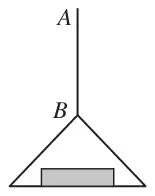
A vertical rope \(AB\) has its end \(B\) attached to the top of a scale pan. The scale pan has mass 0.5 kg and carries a brick of mass 1.5 kg, as shown in Figure 1. The scale pan is raised vertically upwards with constant acceleration 0.5 m s\(^{-2}\) using the rope \(AB\). The rope is modelled as a light inextensible string.
(a) Find the tension in the rope \(AB\). (3)
(b) Find the magnitude of the force exerted on the scale pan by the brick. (3)
Mark scheme (a)
Scheme
Marks
\(T - 0.5g - 1.5g = 2 \times 0.5\)
M1 A1
\(T = 20.6\) (N) or 21 (N)
A1
(3)
Notes
N.B. In both parts of this question use the mass which is being used to guide you as to which part of the system is being considered
M1 is for an equation for whole system in \(T\) only, with usual rules
First A1 for a correct equation
Second A1 for 20.6 or 21
Mark scheme (b)
Scheme
Marks
\(R - 1.5g = 1.5 \times 0.5\)
M1 A1
Force = 15.5 (N) or 15 (N)
A1
OR: \(T - R - 0.5g = 0.5 \times 0.5\)
OR M1 A1
Force = 15.5 (N) or 15 (N)
A1
(3)
(6 marks)
Notes
N.B. In both parts of this question use the mass which is being used to guide you as to which part of the system is being considered
First M1 is for an equation for the brick only (1st alternative) or for the scale pan only (2nd alternative) with usual rules.
First A1 for a correct equation (in the second alternative \(T\) does not need to be substituted)
Second A1 for 15.5 or 15
N.B. If \(R\) is replaced by \(-R\) in either equation, can score M1A1. This would lead to \(R = -15.5\) or \(-15\). The second A1 can then only be scored if the candidate explains why the –ve sign is being ignored.
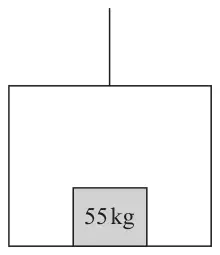
A lift of mass 200 kg is being lowered into a mineshaft by a vertical cable attached to the top of the lift. A crate of mass 55 kg is on the floor inside the lift, as shown in Figure 2. The lift descends vertically with constant acceleration. There is a constant upwards resistance of magnitude 150 N on the lift. The crate experiences a constant normal reaction of magnitude 473 N from the floor of the lift.
(a) Find the acceleration of the lift. (3)
(b) Find the magnitude of the force exerted on the lift by the cable. (4)
Mark scheme (a)
Scheme
Marks
For crate, \(55g - 473 = 55a\)
M1 A1
\(a = 1.2\) m s\(^{-2}\)
A1
(3)
Notes
M1 for an equation in \(a\) only, with usual rules.
First A1 for a correct equation
Second A1 for 1.2 (m s\(^{-2}\)). Allow −1.2 (m s\(^{-2}\)) if appropriate
Mark scheme (b)
Scheme
Marks
For system, \(55g + 200g \pm T - 150 = 255a\)
M1 A2
Magnitude = 2040 N or 2000 N
A1
OR
For lift, \(200g + 473 - 150 \pm T = 200a\)
M1 A2
Magnitude = 2040 N or 2000 N
A1
(4)
(7 marks)
Notes
M1 for an equation, in \(T\) and \(a\), for the system or the lift only, with usual rules. (\(a\) does not need to be a numerical value)
A2 (-1 each error) for a correct equation (Allow \(\pm T\)). We do not need to see a numerical value for \(a\).
Third A1 for 2040 (N) or 2000 (N)
N.B. In both parts of this question use the mass which is being used to guide you as to which part of the system is being considered.
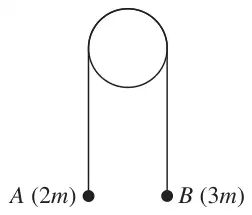
Two particles \(A\) and \(B\) have masses \(2m\) and \(3m\) respectively. The particles are connected by a light inextensible string which passes over a smooth light fixed pulley. The system is held at rest with the string taut. The hanging parts of the string are vertical and \(A\) and \(B\) are above a horizontal plane, as shown in Figure 2. The system is released from rest.
(a) Show that the tension in the string immediately after the particles are released is \(\dfrac{12}{5}mg\). (6)
After descending 1.5 m, \(B\) strikes the plane and is immediately brought to rest. In the subsequent motion, \(A\) does not reach the pulley.
(b) Find the distance travelled by \(A\) between the instant when \(B\) strikes the plane and the instant when the string next becomes taut. (6)
Given that \(m = 0.5\) kg,
(c) find the magnitude of the impulse on \(B\) due to the impact with the plane. (2)
Mark scheme (a)
Scheme
Marks
\(3mg - T = 3ma\)
M1A1
\(T - 2mg = 2ma\)
M1A1
\(T = 2mg + 2\left(mg - \dfrac{T}{3}\right)\)
DM1
\(T = \dfrac{12}{5}mg\) *Given Answer*
A1
(6)
Notes
First M1 for resolving vertically (up or down) for \(B\), with correct no. of terms etc (allow if they omit \(m\) but have the 3)
First A1 for a correct equation.
Second M1 for resolving vertically (up or down) for \(A\), with correct no. of terms etc (allow if they omit \(m\) but have the 2)
Second A1 for a correct equation
Third M1, dependent on the first two M marks, for eliminating \(a\)
Third A1 for \(T = 12mg/5\) given answer
N.B. Either equation above can be replaced by the whole system equation
M1A1 for \(3mg - 2mg = 5ma\); any error loses both marks.
N.B. If \(m\) has been omitted in (a), which has led to a dimensionally incorrect value of \(a\), can score max B0M1A0M1M1A0 in (b) and M1A0 in (c).
Mark scheme (b)
Scheme
Marks
\(a = \dfrac{g}{5}\)
B1
At time of impact \(v^2 = u^2 + 2as = 2 \times \dfrac{g}{5} \times 1.5 = 0.6g\)
M1A1
Vertical motion under gravity \(0 = 0.6g - 2gs\)
M1
\(s = 0.3\) (m)
Total distance \(2 \times 0.3 = 0.6\) (m)
DM1A1
(6)
Notes
B1 for \(a = g/5\) found (possibly in part (a)) and used here.
First M1 for using suvat with their \(a\) from part (a), to find the speed \(v\) (or \(v^2\)) of \(B\) at impact
First A1 for \(\sqrt{0.6g}\) oe, 2.4 or better (may be implied) found correctly.
Second M1 for using suvat with \(a = \pm g\), to obtain an equation in \(s\) only, using their \(v\) (or \(v^2\)) with final velocity \(= 0\)
Third M1, dependent on second M1, for doubling their \(s\) value
Second A1 for 0.6 (m)
Mark scheme (c)
Scheme
Marks
Impulse \(= 3m(v - u) = -3mu\)
M1
Magnitude \(= 3m\sqrt{0.6g} = 3.6\) (Ns) (3.64)
A1
(2)
(14 marks)
Notes
M1 for \(\pm 3m \times\) (their \(v\)) or \(\pm 1.5 \times\) (their \(v\)) or \(\pm m \times\) (their \(v\)) or \(\pm 0.5 \times\) (their \(v\))
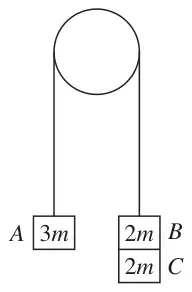
Three particles \(A\), \(B\) and \(C\) have masses \(3m\), \(2m\) and \(2m\) respectively. Particle \(C\) is attached to particle \(B\). Particles \(A\) and \(B\) are connected by a light inextensible string which passes over a smooth light fixed pulley. The system is held at rest with the string taut and the hanging parts of the string vertical, as shown in Figure 5. The system is released from rest and \(A\) moves upwards.
(a)
(i) Show that the acceleration of \(A\) is \(\dfrac{g}{7}\)
(ii) Find the tension in the string as \(A\) ascends. (7)
At the instant when \(A\) is 0.7 m above its original position, \(C\) separates from \(B\) and falls away. In the subsequent motion, \(A\) does not reach the pulley.
(b) Find the speed of \(A\) at the instant when it is 0.7 m above its original position. (2)
(c) Find the acceleration of \(A\) at the instant after \(C\) separates from \(B\). (4)
(d) Find the greatest height reached by \(A\) above its original position. (3)
Mark scheme (a)
Scheme
Marks
\(4mg - T = 4ma\)
M1A1
\(T - 3mg = 3ma\)
M1A1
Condone the use of \(4mg - 3mg = 4ma + 3ma\) in place of one of these equations.
M1A1
Reach given answer \(a = \dfrac{g}{7}\) correctly ***
A1
Form an equation in \(T\): \(T = 3mg + 3\left(mg - \dfrac{T}{4}\right)\), \(T = 3mg + 3m\dfrac{g}{7}\), or \(T = 4mg - 4m\dfrac{g}{7}\)
M1
\(T = \dfrac{24}{7}mg\) or equivalent, \(33.6m\), \(34m\)
A1
(7)
Notes
First M1 for resolving vertically (up or down) for \(B + C\), with correct no. of terms.
First A1 for a correct equation.
Second M1 for resolving vertically (up or down) for \(A\), with correct no. of terms.
Second A1 for a correct equation.
Third A1 for \(g/7\), obtained correctly. Given answer (1.4 A0)
Third M1 for an equation in \(T\) only
Fourth A1 for \(24mg/7\) oe or \(33.6m\) or \(34m\)
N.B. If they omit \(m\) throughout (which gives \(a = g/7\)), can score max M1A0M1A0A0M1A0 for part (a) BUT CAN SCORE ALL OF THE MARKS in parts (b), (c) and (d).
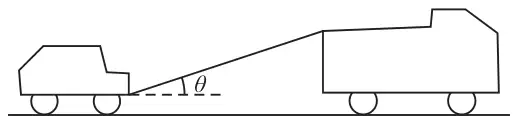
A truck of mass 1750 kg is towing a car of mass 750 kg along a straight horizontal road. The two vehicles are joined by a light towbar which is inclined at an angle \(\theta\) to the road, as shown in Figure 4. The vehicles are travelling at 20 m s\(^{-1}\) as they enter a zone where the speed limit is 14 m s\(^{-1}\). The truck’s brakes are applied to give a constant braking force on the truck. The distance travelled between the instant when the brakes are applied and the instant when the speed of each vehicle is 14 m s\(^{-1}\) is 100 m.
(a) Find the deceleration of the truck and the car. (3)
The constant braking force on the truck has magnitude \(R\) newtons. The truck and the car also experience constant resistances to motion of 500 N and 300 N respectively. Given that \(\cos\theta = 0.9\), find
(b) the force in the towbar, (4)
(c) the value of \(R\). (4)
Mark scheme (a)
Scheme
Marks
Use of \(v^2 = u^2 + 2as\)
M1
\(14^2 = 20^2 - 2a \times 100\)
A1
Deceleration is 1.02(m s\(^{-2}\))
A1
(3)
Notes
M1 for a complete method to produce an equation in \(a\) only.
First A1 for a correct equation.
Second A1 for 1.02 (ms\(^{-2}\)) oe. must be POSITIVE.
Mark scheme (b)
Scheme
Marks
Horizontal forces on the car: \(\pm T\cos\theta - 300 = 750 \times -1.02 = -765\) \(T = -1550/3\)
M1A2 f.t.
The force in the tow-bar is 1550/3, 520 (N) or better (allow –ve answer)
A1
(4)
Notes
M1 for considering the car ONLY horizontally to produce an equation in \(T\) only, with usual rules. i.e. correct no. of terms AND \(T\) resolved:
\(\pm T\cos\theta - 300 = 750 \times -1.02\)
A2 ft on their \(a\) for a correct equation (300 and \(a\) must have same sign); -1 each error (treat cos 0.9 as an A error)
A1 for 1550/3 oe, 520 or better (N) N.B. Allow a negative answer.
Mark scheme (c)
Scheme
Marks
Horizontal forces on the truck: \(\pm T\cos\theta - 500 - R = 1750 \times -1.02\)
M1A2 f.t.
Braking force \(R = 1750\) (N)
A1
(4)
(11 marks)
Notes
M1 for considering the truck ONLY horizontally to produce an equation, with usual rules. i.e. correct no. of terms AND \(T\) resolved:
\(\pm T\cos\theta - 500 - R = 1750 \times -1.02\)
A2 ft on their \(T\) and \(a\) for a correct equation (500, \(a\) and \(R\) must have same sign); -1 each error (treat cos 0.9 as an A error)
A1 for 1750 (N).
OR
M1 for considering the whole system to produce an equation in \(R\) only, with usual rules. i.e. correct no. of terms.
A2 ft on their \(a\) for a correct equation (\(a\) and \(R\) must have same sign) -1 each error
A1 for 1750 (N).
N.B. If 300 and 500 are given separately, penalise any sign errors only ONCE.
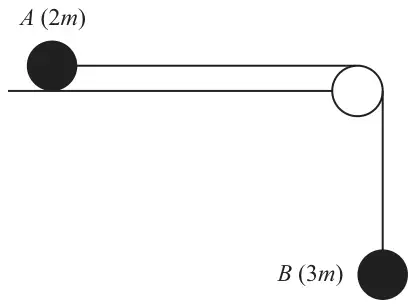
Two particles \(A\) and \(B\) have masses \(2m\) and \(3m\) respectively. The particles are attached to the ends of a light inextensible string. Particle \(A\) is held at rest on a smooth horizontal table. The string passes over a small smooth pulley which is fixed at the edge of the table. Particle \(B\) hangs at rest vertically below the pulley with the string taut, as shown in Figure 2.
Particle \(A\) is released from rest. Assuming that \(A\) has not reached the pulley, find
(a) the acceleration of \(B\), (5)
(b) the tension in the string, (1)
(c) the magnitude and direction of the force exerted on the pulley by the string. (4)
Mark scheme (a)
Scheme
Marks
For \(A\), \(T = 2ma\)
B1
For \(B\), \(3mg - T = 3ma\)
M1 A1
\(3mg = 5ma\)
DM1
\(\dfrac{3g}{5} = a\) (5.9 or 5.88 m s\(^{-2}\))
A1
(5)
Notes
B1 for \(T = 2ma\)
First M1 for resolving vertically (up or down) for \(B\), with correct no. of terms. (allow omission of \(m\), provided 3 is there)
First A1 for a correct equation.
Second M1, dependent on first M1, for eliminating \(T\), to give an equation in \(a\) only.
Second A1 for 0.6g, 5.88 or 5.9.
N.B. ‘Whole system’ equation: \(3mg = 5ma\) earns first 4 marks but any error loses all 4.
Direction clearly marked on a diagram, with an arrow, and 45\(^\circ\) (oe) marked
B1
(4)
(10 marks)
Notes
M1 \(\sqrt{(T^2 + T^2)}\) or \(\dfrac{T}{\sin 45^\circ}\) or \(\dfrac{T}{\cos 45^\circ}\) or \(2T\cos 45^\circ\) or \(2T\sin 45^\circ\) (allow if \(m\) omitted)
(M0 for \(T\sin 45^\circ\))
First A1 ft on their \(T\).
Second A1 cao for \(\dfrac{6mg\sqrt{2}}{5}\) oe, \(1.7mg\) (or better), \(16.6m\), \(17m\)
B1 for the direction clearly shown on a diagram with an arrow and 45\(^\circ\) marked.
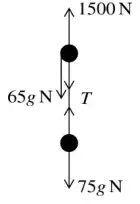
2. A woman travels in a lift. The mass of the woman is 50 kg and the mass of the lift is 950 kg. The lift is being raised vertically by a vertical cable which is attached to the top of the lift. The lift is moving upwards and has constant deceleration of 2 m s\(^{-2}\). By modelling the cable as being light and inextensible, find
(a) the tension in the cable, (3)
(b) the magnitude of the force exerted on the woman by the floor of the lift. (3)
(In both parts, use the mass to decide which part of the system is being considered and M marks can only be scored if an equation contains only forces acting on that part of the system)
M1 is for a complete method for finding \(T\) i.e. for an equation in \(T\) only, dimensionally correct, with the correct number of terms.
First A1 for a correct equation.
Second A1 for 7800 (N).
Mark scheme (b)
Scheme
Marks
For woman, \((\uparrow)\), \(R - 50g = 50 \times -2\)
M1 A1
\(R = 390\) N
A1
(3)
(6 marks)
Notes
M1 is for a complete method for finding \(R\) i.e. for an equation in \(R\) only, dimensionally correct, with the correct number of terms.
First A1 for a correct equation.
Second A1 for 390 (N).
N.B. Equation for lift only is: \(T - 950g - R = 950 \times (-2)\)
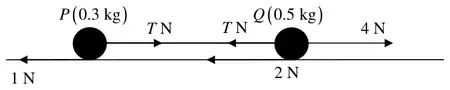
Two particles \(P\) and \(Q\), of mass 0.3 kg and 0.5 kg respectively, are joined by a light horizontal rod. The system of the particles and the rod is at rest on a horizontal plane. At time \(t = 0\), a constant force \(\mathbf{F}\) of magnitude 4 N is applied to \(Q\) in the direction \(PQ\), as shown in Figure 3. The system moves under the action of this force until \(t = 6\) s. During the motion, the resistance to the motion of \(P\) has constant magnitude 1 N and the resistance to the motion of \(Q\) has constant magnitude 2 N.
Find
(a) the acceleration of the particles as the system moves under the action of \(\mathbf{F}\), (3)
(b) the speed of the particles at \(t = 6\) s, (2)
(c) the tension in the rod as the system moves under the action of \(\mathbf{F}\). (3)
At \(t = 6\) s, \(\mathbf{F}\) is removed and the system decelerates to rest. The resistances to motion are unchanged. Find
(d) the distance moved by \(P\) as the system decelerates, (4)
(e) the thrust in the rod as the system decelerates. (3)
Mark scheme (a)
Scheme
Marks
For system N2L \(4 - 3 = 0.8a\)
M1 A1
\(a = 1.25\) (m s\(^{-2}\)), 1.3
A1
(3)
Notes
(In parts (a), (c), (d) and (e) use the value of the mass being used to guide you as to which part of the system is being considered, and mark equation(s) accordingly)
M1 for resolving horizontally to produce an equation in \(a\) ONLY.
First A1 for a correct equation
Second A1 for 1.25
Mark scheme (b)
Scheme
Marks
\(v = u + at\ \Rightarrow\ v = 0 + 1.25 \times 6 = 7.5\) (m s\(^{-1}\))
M1 A1
(2)
Notes
M1 for a complete method to find the speed
A1 cao 7.5
Mark scheme (c)
Scheme
Marks
For \(P\) N2L \(T - 1 = 0.3 \times 1.25\) ft their \(a\)
M1 A1ft
\(T = 1.375\) (N) 1.38, 1.4
A1
(3)
Notes
M1 for resolving horizontally, for either \(P\) or \(Q\), to produce an equation in \(T\) only.
First A1ft for a correct equation, ft on their \(a\)
Second A1 cao for 1.38 (N) or 1.375 (N)
OR
For \(Q\) N2L \(4 - 2 - T = 0.5 \times 1.25\)
Mark scheme (d)
Scheme
Marks
For system N2L \(-3 = 0.8a\ \Rightarrow\ a = -3.75\)
First M1 for resolving horizontally to produce an equation in \(a\) ONLY.
First A1cao for \(-3.75\) (or 3.75)
Second M1 for use of \(v^2 = u^2 + 2as\), with \(v = 0\), \(u =\) their (b) and their \(a\), (or any other complete method which produces an equation in \(s\) only)
M0 if they haven’t calculated a value of \(a\).
Second A1 for 7.5 m
Mark scheme (e)
Scheme
Marks
For \(P\) N2L \(T^{\prime} + 1 = 0.3 \times 3.75\)
M1 A1
\(T^{\prime} = 0.125\) (N), 0.13
A1
(3)
(15 marks)
Notes
M1 for resolving horizontally, for either \(P\) or \(Q\), to produce an equation in \(T\) only.
M0 if they haven’t calculated a value of \(a\)
First A1cao for a correct equation
Second A1 cao for 0.125 or 0.13 (N) (must be positive)
Alternative for (e)
For \(Q\) N2L \(2 - T^{\prime} = 0.5 \times 3.75\)
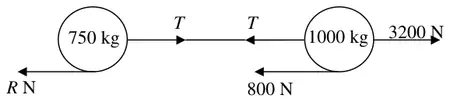
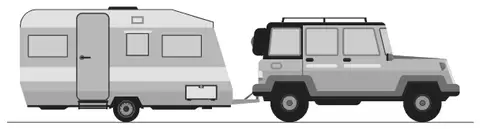
2. A car of mass 1000 kg is towing a caravan of mass 750 kg along a straight horizontal road. The caravan is connected to the car by a tow-bar which is parallel to the direction of motion of the car and the caravan. The tow-bar is modelled as a light rod. The engine of the car provides a constant driving force of 3200 N. The resistances to the motion of the car and the caravan are modelled as constant forces of magnitude 800 newtons and \(R\) newtons respectively.
Given that the acceleration of the car and the caravan is 0.88 m s\(^{-2}\),
(a) show that \(R = 860\), (3)
(b) find the tension in the tow-bar. (3)
Mark scheme (a)
Scheme
Marks
For the whole system
R\((\rightarrow)\) \(3200 - 800 - R = 1750 \times 0.88\)
M1 A1
Leading to \(R = 860\) *
A1
(3)
Mark scheme (b)
Scheme
Marks
For the caravan
R\((\rightarrow)\) \(T - 860 = 750 \times 0.88\)
M1 A1
Leading to \(T = 1520\ \ (\text{N})\)
A1
(3)
(6 marks)
Alternative for (b)
For the car
R\((\rightarrow)\) \(3200 - 800 - T = 1000 \times 0.88\)
Two particles \(A\) and \(B\) have mass 0.4 kg and 0.3 kg respectively. The particles are attached to the ends of a light inextensible string. The string passes over a small smooth pulley which is fixed above a horizontal floor. Both particles are held, with the string taut, at a height of 1 m above the floor, as shown in Figure 3. The particles are released from rest and in the subsequent motion \(B\) does not reach the pulley.
(a) Find the tension in the string immediately after the particles are released. (6)
(b) Find the acceleration of \(A\) immediately after the particles are released. (2)
When the particles have been moving for 0.5 s, the string breaks.
(c) Find the further time that elapses until \(B\) hits the floor. (9)
Two particles \(A\) and \(B\) have masses \(5m\) and \(km\) respectively, where \(k \lt 5\). The particles are connected by a light inextensible string which passes over a smooth light fixed pulley. The system is held at rest with the string taut, the hanging parts of the string vertical and with \(A\) and \(B\) at the same height above a horizontal plane, as shown in Figure 4. The system is released from rest. After release, \(A\) descends with acceleration \(\dfrac{1}{4}g\).
(a) Show that the tension in the string as \(A\) descends is \(\dfrac{15}{4}mg\). (3)
(b) Find the value of \(k\). (3)
(c) State how you have used the information that the pulley is smooth. (1)
After descending for 1.2 s, the particle \(A\) reaches the plane. It is immediately brought to rest by the impact with the plane. The initial distance between \(B\) and the pulley is such that, in the subsequent motion, \(B\) does not reach the pulley.
(d) Find the greatest height reached by \(B\) above the plane. (7)
Mark scheme (a)
Scheme
Marks
N2L \(A\): \(5mg - T = 5m \times \dfrac{1}{4}g\)
M1 A1
\(T = \dfrac{15}{4}mg\) * cso
A1
(3)
Mark scheme (b)
Scheme
Marks
N2L \(B\): \(T - kmg = km \times \dfrac{1}{4}g\)
M1 A1
\(k = 3\)
A1
(3)
Mark scheme (c)
Scheme
Marks
The tensions in the two parts of the string are the same
6. A car of mass 800 kg pulls a trailer of mass 200 kg along a straight horizontal road using a light towbar which is parallel to the road. The horizontal resistances to motion of the car and the trailer have magnitudes 400 N and 200 N respectively. The engine of the car produces a constant horizontal driving force on the car of magnitude 1200 N. Find
(a) the acceleration of the car and trailer, (3)
(b) the magnitude of the tension in the towbar. (3)
The car is moving along the road when the driver sees a hazard ahead. He reduces the force produced by the engine to zero and applies the brakes. The brakes produce a force on the car of magnitude \(F\) newtons and the car and trailer decelerate. Given that the resistances to motion are unchanged and the magnitude of the thrust in the towbar is 100 N,
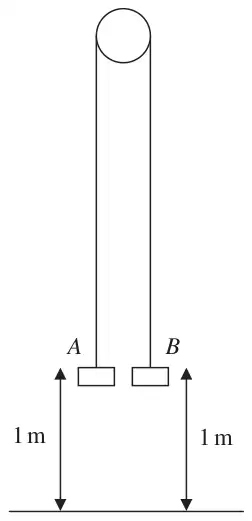
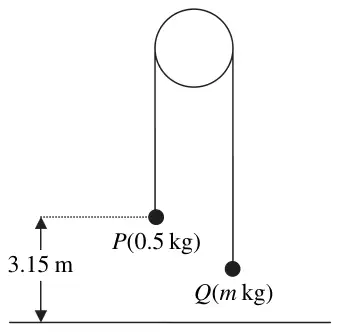
Two particles \(P\) and \(Q\) have mass 0.5 kg and \(m\) kg respectively, where \(m \lt 0.5\). The particles are connected by a light inextensible string which passes over a smooth, fixed pulley. Initially \(P\) is 3.15 m above horizontal ground. The particles are released from rest with the string taut and the hanging parts of the string vertical, as shown in Figure 4. After \(P\) has been descending for 1.5 s, it strikes the ground. Particle \(P\) reaches the ground before \(Q\) has reached the pulley.
(a) Show that the acceleration of \(P\) as it descends is 2.8 m s\(^{-2}\). (3)
(b) Find the tension in the string as \(P\) descends. (3)
(c) Show that \(m = \dfrac{5}{18}\). (4)
(d) State how you have used the information that the string is inextensible. (1)
When \(P\) strikes the ground, \(P\) does not rebound and the string becomes slack. Particle \(Q\) then moves freely under gravity, without reaching the pulley, until the string becomes taut again.
(e) Find the time between the instant when \(P\) strikes the ground and the instant when the string becomes taut again. (6)
6. A car is towing a trailer along a straight horizontal road by means of a horizontal tow-rope. The mass of the car is 1400 kg. The mass of the trailer is 700 kg. The car and the trailer are modelled as particles and the tow-rope as a light inextensible string. The resistances to motion of the car and the trailer are assumed to be constant and of magnitude 630 N and 280 N respectively. The driving force on the car, due to its engine, is 2380 N. Find
(a) the acceleration of the car, (3)
(b) the tension in the tow-rope. (3)
When the car and trailer are moving at 12 m s\(^{-1}\), the tow-rope breaks. Assuming that the driving force on the car and the resistances to motion are unchanged,
(c) find the distance moved by the car in the first 4 s after the tow-rope breaks. (6)
(d) State how you have used the modelling assumption that the tow-rope is inextensible. (1)
Mark scheme (a)
Scheme
Marks
Car + trailer: \(2100a = 2380 - 280 - 630\)
M1 A1
\(= 1470 \;\Rightarrow\; a = 0.7\) m s\(^{-2}\)
A1
(3)
Notes
(a) M1 for a complete (potential) valid method to get \(a\)
Mark scheme (b)
Scheme
Marks
e.g. trailer: \(700 \times 0.7 = T - 280\)
M1 A1ft
\(\Rightarrow T = 770\) N
A1
(3)
Notes
(b) If consider car: then get \(1400a = 2380 - 630 - T\).
Allow M1 A1 for equn of motion for car or trailer wherever seen (e.g. in (a)).
So if consider two separately in (a), can get M1 A1 from (b) for one equation; then M1 A1 from (a) for second equation, and then A1 [(a)] for \(a\) and A1 [(b)] for \(T\).
In equations of motion, M1 requires no missing or extra terms and dimensionally correct (e.g. extra force, or missing mass, is M0). If unclear which body is being considered, assume that the body is determined by the mass used. Hence if ‘\(1400a\)’ used, assume it is the car and mark forces etc accordingly. But allow e.g. 630/280 confused as an A error.
Describes any valid assumption not related to those assumptions already stated in the question. Eg The particle is at least 2m above the ground Eg The particle does not collide with the load
E1
3.5b
(1)
(10 marks)
Typical solution
I assumed that the top of the container does not reach the pulley
15 A tractor and its driver have a combined mass of \(m\) kilograms.
The tractor is towing a trailer of mass \(4m\) kilograms in a straight line along a horizontal road.
The tractor and trailer are connected by a horizontal tow bar, modelled as a light rigid rod.
A driving force of 11 080 N and a total resistance force of 160 N act on the tractor.
A total resistance force of 600 N acts on the trailer.
The tractor and the trailer have an acceleration of 0.8 m s−2
(a) Find \(m\). [3 marks]
(b) Find the tension in the tow bar. [2 marks]
(c) At the instant the speed of the tractor reaches 18 km h−1 the tow bar breaks.
The total resistance force acting on the trailer remains constant.
Starting from the instant the tow bar breaks, calculate the time taken until the speed of the trailer reduces to 9 km h−1[4 marks]
Mark scheme (a)
Scheme
Marks
AO
Models overall system as a single particle using Newton’s second law, one side of equation correct. If two separate equations used, must eliminate \(T\) to obtain a single equation
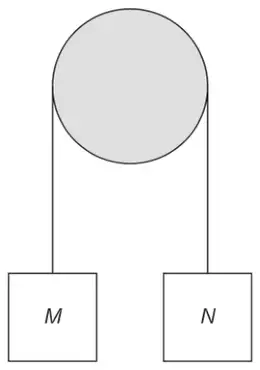
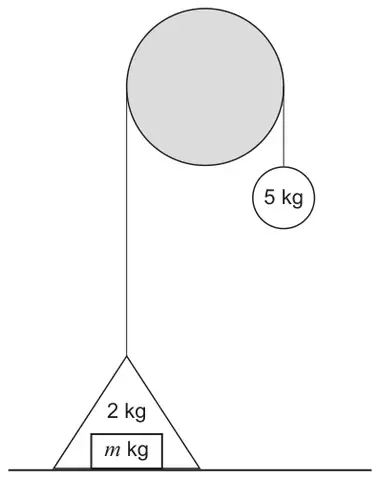
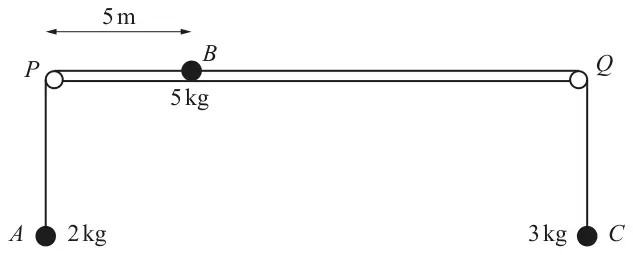
One end of a light inextensible string is attached to a particle \(A\) of mass 2 kg. The other end of the string is attached to a second particle \(B\) of mass 5 kg. Particle \(B\) is in contact with a smooth horizontal surface. The string passes over a small smooth pulley \(P\) which is fixed at one edge of the surface. Particle \(A\) hangs vertically below \(P\).
A second light inextensible string is attached to \(B\). The other end of this second string is attached to a third particle \(C\) of mass 3 kg. This string passes over a small smooth pulley \(Q\) which is fixed at the other edge of the surface. Particle \(C\) hangs vertically below \(Q\) (see diagram).
The system is released from rest with the strings taut and \(B\) a distance 5 m from \(P\). In the subsequent motion \(A\) does not reach \(P\).
(a) Determine, in terms of \(g\), the tension in the string connecting \(B\) and \(C\). [4]
When the particles have been in motion for 3 seconds the string connecting \(A\) and \(B\) breaks. Particle \(B\) reaches \(Q\) after a further 2 seconds.
(b) Determine the distance \(PQ\). [6]
(c) State what it would mean about the tension in the string connecting \(B\) and \(C\) if pulley \(Q\) could not be assumed to be smooth. [1]
It is given that in fact the horizontal surface is not smooth. When the system, as shown in the diagram, is released, it remains at rest. (You may assume that pulley \(Q\) is smooth.)
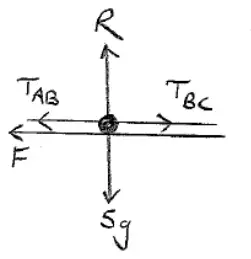
(d) Complete the diagram below showing all the forces acting on \(B\). [1]
(e) State the magnitude of the frictional force acting on \(B\). Give a brief justification for your answer. [1]
B1FT: Correct (follow through) expression for \(s_1\) where \(s_1\) is the distance travelled by \(B\) in the first 3 seconds Using their value for initial acceleration (most likely seen in part (a)) coming from some attempt at N2L Not an acceleration of \(\pm g\)
M1*: Applying N2L for both \(B\) and \(C\) Where \(T\) is the tension in string \(BC\) and \(a_1\) is the acceleration of the system after the string breaks
B1FT*: Correct (follow through) expression for the velocity of \(B\) at the instant when the string breaks Not an acceleration of \(\pm g\). Acceleration coming from some attempt at N2L
M1dep*: Attempt to find distance travelled, using \(s = ut + 0.5at^2\), in the 2 seconds after the string breaks So must be using \(t = 2\)
A1: Allow 22.6 www
Mark scheme (c)
Scheme
Marks
AO
Eg. The tension is not the same throughout the string oe
B1
3.5a
[1]
Notes
B1: Any statement which suggests the tension is not constant (throughout the string)
Mark scheme (d)
Scheme
Marks
AO
B1
3.5c
[1]
Notes
B1: All five forces correct – \(F\) must be acting towards the left, B0 if \(T\) used on both strings
Might see \(T_{BC} = 3g, T_{AB} = 2g, F = g, R = 5g\) Allow \(W\) or \(mg\) used for the weight
\(F\) and \(R\) may be replaced by a single contact force acting in the correct direction
Do not allow \(F = \mu R\)
Mark scheme (e)
Scheme
Marks
AO
\(g\) or 9.8 because for \(B\) to remain in equilibrium the frictional force must be equal to \(T_{BC} - T_{AB}\) which is equal to \(3g - 2g\)
B1
2.4
[1]
Notes
B1: Correct value together with correct justification (must mention the tension in the two strings or the weights of the other two masses)
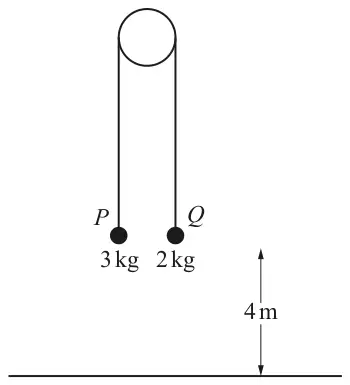
Two small balls \(P\) and \(Q\), of masses \(3\,\mathrm{kg}\) and \(2\,\mathrm{kg}\) respectively, are attached to the ends of a light inextensible string. The string passes over a smooth fixed pulley. The balls are held at a height of 4 m above a horizontal floor, with the string taut. The parts of the string which are not in contact with the pulley are vertical (see diagram).
The system is set in motion in such a way that \(P\) moves vertically downwards.
(a) Determine the tension in the string immediately after the system is set in motion. [4]
The initial downward speed of \(P\) is \(4.2\,\mathrm{m\,s^{-1}}\) and when \(P\) reaches the floor it is immediately brought to rest. It is given that \(Q\) does not reach the pulley in the subsequent motion.
(b) Find the speed of \(P\) as it hits the floor. [2]
(c) Determine the time, after the start of the motion, at which \(Q\) reaches its greatest height above the floor. [4]
(d) State what it would mean about the accelerations of the balls if the string could not be assumed to be inextensible. [1]
Mark scheme (a)
Scheme
Marks
AO
M1*
3.3
\(3g - T = 3a\) \(T - 2g = 2a\)
A1
1.1
\(3g - T = 3\left(\dfrac{T - 2g}{2}\right) \Rightarrow T = \ldots\)
M1dep*
3.4
\(T = 23.52\) (N)
A1
1.1
[4]
Notes
M1*: Attempt N2L for \(P\) and \(Q\) – three terms, mass required, condone sign errors M0 for \(a = 0\) or \(\pm g\)
A1: Both equations correct
M1dep*: Eliminate \(a\) and attempt to solve for \(T\) Or eliminate \(T\) to find \(a\) first and substitute back numerical \(a\) to evaluate \(T\) \(\left(a = \tfrac{1}{5}g = 1.96\right)\)
A1: Accept 23.5 or \(\dfrac{12}{5}g\)
Mark scheme (b)
Scheme
Marks
AO
\(v^2 = 4.2^2 + 2(\text{‘}1.96\text{’})(4)\)
M1
3.4
\(v = 5.77\) to 3 sf
A1
1.1
[2]
Notes
M1: \(v^2 = u^2 + 2as\) with \(u = 4.2\), \(s = 4\) and their \(a\) (which must be positive but not \(g\)) May have \(s = -4\) and their \(a\) is negative (but not \(-g\))
M1: Correctly uses \(v = u + at\) with \(u = 4.2\) and their \(v\) and \(a\) where \(a \neq 0\) or \(g\). (Or uses \(s = ut + \tfrac{1}{2}at^2\) with \(u = 4.2\), \(s = 4\) and their calculated value for \(a\) Or uses \(s = \tfrac{1}{2}(u + v)t\) with \(s = 4\), \(u = 4.2\) and their \(v\)) Where \(t_1\) is the time for \(P\) to move 4 m Must be using a consistent sign convention to earn M1
M1: Correct use of \(v = u + at\) with \(v = 0\), \(a = -g\) and their positive \(u\) from part (b) (If correct: \(t_2 = \dfrac{\sqrt{17}}{7} = 0.5890150894\ldots\)) Where \(t_2\) is the time from \(P\) hitting the ground until \(Q\) comes to rest
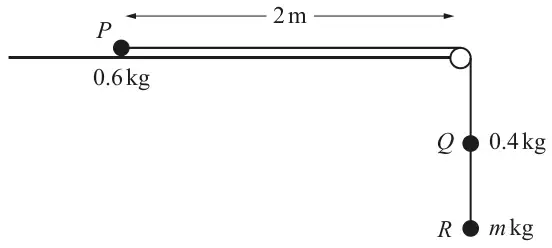
11 Two balls \(P\) and \(Q\) have masses \(0.6\,\mathrm{kg}\) and \(0.4\,\mathrm{kg}\) respectively. The balls are attached to the ends of a string. The string passes over a pulley which is fixed at the edge of a rough horizontal surface. Ball \(P\) is held at rest on the surface \(2\,\mathrm{m}\) from the pulley. Ball \(Q\) hangs vertically below the pulley. Ball \(Q\) is attached to a third ball \(R\) of mass \(m\,\mathrm{kg}\) by another string and \(R\) hangs vertically below \(Q\) (see diagram).
The system is released from rest with the strings taut. Ball \(P\) moves towards the pulley with acceleration \(3.5\,\mathrm{m\,s^{-2}}\) and a constant frictional force of magnitude \(4.5\,\mathrm{N}\) opposes the motion of \(P\).
The balls are modelled as particles, the pulley is modelled as being small and smooth, and the strings are modelled as being light and inextensible.
(a) By considering the motion of \(P\), find the tension in the string connecting \(P\) and \(Q\). [2]
(b) Hence determine the value of \(m\). Give your answer correct to 3 significant figures. [4]
When the balls have been in motion for 0.4 seconds the string connecting \(Q\) and \(R\) breaks.
(c) Show that, according to the model, \(P\) does not reach the pulley. [6]
It is given that in fact ball \(P\) does reach the pulley.
(d) Identify one factor in the modelling that could account for this difference. [1]
Mark scheme (a)
Scheme
Marks
AO
\(T_1 - 4.5 = 0.6(3.5)\)
M1
3.3
\(T_1 = 6.6\ (\mathrm{N})\)
A1
1.1
[2]
Notes
M1: N2L for \(P\) – correct number of terms and dimensionally consistent – allow sign confusion
Mark scheme (b)
Scheme
Marks
AO
For \(Q\): \(T_2 + 0.4g - T_1 = 0.4(3.5)\) For \(R\): \(mg - T_2 = m(3.5)\)
M1 M1 A1
3.3 3.3 1.1
\(m = 0.648\)
A1
1.1
[4]
Notes
M1 for N2L for \(Q\) and M1 for N2L for \(R\) – correct number of terms and dimensionally consistent – allow sign confusion Must be using \(a = 3.5\)
A1 for both correct (allow with their tension from (a))
Or (by considering \(Q\) and \(R\) together) \((0.4 + m)g - T_1 = (0.4 + m) \times 3.5\) scores M2 A1
Before string breaks \(P\) moves \(0.5(3.5)(0.4)^2\ (= 0.28)\)
B1
3.4
When string breaks the speed of \(P\) is \(3.5(0.4)\ (= 1.4)\)
B1
3.4
For \(P\): \(T - 4.5 = 0.6a\) For \(Q\): \(0.4g - T = 0.4a\)
M1* A1
3.3 1.1
When string breaks \(P\) travels a distance \(s\) where \(0 = 1.4^2 + 2(-0.58)s\)
M1dep*
3.1b
Total distance is \(0.28 + 1.689\ldots = 1.9696\ldots \lt 2\) or Total distance is \(0.28 + 1.689\ldots = 1.9696\ldots\) so \(P\) does not reach the pulley
A1
2.2a
[6]
Notes
B1: Correct (unsimplified) expression
B1: Correct (unsimplified) expression
M1*:M1 for attempt at N2L for both P and Q after string breaks – correct number of terms and dimensionally consistent- but allow sign confusion For reference if solved correctly then \(a\) is \(-0.58\)
M1dep*: Use of \(v^2 = u^2 + 2as\) with \(v = 0\) and their values for \(u\) and \(a\) M0 if \(a = 3.5\) used For reference \(s = \tfrac{49}{29} = 1.689655\ldots\)
A1:AG
Mark scheme (d)
Scheme
Marks
AO
Both \(P\) and the pulley are modelled as having negligible size rather than as objects with dimensions and therefore this could account for why \(P\) does reach the pulley
See Appendix for some allowable responses Identifying a relevant factor is sufficient
B1
3.5a
[1]
Notes
B1: An answer that refers to the dimensions of \(P\) and/or the pulley If more than one factor given then B1 if all are acceptable, B0 if not.
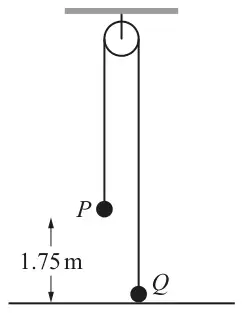
Particles \(P\) and \(Q\), of masses \(4\,\mathrm{kg}\) and \(6\,\mathrm{kg}\) respectively, are attached to the ends of a light inextensible string. The string passes over a smooth fixed pulley. The system is in equilibrium with \(P\) hanging \(1.75\,\mathrm{m}\) above a horizontal plane and \(Q\) resting on the plane. Both parts of the string below the pulley are vertical (see diagram).
(a) Find the magnitude of the normal reaction force acting on \(Q\). [1]
The mass of \(P\) is doubled, and the system is released from rest. You may assume that in the subsequent motion \(Q\) does not reach the pulley.
(b) Determine the magnitude of the force exerted on the pulley by the string before \(P\) strikes the plane. [5]
(c) Determine the total distance travelled by \(Q\) between the instant when the system is released and the instant when \(Q\) first comes momentarily to rest. [4]
When this motion is observed in practice, it is found that the total distance travelled by \(Q\) between the instant when the system is released and the instant when \(Q\) first comes momentarily to rest is less than the answer calculated in part (c).
(d) State one factor that could account for this difference. [1]
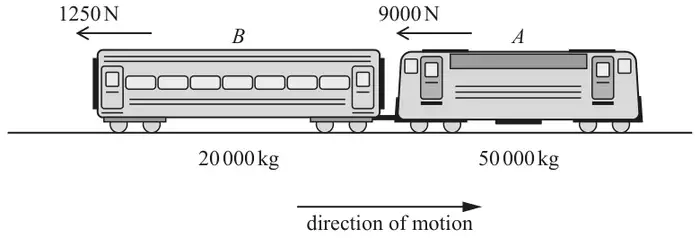
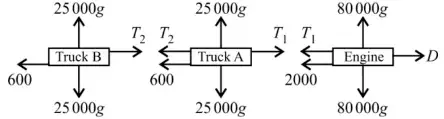
A train consists of an engine \(A\) of mass \(50\,000\,\mathrm{kg}\) and a carriage \(B\) of mass \(20\,000\,\mathrm{kg}\). The engine and carriage are connected by a rigid coupling. The coupling is modelled as light and horizontal.
The resistances to motion acting on \(A\) and \(B\) are \(9000\,\mathrm{N}\) and \(1250\,\mathrm{N}\) respectively (see diagram).
The train passes through station \(P\) with speed \(15\,\mathrm{m\,s^{-1}}\) and moves along a straight horizontal track with constant acceleration \(0.01\,\mathrm{m\,s^{-2}}\) towards station \(Q\). The distance between \(P\) and \(Q\) is \(12.95\,\mathrm{km}\).
(a) Determine the time, in minutes, to travel between \(P\) and \(Q\). [3]
For the train’s motion between \(P\) and \(Q\), determine the following.
(b) The driving force of the engine. [2]
(c) The tension in the coupling between \(A\) and \(B\). [2]
Mark scheme (a)
Scheme
Marks
AO
M1
3.4
\(12950 = 15t + 0.5(0.01)t^2\) leading to \(t = \ldots\)
A1
1.1
11.7 (minutes)
A1
1.1
[3]
Notes
M1: Use of \(s = ut + \frac{1}{2}at^2\)
A1: Correct equation and attempt to solve Consistent values used
A1:BC cao (exact value is \(11\frac{2}{3}\))
Mark scheme (b)
Scheme
Marks
AO
\(D - 1250 - 9000 = 70000(0.01)\)
M1
3.3
\(10\,950\) (N)
A1
1.1
[2]
Notes
M1: N2L applied to the whole system, correct number of terms (allow sign errors)
9 A crane lifts a car vertically. The car is inside a crate which is raised by the crane by means of a strong cable. The cable can withstand a maximum tension of 9500 N without breaking. The crate has a mass of 55 kg and the car has a mass of 830 kg.
(a) Find the maximum acceleration with which the crate and car can be raised. [2]
(b) Show on a clearly labelled diagram the forces acting on the crate while it is in motion. [1]
(c) Determine the magnitude of the reaction force between the crate and the car when they are ascending with maximum acceleration. [3]
Mark scheme (a)
Scheme
Marks
AO
\(9500 - 55g - 830g = 885a\)
M1
3.3
\(a = 0.934\ \text{m s}^{-2}\)
A1
1.1
[2]
Notes
M1: Attempt at Newton’s second law – correct number of terms (condone sign errors) Weight and mass correctly used
A1: Allow 827/885 0.9344632768…
Mark scheme (b)
Scheme
Marks
AO
B1
3.3
[1]
Notes
Correct diagram – three forces (tension in the cable vertically upwards, weight of the crate vertically downwards and normal contact force acting vertically downwards)
Note – all three forces labelled somehow, either numerically or with letters, with no extras.
Corresponding values not required but if present must be correct
Mark scheme (c)
Scheme
Marks
AO
M1
3.3
\(9500 - 55g - R = 55(0.9344\ldots)\) or \(R - 830g = 830(0.9344\ldots)\)
A1ft
3.4
\(R = 8910\) N
A1
1.1
[3]
Notes
M1: Attempt at Newton’s second law for either the crate or car – correct number of terms (accept sign errors) Allow in terms of \(a\) Weight and mass correctly used
A1ft: Correct application of N2L following through their value of \(a\) from (a)
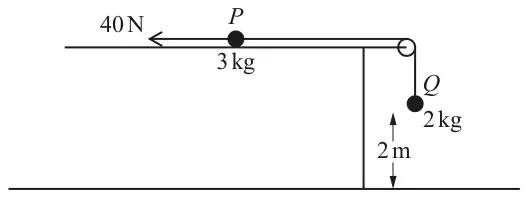
11 Two small balls \(P\) and \(Q\) have masses 3 kg and 2 kg respectively. The balls are attached to the ends of a string. \(P\) is held at rest on a rough horizontal surface. The string passes over a pulley which is fixed at the edge of the surface. \(Q\) hangs vertically below the pulley at a height of 2 m above a horizontal floor.
The system is initially at rest with the string taut. A horizontal force of magnitude 40 N acts on \(P\) as shown in the diagram.
\(P\) is released and moves directly away from the pulley. A constant frictional force of magnitude 8 N opposes the motion of \(P\). It is given that \(P\) does not leave the horizontal surface and that \(Q\) does not reach the pulley in the subsequent motion.
The balls are modelled as particles, the pulley is modelled as being small and smooth, and the string is modelled as being light and inextensible.
(a) Show that the magnitude of the acceleration of each particle is \(2.48\,\text{m}\,\text{s}^{-2}\). [5]
(b) Find the tension in the string. [2]
When the balls have been in motion for 0.5 seconds, the string breaks.
(c) Find the additional time that elapses until \(Q\) hits the floor. [5]
(d) Find the speed of \(Q\) as it hits the floor. [2]
(e) Write down the magnitude of the normal reaction force acting on \(Q\) when \(Q\) has come to rest on the floor. [1]
(f) State one improvement that could be made to the model. [1]
Mark scheme (a)
Scheme
Marks
AO
M1*
3.3
For \(P\): \(40 - T - 8 = 3a\)
A1
1.1
For \(Q\): \(T - 2g = 2a\)
A1
1.1
\(32 - 2g = 5a \Rightarrow a = \ldots\)
Dep*M1
1.1
\(a = 2.48\ \text{m}\,\text{s}^{-2}\)
A1
2.2a
[5]
Notes
M1*: Attempt N2L for \(P\) or \(Q\). Must include correct number of terms – use of weight for mass is M0
Dep*M1: Attempt to solve simultaneous equations
A1:AG Must show sufficient working to justify the given answer
M1 A2 for \(40 - 8 - 2g = 5a\) for M1 must have correct number of terms and mass must be 5 not \(5g\)
Mark scheme (b)
Scheme
Marks
AO
\(T - 2g = 2(2.48)\)
M1
3.4
\(T = 24.56\,\text{N}\)
A1
1.1
[2]
Notes
M1: Substitute given value of \(a\) into either equation. Must include correct number of terms – use of weight for mass is M0
A1: cao Allow 24.6
Mark scheme (c)
Scheme
Marks
AO
\(v = 2.48(0.5)\)
B1
3.4
\(s = 0.5(2.48)(0.5)^2\)
B1
3.4
M1
3.1b
\(-(2 + 0.31) = 1.24t - 0.5(9.8)t^2\)
A1
1.1
\(t = 0.825\,\text{s}\)
A1
2.2a
[5]
Notes
B1: Speed after 0.5 seconds 1.24
B1: Distance travelled in this time 0.31
M1: Applying \(s = ut + 0.5at^2\) correctly — allow sign errors. M0 if not using relevant displacement
B1: Speed after 0.5 seconds 1.24 B1: Distance travelled in this time 0.31 M1: Complete method to calculate the time down A1: Correct value for time down
Mark scheme (d)
Scheme
Marks
AO
\(v^2 = 1.24^2 + 2(-9.8)(-2.31)\)
M1
3.3
\(v = 6.84\,\text{m}\,\text{s}^{-1}\)
A1
1.1
[2]
Notes
M1: Applying \(v^2 = u^2 + 2as\) correctly with their 1.24 and 2.31 or any other complete method. M0 if not using total time or relevant displacement
A1: Allow 6.85 6.8420464…
Mark scheme (e)
Scheme
Marks
AO
\(19.6\,\text{N}\)
B1
3.4
[1]
Notes
Accept \(2g\)
Mark scheme (f)
Scheme
Marks
AO
e.g. include a more accurate value for \(g\) e.g. include a variable resistance in the model rather than a constant e.g. include the dimension of the pulley in the model so that the string is not parallel to the table e.g. include a frictional force at the pulley
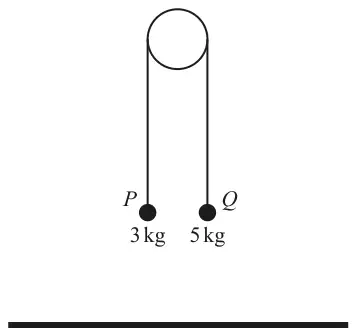
10 Particles \(P\) and \(Q\), of masses \(3\,\text{kg}\) and \(5\,\text{kg}\) respectively, are attached to the ends of a light inextensible string. The string passes over a smooth fixed pulley. The system is held at rest with the string taut. The hanging parts of the string are vertical and \(P\) and \(Q\) are above a horizontal plane (see diagram).
(i) Find the tension in the string immediately after the particles are released. [4]
After descending \(2.5\,\text{m}\), \(Q\) strikes the plane and is immediately brought to rest. It is given that \(P\) does not reach the pulley in the subsequent motion.
(ii) Find the distance travelled by \(P\) between the instant when \(Q\) strikes the plane and the instant when the string becomes taut again. [4]
Mark scheme (i)
Scheme
Marks
AO
\(T - 3g = 3a\) \(5g - T = 5a\)
M1* A1
3.3 1.1
\(5g - T = 5\left(\dfrac{T - 3g}{3}\right) \Rightarrow T = \ldots\)
Dep*M1
1.1
\(T = 36.75\) (N)
A1
1.1
[4]
Notes
M1*: Attempt N2L for \(P\) and \(Q\) – three terms, mass required, condone sign errors. M0 for \(a = 0\) or \(\pm g\)
Dep*M1: Eliminate \(a\) and attempt to solve for \(T\)
A1: Accept \(\dfrac{15}{4}g\), 36.8
Mark scheme (ii)
Scheme
Marks
AO
\(a = 2.45\,\text{m}\,\text{s}^{-2}\)
B1
3.4
\(v^2 = 0 + 2(2.45)(2.5)\)
M1*
3.3
\(0 = 12.25 + 2h(-g)\)
Dep*M1
3.3
\((2h =)\ 1.25\) (m)
A1
1.1
[4]
Notes
B1: \(0.25g\)
M1*: Use of \(v^2 = u^2 + 2as\) for \(P\) with \(u = 0\). M0 for \(a = 0\) or \(\pm g\)
Dep*M1: Use of \(v^2 = u^2 + 2as\) for \(P\) with \(v = 0\) \(a = \pm g\)
5 Two blocks A and B have masses 5 kg and 2 kg respectively. The blocks are joined together by a light rigid horizontal bar and slide across a horizontal surface. The resistances on the blocks A and B are modelled as 7 N and 1.75 N respectively. There are no other external horizontal forces.
(a) Calculate the acceleration of the system, according to the model. [3]
(b) In reality, the acceleration of the system is not constant. State an improvement that could be made to the model so that it will produce results which are closer to the real situation. [1]
Mark scheme (a)
Scheme
Marks
AO
\(-7 - 1.75 = (5+2)a\)
M1 A1
1.1a 1.1
\(a = -\frac{8.75}{7} = -1.25\ \text{ms}^{-2}\)
A1
1.1
[3]
Notes
M1: Uses the combined mass in N2L equation. Allow sign errors. No extra forces. Do not allow for \(mga\).
A1: Correct equation Also allow \(8.75 = 7a\) soi.
A1: Cao. Negativity must follow from their working, or clearly states deceleration of 1.25 \(\text{ms}^{-2}\)
Alternative method
Scheme
Marks
AO
For 5kg block \(T - 7 = 5a\) For 2kg block \(-T - 1.75 = 2a\)
M1
\(-7 - 1.75 = (5+2)a\)
A1
\(a = -\frac{8.75}{7} = -1.25\ \text{ms}^{-2}\)
A1
M1: Sets up an equation for each block including Tension. Allow sign errors. No extra forces. Do not allow for \(mga\).
A1: Correct equation with T eliminated. Any form. Also allow \(8.75 = 7a\) soi.
A1: Cao. Negativity must follow from their working, or clearly states deceleration of 1.25 \(\text{ms}^{-2}\)
Mark scheme (b)
Scheme
Marks
AO
Model the resistance with a variable force
B1
3.5c
[1]
Notes
B1: Allow a particular example of a variable force or variation in some other factor
10 A boat pulls a water skier of mass 65 kg with a light inextensible horizontal towrope. The mass of the boat is 985 kg. There is a driving force of 2400 N acting on the boat. There are horizontal resistances to motion of 400 N and 1200 N acting on the skier and the boat respectively.
(a) Draw a diagram showing all the horizontal forces acting on the skier and the boat. [2]
(b)
(i) Write down the equation of motion of the skier. [1]
(ii) Find the equation of motion of the boat. [2]
(c) Find the acceleration of the skier and the boat. [1]
The driving force of the boat is increased. The skier can only hold on to the towrope when the tension is no greater than her weight.
(d) Determine her greatest acceleration, assuming that the resistances to motion stay the same. [2]
Mark scheme (a)
Scheme
Marks
AO
B1
B1
1.1
1.1
[2]
Notes
B1: Driving force and common tension correct and labelled (boat shown on right – allow mirror image) Allow T marked as a thrust if consistent with equations in 10bi and 10bii
B1: Both resistances correct and labelled
Mark scheme (b)
Scheme
Marks
AO
(i) N2L for skier \(T - 400 = 65a\)
B1
1.1
[1]
(ii) N2L for the boat \(2400 - 1200 - T = 985a\)
M1
1.1
\(1200 - T = 985a\)
A1
1.1
[2]
Notes
(i) B1: Allow \(-T - 400 = 65a\) if consistent with their diagram
(ii) M1: Attempt to use N2L with \(m = 985\) for the boat. Allow missing or incorrect resistance. (do not allow for weight included) Allow 400 for resistance if 1200 used in (i). Allow \(-T\) used for \(T\) if consistent with their diagram.
(ii) A1: Allow if not simplified
Allow SC1 for \(2400 - 1200 - 400 = 1050a\)
Mark scheme (c)
Scheme
Marks
AO
Add equations to give acceleration \(\dfrac{800}{1050} = 0.762\) \(\text{m s}^{-2}\)
11 A block of mass 3 kg is at rest on a smooth horizontal table. It is attached to a light inextensible string which passes over a smooth pulley. This part of the string is horizontal. A sphere of mass 1.2 kg is attached to the other end of the string. The sphere hangs with this part of the string vertical as shown in the diagram. A horizontal force of magnitude \(F\) N is applied to the block to prevent motion.
(a) Complete the copy of the diagram in the Printed Answer Booklet to show all the forces acting on the block and the sphere. [2]
(b) Find the value of \(F\). [2]
The force \(F\) N is removed, and the system begins to move.
(c) The equation of motion of the block is \(T = 3a\), where \(T\) N is the tension in the string and \(a\) \(\text{m s}^{-2}\) is the acceleration of the block.
Write down the equation of motion of the sphere. [1]
(d) Find the value of \(T\). [2]
Mark scheme (a)
Scheme
Marks
AO
B1
B1
3.3
3.3
[2]
Notes
B1: Both forces on the sphere correct and labelled
B1: All forces correct on the block. Tension must be marked the same or if \(T_1\) and \(T_2\) used, equated to each other elsewhere in the question. The horizontal force \(F\) must be in the correct direction
Mark scheme (b)
Scheme
Marks
AO
For the system to be in equilibrium sphere gives \(T = 1.2g\) N
M1
1.1b
for the block \(F = T = 1.2g = 11.76\)
A1
1.1b
[2]
Notes
M1: soi
A1: any form
Mark scheme (c)
Scheme
Marks
AO
\(1.2g - T = 1.2a\)
B1
3.4
[1]
Notes
B1: cao
Mark scheme (d)
Scheme
Marks
AO
For the block \(T = 3a\) Add the equations \(1.2g = 4.2a\) \(a = 2.8\) \(\text{m s}^{-2}\)
M1
1.1a
Substitute \(T = 3a = 8.4\)
A1
1.1b
[2]
Notes
M1: Attempt to solve simultaneous equations leading to a value for \(a\). Do not award if their equation 11(c) does not have \(T\).
9 A tractor of mass 1800 kg uses a towbar to pull a trailer of mass 1000 kg on a level field. The tractor and trailer experience resistances to motion of 1600 N and 800 N respectively. The tractor provides a driving force of 6600 N.
(a) Draw a force diagram showing all the horizontal forces acting on the tractor and trailer. [2]
(b) Find the tension in the towbar. [4]
Mark scheme (a)
Scheme
Marks
AO
Horizontal forces (could be mirror image)
B1
B1
3.3
3.3
[2]
Notes
Ignore vertical forces.
B1: 6600 N and resistances correctly placed and labelled. No extra horizontal forces
B1: Common tension in the towbar shown.
Mark scheme (b)
Scheme
Marks
AO
Tractor and trailer together \(6600 - 1600 - 800 = 2800a\)
M1
3.1b
\(a = 1.5\) \(\text{m s}^{-2}\)
A1
1.1b
Newton’s second law for the trailer \(T - 800 = 1000 \times 1.5\)
M1
3.1b
\(T = 2300\) N
A1
1.1b
[4]
Notes
M1: 2800 kg used. Allow a missing or an extra horizontal force for the method mark
A1: soi
M1: Newton’s second law with correct mass. FT their acceleration. Also allow for the tractor \(6600 - T - 1600 = 1800 \times 1.5\) used
A1: cao
Alternative method
Scheme
Marks
AO
Newton’s second law for the tractor \(6600 - T - 1600 = 1800a\) Newton’s second law for the trailer \(T - 800 = 1000a\)
M1 A1
Simultaneous equations
M1
giving \(T = 2300\) N
A1
M1: Newton’s second law for both parts of the system with correct masses; allow a missing or an extra horizontal force for the method mark
A1: Both equations correct
M1: Attempt to solve simultaneous equations leading to a value of \(T\). BC means method need not be seen
10 A rescue worker is lowered from a helicopter on a rope. She attaches a second rope to herself and to a woman in difficulties on the ground. The helicopter winches both women upwards with the rescued woman vertically below the rescue worker, as shown in the diagram.
The model for this motion uses the following modelling assumptions:
each woman can be modelled as a particle;
the ropes are both light and inextensible;
there is no air resistance to the motion;
the motion is in a vertical line.
(a) Explain what it means when the women are each ‘modelled as a particle’. [1]
(b) Explain what ‘light’ means in this context. [1]
The tension in the rope to the helicopter is 1500 N. The rescue worker has a mass of 65 kg and the rescued woman has a mass of 75 kg.
(c) Draw a diagram showing the forces on the two women. [2]
(d) Write down the equation of motion of the two women considered as a single particle. [2]
(e) Calculate the acceleration of the women. [1]
(f) Determine the tension in the rope connecting the two women. [3]
Mark scheme (a)
Scheme
Marks
AO
The size/shape of the women are not taken into account
E1
3.3
[1]
Notes
E1: Allow women are modelled as point masses
Allow model only involves their mass/weight
Mark scheme (b)
Scheme
Marks
AO
The mass (weight) of the rope is negligible [compared to that of the women]
E1
3.3
[1]
Notes
E1: Allow either mass or weight used. Allow “no weight” oe
Mark scheme (c)
Scheme
Marks
AO
B1
B1
3.3
3.3
[2]
Notes
B1: Draw and label the correct weights
B1: Draw and label the given tension and the tension in the second rope. No extra forces
Mark scheme (d)
Scheme
Marks
AO
Total mass 140 kg
M1
3.3
\(1500 - 65g - 75g = 140a\)
A1
1.1
[2]
Notes
M1: Attempt to form N2L equation with \((65 + 75)a\). Condone one missing force
A1: All correct
Mark scheme (e)
Scheme
Marks
AO
\(a = \frac{32}{35} = 0.914\) \(\text{m s}^{-2}\)
B1
1.1
[1]
Notes
B1: cao Allow from the solution of two separate equations
6 Fig. 6 shows a train consisting of an engine of mass 80 tonnes pulling two trucks each of mass 25 tonnes.
Fig. 6
The engine exerts a driving force of \(D\) N and experiences a resistance to motion of 2000 N. Each truck experiences a resistance of 600 N. The train travels in a straight line on a level track with an acceleration of 0.1 \(\text{m s}^{-2}\).
(a) Complete the force diagram below to show all the forces acting on the engine and each of the trucks.Force diagram[3]
(b) Calculate the value of \(D\). [2]
(c) The tension in the coupling between the engine and truck A is larger than that in the coupling between the trucks. Determine how much larger. [2]
Mark scheme (a)
Scheme
Marks
AO
B1 B1 B1
1.1a 1.1a 1.1a
[3]
Notes
B1: Weights and normal reactions shown
B1: Tensions (must be two distinct) shown
B1: Driving force (\(D\) or 16 200) and three resistances correctly shown
Allow \(\text{N}_1\), \(\text{N}_1\) and \(\text{N}_2\) instead of values to match weights for the normal reaction (condone \(\text{N}_1\), \(\text{N}_2\), \(\text{N}_3\))
Mark scheme (b)
Scheme
Marks
AO
N2L for the whole train: \(D - 2000 - 600 - 600 = 130\,000 \times 0.1\)
M1
1.1a
\(D = 16\,200\)
A1
1.1
[2]
Notes
M1: All forces present and no extras – allow slip in the mass as long as it is their attempt at total mass of the train. Signs must be consistent
Alternative solution
Scheme
Marks
AO
N2L for each part of the train \(D - 2000 - T_1 = 80\,000 \times 0.1\) \(T_1 - T_2 - 600 = 25\,000 \times 0.1\) \(T_2 - 600 = 25\,000 \times 0.1\)
Add equations to eliminate tension
M1
\(D = 16\,200\)
A1
All forces present and no extras in each equation. Signs must be consistent
Other equations may be used instead Both trucks A and B \(T_1 - 2 \times 600 = 5000\) Engine plus A \(D - T_2 - 2600 = 10\,500\)
M1: Award the M mark only when an attempt is made to solve the equations simultaneously
M1: All forces present and no extras. Signs must be consistent. Values for tensions need not be found
A1: from correct working
Alternative solution
Scheme
Marks
AO
For the engine \(D - 2000 - T_1 = 8000\) \(T_1 = 6200\) N For truck B \(T_2 - 600 = 2500\) \(T_2 = 3100\) N
M1
Difference \(T_1 - T_2\) is 3100 N
A1
M1: All forces present and no extras in one equation leading to a value for either \(T_1\) or \(T_2\). Signs must be consistent. The equations may have been found in part (b)
A1: FT their \(D\)
Also allow \(T_1\) is twice \(T_2\) oe from correct values
4 Fig. 4 shows a block of mass \(4m\) kg and a particle of mass \(m\) kg connected by a light inextensible string passing over a smooth pulley. The block is on a horizontal table, and the particle hangs freely. The part of the string between the pulley and the block is horizontal. The block slides towards the pulley and the particle descends. In this motion, the friction force between the table and the block is \(\frac{1}{2}mg\) N.
Fig. 4
Find expressions for
the acceleration of the system,
the tension in the string. [4]
Mark scheme
Scheme
Marks
AO
\(T - \frac{1}{2}mg = 4ma\)
B1
3.1b
\(mg - T = ma\)
B1
3.1b
\(a = \dfrac{g}{10}\ \text{m s}^{-2},\quad T = \dfrac{9mg}{10}\ \text{N}\)
M1dep
1.1a
A1
1.1b
[4]
Notes
B1: Award for first of these two equations
B1: Signs consistent with first equation
M1dep: Attempting to solve the simultaneous equations leading to either \(T\) or \(a\) soi
8. Two objects \(A\) and \(B\) are connected by a light inextensible string passing over a smooth fixed pulley. Object \(A\) has mass \(2\text{ kg}\) and object \(B\) has mass \(2\text{ kg}\). Another object \(C\), of mass \(3\text{ kg}\), is attached to object \(B\) as shown in the diagram below.
Initially, the system is held at rest with the string just taut and the hanging parts of the string vertical.
The system is then released from rest.
(a)
(i) Find the magnitude of the acceleration of \(A\) and the tension in the string. [6]
(ii) Hence, find the force exerted by the string on the pulley. [1]
(b) Object \(C\) separates from \(B\) and falls away. Without carrying out any further calculations, write down the acceleration of \(A\) after the separation. [1]
Mark scheme (a)
Scheme
Marks
Comments
(i) N2L applied to both \(A\) and \(B\&C\)
M1
Dimensionally correct eqn. for at least 1 direction \(T\) and \(2g/(2+3)g\) opposing
\(T-2g=2a\) \((T-19{\cdot}6=2a)\)
B1
1st correct equation
\(5g-T=5a\) \((49-T=5a)\)
A1
2nd correct equation
Eliminating one variable: Eliminating \(T\) \(3g=7a\) \((29{\cdot}4=7a)\)
m1
Eliminating \(a\) \(7T-20g=0\) \((7T-196=0)\)
\(a=\frac{3}{7}g=4{\cdot}2\) \((\text{ms}^{-2})\)
A1
cao, any form
\(T=\frac{20}{7}g=28\) (N)
A1
cao, any form
(ii) Force exerted on pulley \(=2T\) \(2T=2\times\frac{20}{7}g=\frac{40}{7}g=56\) (N)
B1
FT T, any form
[7]
Corrected by Westie's Workshop
The board's mark scheme printed “\(T=2\times\frac{20}{7}g=\frac{40}{7}g=56\)”. Changed to “\(2T=2\times\frac{20}{7}g=\frac{40}{7}g=56\)” because 56 N is the force on the pulley, \(2T\); the tension \(T\) itself is 28 N, found in part (i).
Original: see the board's mark scheme PDF (link above).
9. The diagram below shows an object \(A\), of mass \(2m\text{ kg}\), lying on a horizontal table. It is connected to another object \(B\), of mass \(m\text{ kg}\), by a light inextensible string, which passes over a smooth pulley \(P\), fixed at the edge of the table. Initially, object \(A\) is held at rest so that object \(B\) hangs freely with the string taut.
Object \(A\) is then released.
(a) When object \(B\) has moved downwards a vertical distance of \(0{\cdot}4\text{ m}\), its speed is \(1{\cdot}2\text{ ms}^{-1}\). Use a formula for motion in a straight line with constant acceleration to show that the magnitude of the acceleration of \(B\) is \(1{\cdot}8\text{ ms}^{-2}\). [2]
(b) During the motion, object \(A\) experiences a constant resistive force of \(22\text{ N}\). Find the value of \(m\) and hence determine the tension in the string. [6]
(c) What assumption did the word ‘inextensible’ in the description of the string enable you to make in your solution? [1]
Mark scheme (a)
Scheme
Marks
Comments
\(v^2=u^2+2as\), with \(s=0{\cdot}4,\ u=0,\ v=1{\cdot}2\) \((1{\cdot}2)^2=(0)^2+2a(0{\cdot}4)\) \((1{\cdot}44=0{\cdot}8a)\)
10. The diagram below shows two objects \(A\) and \(B\) connected by a light inextensible string passing over a smooth fixed pulley. Object \(A\) has mass \(4{\cdot}5\text{ kg}\) and object \(B\) has mass \(7{\cdot}5\text{ kg}\). Initially, object \(A\) is held on a horizontal surface so that object \(B\) hangs freely with the string taut. The distance of object \(B\) above the horizontal surface is \(1{\cdot}8\text{ m}\).
(a) Write down the tension in the string connecting the two objects. [1]
(b) Object \(A\) is then released.
(i) Calculate the magnitude of the acceleration of \(A\).
(ii) Hence, find the time taken for the objects to be at the same height above the horizontal surface.
(iii) In reality, there will be air resistance acting on the objects as they move. State how this fact will affect your answer to (ii). [9]
9. The diagram below shows an object \(A\), of mass \(15\text{ kg}\), lying on a smooth horizontal surface. It is connected to a box \(B\) by a light inextensible string which passes over a smooth pulley \(P\), fixed at the edge of the surface, so that box \(B\) hangs freely. An object \(C\) lies on the horizontal floor of box \(B\) so that the combined mass of \(B\) and \(C\) is \(10\text{ kg}\).
Initially, the system is held at rest with the string just taut. A horizontal force of magnitude \(150\text{ N}\) is then applied to \(A\) in the direction \(PA\) so that box \(B\) is raised.
(a) Find the magnitude of the acceleration of \(A\) and the tension in the string. [6]
(b) Given that object \(C\) has mass \(4\text{ kg}\), calculate the reaction of the floor of the box on object \(C\). [3]
Mark scheme (a)
Scheme
Marks
Comments
Apply N2L to both \(A\) and \(B\)
M1
Dimensionally correct equation for at least 1 object \(T\) and \(10g/150\) opposing
\(150-T=15a\)
B1
1st correct equation
\(T-10g=10a\)
A1
2nd correct equation
Eliminating \(T\) \(150-10g=25a\)
m1
\(a=2{\cdot}08\quad(\text{ms}^{-2})\)
A1
cao
\(T=118{\cdot}8\quad(\text{N})\)
A1
FT their \(a\) if substituted into a correct equation
[6]
Mark scheme (b)
Scheme
Marks
Comments
Apply N2L to \(C\)
M1
Dimensionally correct equation \(R\) and \(4g\) opposing
7. The diagram below shows a vehicle of mass \(1300\text{ kg}\) towing a trailer of mass \(500\text{ kg}\) by means of a light horizontal tow bar. The vehicle is moving forward along a straight horizontal road such that a constant resistance of magnitude \(650\text{ N}\) acts on the vehicle and a constant resistance of magnitude \(320\text{ N}\) acts on the trailer. The vehicle’s engine produces a constant driving force of \(F\text{ N}\).
Given that the acceleration of the vehicle and trailer is \(0{\cdot}85\text{ ms}^{-2}\), show that \(F=2500\) and determine the tension in the tow bar. [6]
Mark scheme
Scheme
Marks
Comments
Method 1 (Combining as one particle)
Apply N2L to vehicle and trailer combined
M1
Dimensionally correct equation \(F\) and 970 opposing
10. Two particles \(A\) and \(B\), of mass 3 kg and \(M\) kg respectively, are connected by a light inextensible string passing over a smooth fixed pulley. Initially, the particles are held at rest with the string just taut either side of the pulley.
The system is then released and the particles move with an acceleration of magnitude 4·2 ms–2.
(a) Calculate the possible values of the tension in the string and the corresponding values of \(M\). [7]
(b) Now suppose that the pulley is not smooth. Write down one assumption which you made in your solution to part (a) that is no longer valid. [1]
Mark scheme (a)
Scheme
Marks
Comments
Apply N2L to particle \(A\) \(\pm T\mp3g=3(4{\cdot}2)\)
M1 A1
Dimensionally correct equation, \(T\) opposing \(3g\) Either form, oe
Apply N2L to particle \(B\) \(\pm Mg\mp T=M(4{\cdot}2)\)
(M1) A1
M1 available once for N2L to either particle (see above) Either form, oe
Adding \(\pm Mg\mp3g=4{\cdot}2(M+3)\) \(\pm Mg-4{\cdot}2M=3(4{\cdot}2)\pm3g\) \(5{\cdot}6M=42\) OR \(14M=16{\cdot}8\)
8. The diagram shows two objects \(A\) and \(B\), of mass 3 kg and 5 kg respectively, connected by a light inextensible string passing over a light smooth pulley fixed at the end of a smooth horizontal surface. Object \(A\) lies on the horizontal surface and object \(B\) hangs freely below the pulley.
Initially, \(B\) is supported so that the objects are at rest with the string just taut. Object \(B\) is then released.
(a) Find the magnitude of the acceleration of \(A\) and the tension in the string. [6]
(b) State briefly what effect a rough pulley would have on the tension in the string. [1]
Mark scheme (a)
Scheme
Marks
Comments
Apply N2L to both particles.
M1
dim correct for at least 1 Allow T±3g=3a, T and 5g opposing.
\(T=3a\)
B1
first correct equation
\(5g-T=5a\)
A1
second correct equation
\(5g=8a\)
m1
\(a=6.125\) (ms-2)
A1
cao
\(T=18.375\) (N)
A1
cao
Mark scheme (b)
Scheme
Marks
Comments
If the pulley is rough, the tension in the string on either side of the pulley would not be the same.
We'd like to use Google Analytics cookies to count visits and see which pages help most. They're optional, and the site works exactly the same either way. Privacy policy