
June 2024 Paper 2 Q10
10
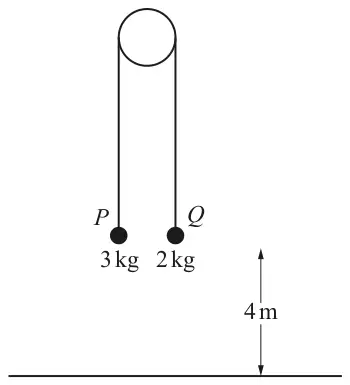
Two small balls \(P\) and \(Q\), of masses \(3\,\mathrm{kg}\) and \(2\,\mathrm{kg}\) respectively, are attached to the ends of a light inextensible string. The string passes over a smooth fixed pulley. The balls are held at a height of 4 m above a horizontal floor, with the string taut. The parts of the string which are not in contact with the pulley are vertical (see diagram).
The system is set in motion in such a way that \(P\) moves vertically downwards.
The initial downward speed of \(P\) is \(4.2\,\mathrm{m\,s^{-1}}\) and when \(P\) reaches the floor it is immediately brought to rest. It is given that \(Q\) does not reach the pulley in the subsequent motion.
| Scheme | Marks | AO |
|---|---|---|
| M1* | 3.3 | |
| \(3g - T = 3a\) \(T - 2g = 2a\) | A1 | 1.1 |
| \(3g - T = 3\left(\dfrac{T - 2g}{2}\right) \Rightarrow T = \ldots\) | M1dep* | 3.4 |
| \(T = 23.52\) (N) | A1 | 1.1 |
| [4] |
Notes
M1*: Attempt N2L for \(P\) and \(Q\) – three terms, mass required, condone sign errors
M0 for \(a = 0\) or \(\pm g\)
A1: Both equations correct
M1dep*: Eliminate \(a\) and attempt to solve for \(T\)
Or eliminate \(T\) to find \(a\) first and substitute back numerical \(a\) to evaluate \(T\) \(\left(a = \tfrac{1}{5}g = 1.96\right)\)
A1: Accept 23.5 or \(\dfrac{12}{5}g\)
| Scheme | Marks | AO |
|---|---|---|
| \(v^2 = 4.2^2 + 2(\text{‘}1.96\text{’})(4)\) | M1 | 3.4 |
| \(v = 5.77\) to 3 sf | A1 | 1.1 |
| [2] |
Notes
M1: \(v^2 = u^2 + 2as\) with \(u = 4.2\), \(s = 4\) and their \(a\) (which must be positive but not \(g\))
May have \(s = -4\) and their \(a\) is negative (but not \(-g\))
A1: 5.772347876… \(\left(\dfrac{7\sqrt{17}}{5}\right)\)
| Scheme | Marks | AO |
|---|---|---|
| \(\text{‘}5.77\ldots\text{’} = 4.2 + (\text{‘}1.96\text{’})t_1\) | M1 | 3.3 |
| \(t_1 = 0.801\ldots\) or \(0.802\ldots\) | A1 | 1.1 |
| \(0 = \text{‘}5.77\ldots\text{’} + (-9.8)t_2\) | M1 | 3.4 |
| 1.39 (s) to 3sf | A1 | 2.2a |
| [4] |
Notes
M1: Correctly uses \(v = u + at\) with \(u = 4.2\) and their \(v\) and \(a\) where \(a \neq 0\) or \(g\).
(Or uses \(s = ut + \tfrac{1}{2}at^2\) with \(u = 4.2\), \(s = 4\) and their calculated value for \(a\)
Or uses \(s = \tfrac{1}{2}(u + v)t\) with \(s = 4\), \(u = 4.2\) and their \(v\))
Where \(t_1\) is the time for \(P\) to move 4 m
Must be using a consistent sign convention to earn M1
A1: 0.802218304… \(\left(\dfrac{-15 + 5\sqrt{17}}{7}\right)\)
M1: Correct use of \(v = u + at\) with \(v = 0\), \(a = -g\) and their positive \(u\) from part (b)
(If correct: \(t_2 = \dfrac{\sqrt{17}}{7} = 0.5890150894\ldots\))
Where \(t_2\) is the time from \(P\) hitting the ground until \(Q\) comes to rest
A1: Allow awrt 1.39 1.391233393… \(\left(\dfrac{-15 + 6\sqrt{17}}{7}\right)\)
| Scheme | Marks | AO |
|---|---|---|
| If this string is not inextensible, then the acceleration of \(P\) and the acceleration of \(Q\) would not have equal magnitude | B1 | 3.5a |
| [1] |
Notes
B0 for inextensible \(\Rightarrow\) accelerations same
B0 for any incorrect extras
See appendix for exemplars (below)
Appendix
We were looking for the idea that the accelerations would be different or that they would not be constant.
Exemplar responses for Q10(d) (corrected from the printed mark scheme: the appendix heading says Q10(b), but these responses are for part (d))
| Response | Mark |
|---|---|
| Acceleration would not be constant | B1 |
| Acceleration would vary | B1 |
| Acceleration would be variable | B1 |
| The acceleration of these two balls would be different | B1 |
| The acceleration of these two balls would not be equal | B1 |
| The acceleration of one ball is greater than the other | B1 |
| The acceleration of these two balls would be greater/increase | B0 |
| The acceleration of these two balls would be lower/decrease | B0 |
| The acceleration of these two balls would be less | B0 |