
June 2025 Paper 2 Q11
11
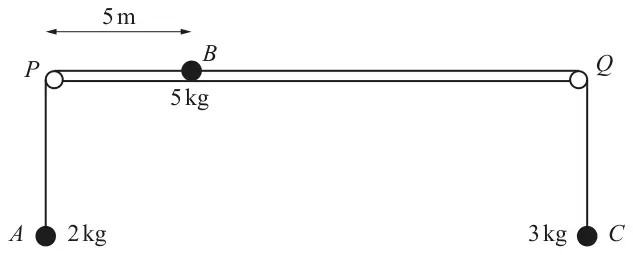
One end of a light inextensible string is attached to a particle \(A\) of mass 2 kg. The other end of the string is attached to a second particle \(B\) of mass 5 kg. Particle \(B\) is in contact with a smooth horizontal surface. The string passes over a small smooth pulley \(P\) which is fixed at one edge of the surface. Particle \(A\) hangs vertically below \(P\).
A second light inextensible string is attached to \(B\). The other end of this second string is attached to a third particle \(C\) of mass 3 kg. This string passes over a small smooth pulley \(Q\) which is fixed at the other edge of the surface. Particle \(C\) hangs vertically below \(Q\) (see diagram).
The system is released from rest with the strings taut and \(B\) a distance 5 m from \(P\). In the subsequent motion \(A\) does not reach \(P\).
When the particles have been in motion for 3 seconds the string connecting \(A\) and \(B\) breaks.
Particle \(B\) reaches \(Q\) after a further 2 seconds.
It is given that in fact the horizontal surface is not smooth. When the system, as shown in the diagram, is released, it remains at rest. (You may assume that pulley \(Q\) is smooth.)

| Scheme | Marks | AO |
|---|---|---|
| M1* | 3.3 | |
| \(3g - T_{BC} = 3a\) \(T_{BC} - T_{AB} = 5a\) \(T_{AB} - 2g = 2a\) | A1 | 1.1 |
| \((3g - 3a) - (2g + 2a) = 5a \Rightarrow a = \ldots\) | M1dep* | 3.4 |
| \(T_{BC} = 3g - 3\left(\dfrac{g}{10}\right) = \dfrac{27}{10}g\) | A1 | 1.1 |
| [4] |
Notes
M1*: Attempt to apply N2L for at least one of the three masses – condone sign errors
Condone using the same \(T\) in both strings for M1 only
A1: All three equations correct
M1dep*: Solve 3 equations involving all required terms (may have sign errors) simultaneously to find \(a\) or \(T_{BC}\) or \(T_{AB}\)
If correct \(a = \dfrac{g}{10}\) (\(= 0.98\)), \(T_{AB} = \dfrac{11}{5}g\) (\(= 21.56\)) (\(T_{BC} = 26.46\))
A1: cao (must be in terms of \(g\))
Accept \(2.7g\) (oe)
Alternative method
| Scheme | Marks |
|---|---|
| M1* | |
| \(3g - 2g = (2 + 5 + 3)a\) \(3g - T_{BC} = 3a\) | A1 |
| M1dep* | |
| \(T_{BC} = 3g - 3\left(\dfrac{g}{10}\right) = \dfrac{27}{10}g\) | A1 |
M1*: Attempt to apply N2L correctly for the whole system or the 3kg mass
Condone sign errors
A1: Both equations correct
M1dep*: Solve 2 equations involving all required terms (may have sign errors) simultaneously to find \(T_{BC}\)
If correct \(a = \dfrac{g}{10}\) (\(= 0.98\)) (\(T_{BC} = 26.46\))
A1: cao (must in terms of \(g\))
Accept \(2.7g\) (oe)
| Scheme | Marks | AO |
|---|---|---|
| \((s_1 =)\ \tfrac{1}{2} \times \tfrac{g}{10} \times 3^2\ (= 4.41)\) | B1FT | 1.1 |
| \(3g - T = 3a_1\) and \(T = 5a_1\) | M1* | 3.1b |
| \(a_1 = \tfrac{3}{8}g\) or 3.675 | A1 | 1.1 |
| \((v =)\ \dfrac{g}{10} \times 3\ (= 2.94)\) | B1FT* | 1.1 |
| \(s_2 = 2.94 \times 2 + \tfrac{1}{2} \times \tfrac{3}{8}g \times 2^2\ (= 13.23)\) | M1dep* | 3.4 |
| Length of surface \(= 5 + 4.41 + 13.23 = 22.64\) (m) | A1 | 3.2a |
| [6] |
Notes
B1FT: Correct (follow through) expression for \(s_1\) where \(s_1\) is the distance travelled by \(B\) in the first 3 seconds
Using their value for initial acceleration (most likely seen in part (a)) coming from some attempt at N2L
Not an acceleration of \(\pm g\)
M1*: Applying N2L for both \(B\) and \(C\)
Where \(T\) is the tension in string \(BC\) and \(a_1\) is the acceleration of the system after the string breaks
B1FT*: Correct (follow through) expression for the velocity of \(B\) at the instant when the string breaks
Not an acceleration of \(\pm g\). Acceleration coming from some attempt at N2L
M1dep*: Attempt to find distance travelled, using \(s = ut + 0.5at^2\), in the 2 seconds after the string breaks
So must be using \(t = 2\)
A1: Allow 22.6 www
| Scheme | Marks | AO |
|---|---|---|
| Eg. The tension is not the same throughout the string oe | B1 | 3.5a |
| [1] |
Notes
B1: Any statement which suggests the tension is not constant (throughout the string)
| Scheme | Marks | AO |
|---|---|---|
 | B1 | 3.5c |
| [1] |
Notes
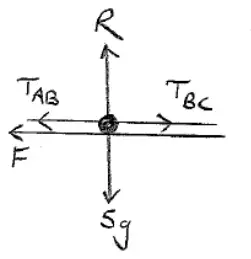
B1: All five forces correct – \(F\) must be acting towards the left, B0 if \(T\) used on both strings
Might see \(T_{BC} = 3g, T_{AB} = 2g, F = g, R = 5g\)
Allow \(W\) or \(mg\) used for the weight
\(F\) and \(R\) may be replaced by a single contact force acting in the correct direction
Do not allow \(F = \mu R\)
| Scheme | Marks | AO |
|---|---|---|
| \(g\) or 9.8 because for \(B\) to remain in equilibrium the frictional force must be equal to \(T_{BC} - T_{AB}\) which is equal to \(3g - 2g\) | B1 | 2.4 |
| [1] |
Notes
B1: Correct value together with correct justification (must mention the tension in the two strings or the weights of the other two masses)